
Notifications
Clear all
Technical
9
Posts
2
Users
7
Reactions
5,922
Views

Topic starter
Hey Alan
Are you aware of this thread on ASR regarding FTC amplifier power testing? Your P282 has been mentioned.
What's your view on the FTC testing?
Posted : 11/12/2024 8:56 pm

Hi @james dyson
I will take a look at the thread when I get a chance and respond.
Posted : 12/12/2024 7:37 pm
I have had a quick look through that thread and most of the salient points have been made by various posters. However it is an interesting topic and could benefit from a more concise commentary here.
I am a bit pressed for time so this will take the form of several posts that cover different aspects of the subject. I will shamelessly be copying some of the posters points from the ASR thread for expediency.
Posted : 13/12/2024 6:52 am
What Is The FTC Amplifier Test?
In the early 1970s the US Federal Trade Commission became concerned about the misleading claims by some amplifier manufacturers regarding the power output of their products. As such they introduced a set of regulations that dictated a suite of technical tests to establish an amplifiers power output under consistent conditions. The intent was to assist consumers in making more informed buying decisions with a level playing field regarding technical performance.
What Is the Scope Of The Regulation?
The regulation is only applicable to technical information published in marketing material within the US. In other words if you publish marketing material in the US that says an amplifier has X watts output, then the number has to have been derived from testing that conformed to what is set out in the regulation.
Note that the product can be sold in the US without this testing. The regulation only applies to information published in advertising and marketing material.
Note that the FTC have no authority or powers outside of the US. This means they have no jurisdiction or powers over foreign companies or marketing material published outside the US, including web sites.
The regulations are *not* a technical standard. They are not a standard agreed to or ratified by any international standards committee or body.
So What's The Problem?
So far this all sounds quite reasonable, help the consumer make informed decisions with accurate technical performance information. Indeed it is a reasonable intent. The problem is that the testing regime dictated by the FTC is so technically ignorant and flawed that it provides the consumer with misleading information. It can actually harm the consumer interest.
Why Is This A Topic After 50 Years?
The FTC recently held a consultation asking if the regulation should be scrapped. The regulation has largely been ignored and unenforced for those 50 years, not least of which because it is so technically inept, but also of little or no benefit to consumers. Unfortunately it was not scrapped and further amendments were introduced which actually worsened the situation. Federal beaurocracy at its best.
The regulations are linked below:
TBC
Posted : 13/12/2024 7:20 am
mschoi96 reacted
A Little More Detail On Why The FTC Test Is Technically Inept
The FTC testing has the following intent:
Accordingly, the Rule standardized the measurement and disclosure of some, but not all, performance characteristics of power amplification equipment to“assure that . . . performance characteristics are based upon conditions of normal use by the consumer, i.e., conditions which are encountered in the home.”3"
Again this is a correct stance and intent. All quite reasonable. However, they then go on to specify a testing regime which is wholly unrepresentative of normal consumer use in the home:
"at any power level from 250mW to the rated power at ALL frequencies within the rated power band of 20Hz to 20kHz without exceeding 1.0% of total harmonic distortion plus noise (THD+N) at an impedance of 8 ohms."
It also requires the amplifier can sustain this for 5 minutes.
So Why Is This Unrepresentative Of Real World Use?
Although the test documentation doesnt explicitly state (another failing in itself), the assumption has to be that the test signal will be a sine wave. Firstly, no one plays sines waves at full blast at home. Sine waves are also very different signal from what is actually played, ie music.
Posted : 28/12/2024 4:06 pm
mschoi96 reacted
Composition Of A Sine Wave
We are used to seeing amplifier power ratings expressed in watts "RMS". RMS stands for root mean squared. https://en.wikipedia.org/wiki/Root_mean_square
It is used to describe the level of a varying waveform, and is equivalent to the same heating value of a DC signal of that voltage when applied to a resistance. Its actually an incorrect term. There is no such thing as watts "RMS". The power output of an amplifier is actually an average. The product of volts RMS and current RMS.
Now thats all a bit technical, but what you need to take away from this is that a sine wave has a low difference between its peak value and its RMS (average) value. It has a low crest factor.
Below is a sine wave and you can see the waveform parameters on the right.
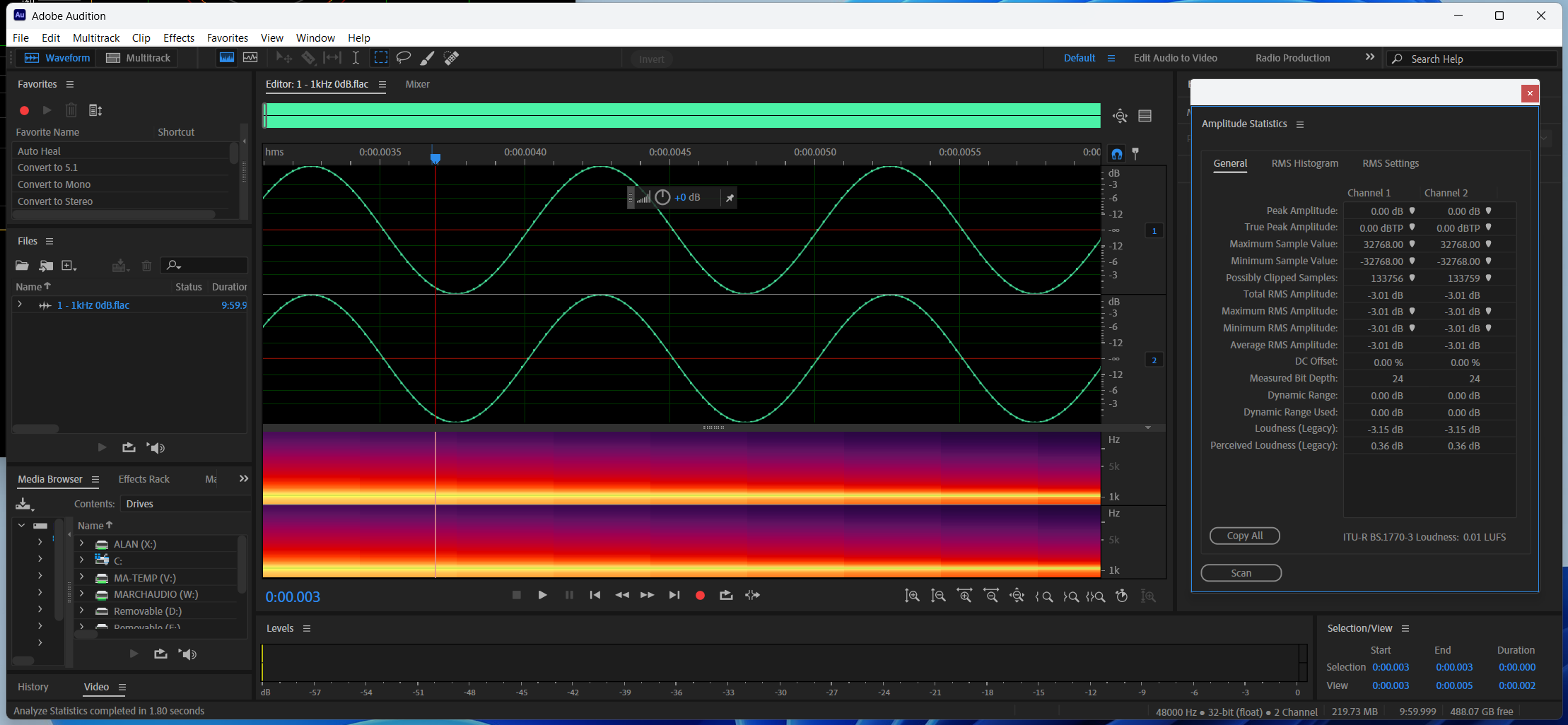
You can see the peak value is 0dB and the RMS value is -3dB.
In contrast I picked a random track from my collection; Carly Simon - Your So Vain.
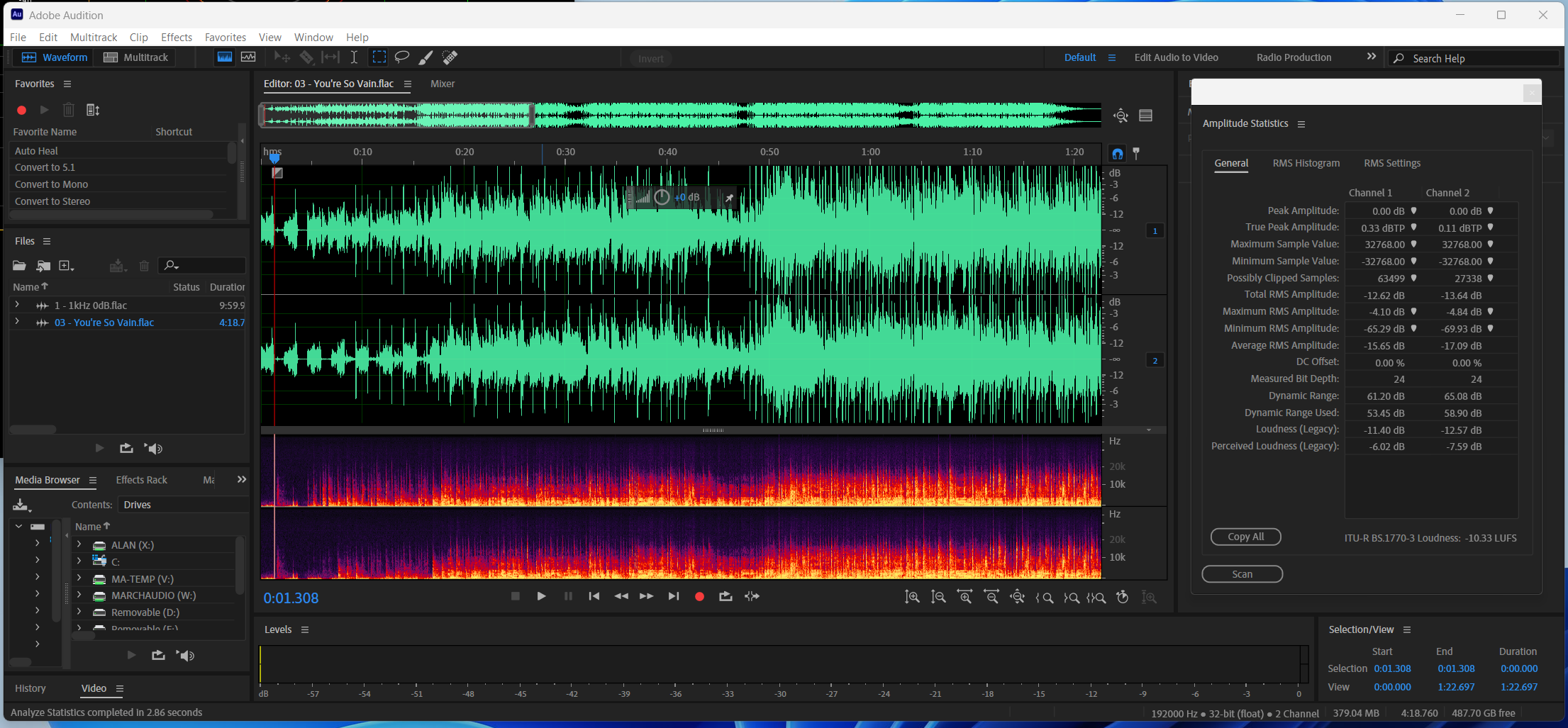
You can probably see its far more "peaky" in nature. The data shows it has the same peak value of 0dB, but the RMS level is only -12dB.
Here is another example, Bruce Springsteen - Born To Run. RMS level is -15dB.
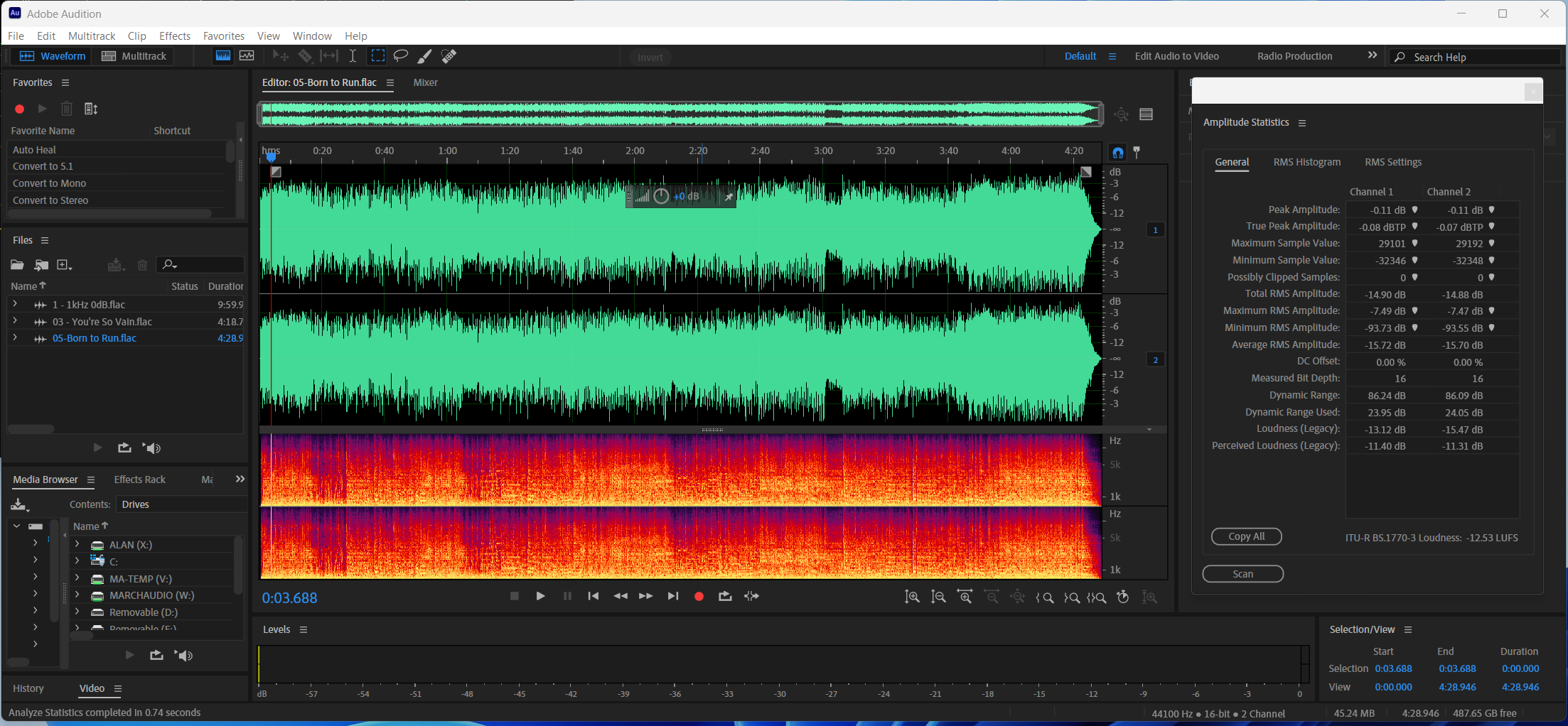
So the takeaway is that music has a very large difference between the peak and average signal level. It has a large crest factor.
What Does This Mean For Amplifier Power?
To put the above numbers into context lets consider some numbers.
A simple rule, a change in 3dB is change of 50% in power. Lets say that the peak level of 0dB is 100 watts. That means for a sine wave at -3dB RMS, the average power is 50 watts
https://sengpielaudio.com/calculator-amplification.htm
For the first music track at -12dB RMS, the average power is only 6 watts. In the second track at -15dB RMS the average power is only 3 watts.
So what we can conclude from this is that a sine wave is far more demanding of an amplifier than real music. In fact an amplifier will never be limited by its RMS power output capability. It will ALWAYS reach its peak power output first. An amplifier will never be playing anywhere near its sine wave RMS rated power.
Just one note, obviously the RMS signal level will be dependant upon the music style and how its been recorded. If very compressed the average signal will be higher. Even taking this into account, according to the Loudness Wars website of 180000 albums, the most compressed album is Metallica Death Magnetic. It has an RMS level of -8dB. There may well be a more compressed piece of music out there with a higher average level, but still even at -6dB RMS this would still be half the average power of a sine wave.
What Matters To Users?
In simple terms, what matters to users is how loud an amp will play. This is not dictated by the RMS power output capability. If you ignore production techniques (compression) and to en extent psychoacoustics, its down to the peak power. Yes, we have been looking at it wrong for a very long time!
Posted : 28/12/2024 5:06 pm
Leigh Gurney and mschoi96 reacted
Music Spectral Content
The majority of the energy in music is concentrated at low frequencies, typically below 1kHz. In fact by 20kHz there is hardly anything happening at all!
Below is a spectral view of Carly Simon - Your So Vain. By 20 kHz the signal level is about -60dB, which is 54dB below whats happening at 150Hz.
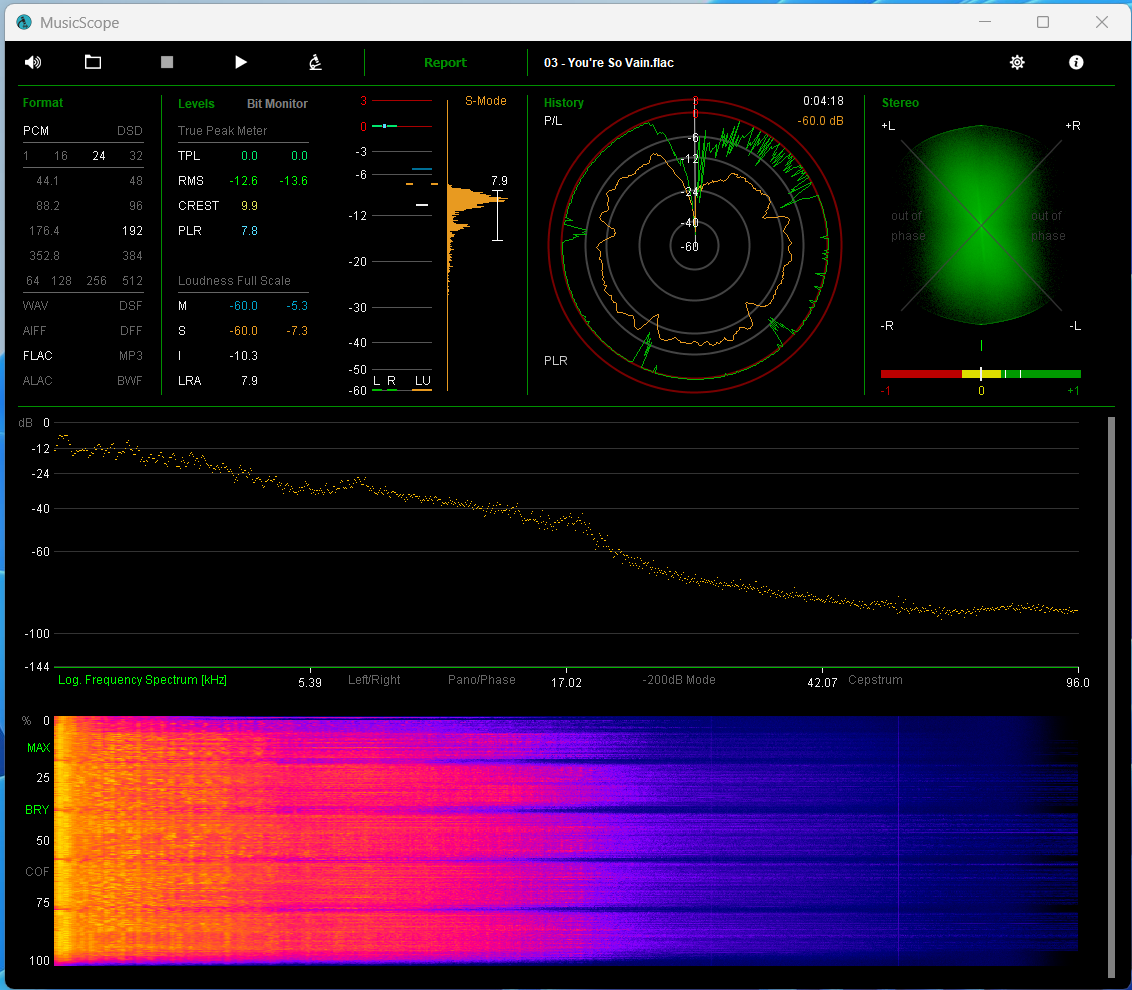
Again using 100 watts as a reference at 150Hz, the power at 20kHz is only 0.0004 watts! That surprised you didnt it.
For something with more high frequency content, Copland - El Salon Mexico
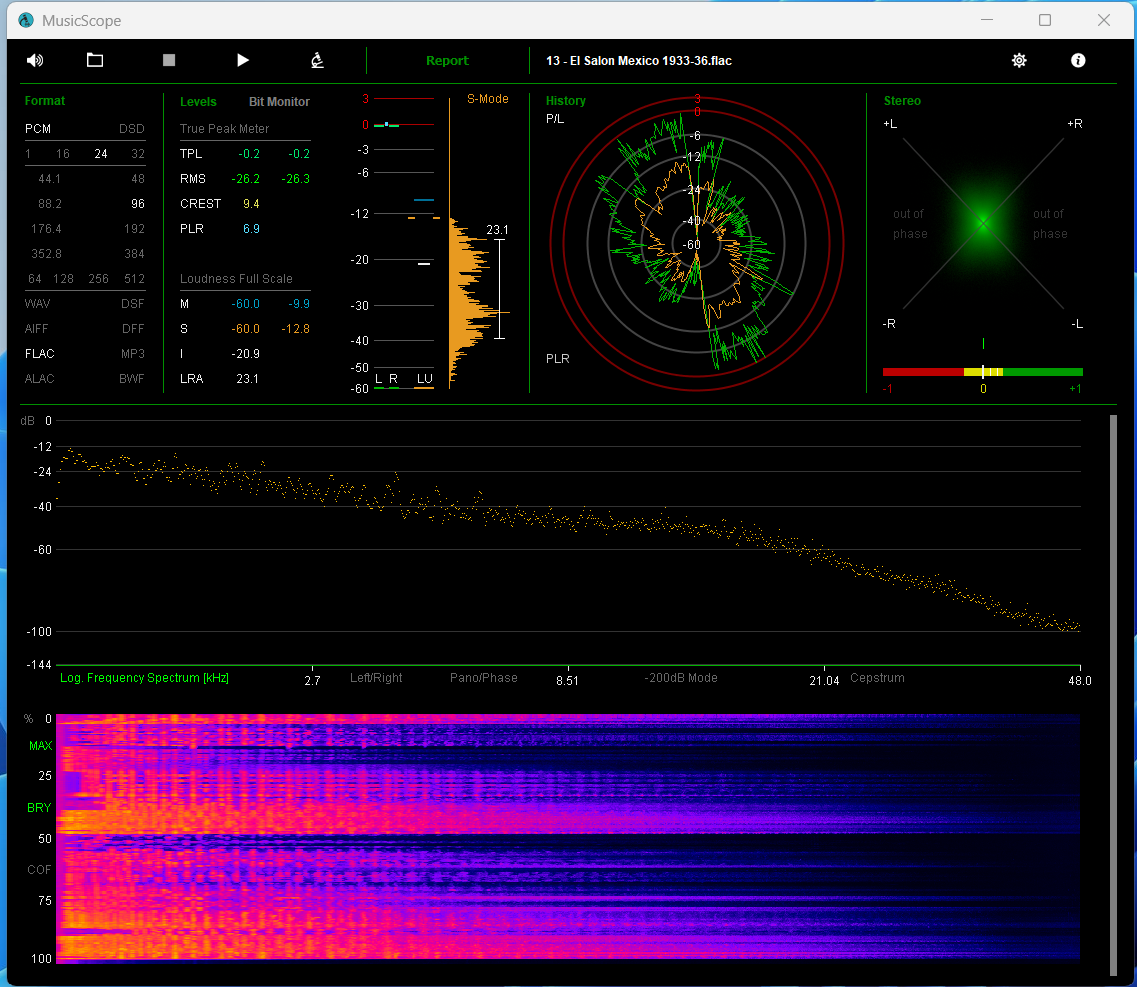
By 20kHz the signal level is 48dB below the level at 100Hz. Refenced to 100 watts the power level at 20kHz is only 0.0016 watts.
So amplifiers need hardly any power at all at high frequencies. Again I will caveat that with the fact that all music is different, but you get the idea.
So testing at full power at 20kHz, as the FTC test dictates, is pointless and provides no useful information to the consumer.
Posted : 28/12/2024 5:28 pm
mschoi96 reacted
Back To The FTC Test
"at any power level from 250mW to the rated power at ALL frequencies within the rated power band of 20Hz to 20kHz without exceeding 1.0% of total harmonic distortion plus noise (THD+N) at an impedance of 8 ohms."
It also requires the amplifier can sustain this for 5 minutes.
As we have seen above, to sustain a sine wave at full rated output for 5 minutes will be far more taxing on an amplifier than playing any real world music signal. The amplifier will have to dissipate far more power, and it will get much hotter than when playing music.
What this means is that an amplifier designer will have to do one of two things to ensure the amp will pass the FTC test.
1. Increase cooling.
2. De-rate the amp power.
Option 1 - Increasing cooling may mean larger heavier heatsinks and/or using fans. This increases manufacturing cost. Unnecessary over engineering just to pass the test. The now necessary larger heavier case means increased shipping cost. Both of these costs will get passed on to the consumer.
Fans are a reliability liability. Fans are noisy which is inapropriate in HiFi equipment. They wear and get more noisy. They suck in dust.
Option 2 misleads the customer. An amp that operates just fine to its rated power with music now has to advertise as a much lower power amplifier. That's also bad for the manufacturer.
Then there is the 5 minute duration. Where has that come from? Fact is that it's completely arbitrary. There is no justification for it. It doesn't test the amps thermal cooling capacity (how do you know if an amp has reached thermal equilibrium at 5 minutes?), nor is it any indication of reliability.
Also, the test insists the amp delivers full power at 20kHz. As we saw above, there is no possible circumstance where this would be required. So what does it prove? Nothing of relevance to the amplifiers quality or performance playing music. Some ill informed people do see it as a badge of honour 😉.
How Does This Help The Consumer?
Simple. It doesn't. It only serves to misinform and increase product costs.
Below is a statement from amp module manufacturer Hypex on how it would affect their products.
https://downloads.regulations.gov/FTC-2024-0039-0096/attachment_1.pdf
The FTC have ignored such informed feedback and lose all credibility as a result.
Posted : 28/12/2024 7:15 pm
Speaker Load
One thing I havent mentioned yet is the speaker load. The FTC test specifies using an 8 ohm resistive load. Again this is totally unrepresentative of real world speakers. These days speakers are more often than not more like a 4 ohm load, some dipping as low as 2 ohms at certain frequencies. They are reactive in nature which makes class A and AB designs dissipate much more power and heat. So the FTC test doesnt tax the amplifier in this respect as much as a real world speaker would.
So in this respect the test is totally inadequate, yet in other respects it is totally excessive.
The FTC test as it stands is worse than useless. It actually misleads the consumer. It will fail perfectly good amplifiers and pass some that would fail with real speaker loads.
Other Technical Considerations
There are a number of other technical considerations and flaws in the FTC test, but I won't go into them for now.
So What Should We Do?
Well firstly it needs to be established if there is actually a problem to solve. Is there any evidence that this is a significant problem requiring regulation? Are there many manufacturers misleading consumers regarding power output? I'm sure you can find some examples, but that doesn't mean there is a significant problem.
Regardless, in my opinion it would still be helpful to have some kind of standardised test to rate amplifier power output. There are various options that could be used that are quite representative of real world music signals and speaker loads. The details are beyond the scope of this article. However the definition of such a test must be taken out of the control of a technically ignorant and incompetent organisation such as the FTC. It should be the pervue of an international technical standards organisation.
March Audio
Due to the reasons outlined, we pay no attention to the FTC test and will not test according to it. Our amps would pass the test, but publicising that that would only give the test undeserved credibility. To use somebody else's words, its a regulation thats firmly stuck in the 1970s, both in attitude and technical understanding.
It needs to be consigned to history.
Posted : 28/12/2024 7:39 pm
Matias and Leigh Gurney reacted