
Notifications
Clear all
Technical
6
Posts
2
Users
3
Reactions
3,623
Views

Topic starter
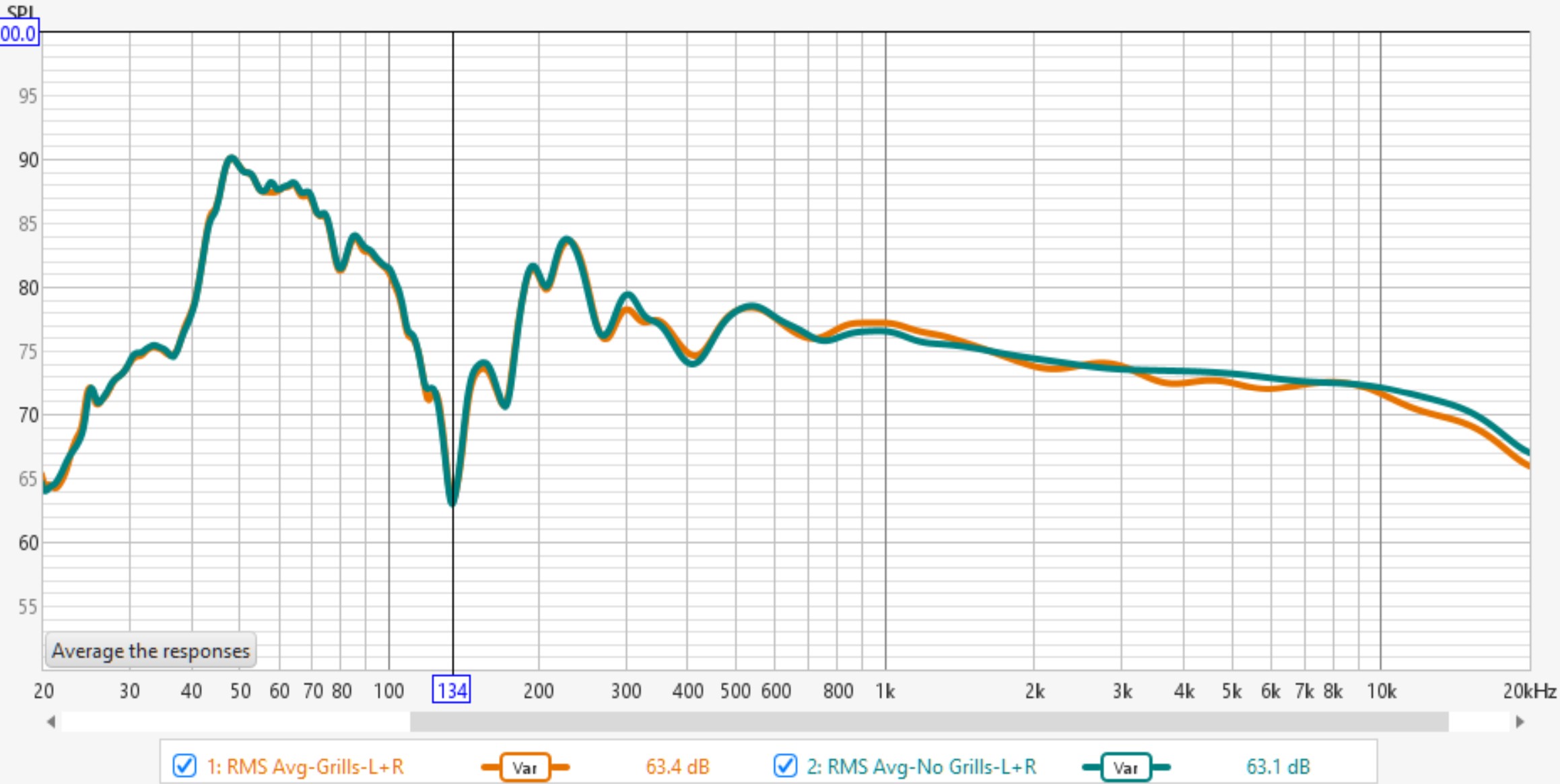
Attached are the first measurements of my new Sointuvas. The graph shows the results of the average of 3 each MMM measurements - Grills On and Off.
1) I only have one LP (8 ft equilateral triangle). I used the MMM measurement style (I don't understand waterfalls!).
2) The measurement were taken without any room EQ and without a Sub.
3) I think the graph shows the benefits of a well engineered speaker. I only need to EQ the room (<600Hz), the speaker itself needs no EQ.
Comments?
Posted : 15/08/2024 2:14 am
TMC and Alan March reacted

Cincyret wrote:
Attached are the first measurements of my new Sointuvas. The graph shows the results of the average of 3 each MMM measurements - Grills On and Off.
1) I only have one LP (8 ft equilateral triangle). I used the MMM measurement style (I don't understand waterfalls!).
2) The measurement were taken without any room EQ and without a Sub.
3) I think the graph shows the benefits of a well engineered speaker. I only need to EQ the room (<600Hz), the speaker itself needs no EQ.
Comments?
152
Hi
If you attach the REW file I'm very happy to go through/explain the waterfall and other data. What are the dimensions of your room?
The issues grills cause with diffraction may not be too obvious in single or averaged placement plots. You need a full spinorama to clearly see whats going on. Having said this your data does show the more uneven response caused by the grill diffraction and the interference patterns it creates (above 800Hz). This is why we dont recommend grills for he highest possible quality of reproduction.
It's also why the edges of the cabinet are curved. It's not just an aesthetic decision, it helps to minimise the diffraction that hard right angle edges would create. This helps create the smoothest frequency response.
Posted : 15/08/2024 10:54 am
Topic starter
Alan March wrote:
HiIf you attach the REW file I'm very happy to go through/explain the waterfall and other data. What are the dimensions of your room?
The issues grills cause with diffraction may not be too obvious in single or averaged placement plots. You need a full spinorama to clearly see whats going on. Having said this your data does show the more uneven response caused by the grill diffraction and the interference patterns it creates (above 800Hz). This is why we dont recommend grills for he highest possible quality of reproduction.
It's also why the edges of the cabinet are curved. It's not just an aesthetic decision, it helps to minimise the diffraction that hard right angle edges would create. This helps create the smoothest frequency response.
I used the MMM method, so I'll redo the measurements using single point. I would appreciate you taking a look. Tomorrow. Thanks! John
Posted : 16/08/2024 4:41 am
Topic starter
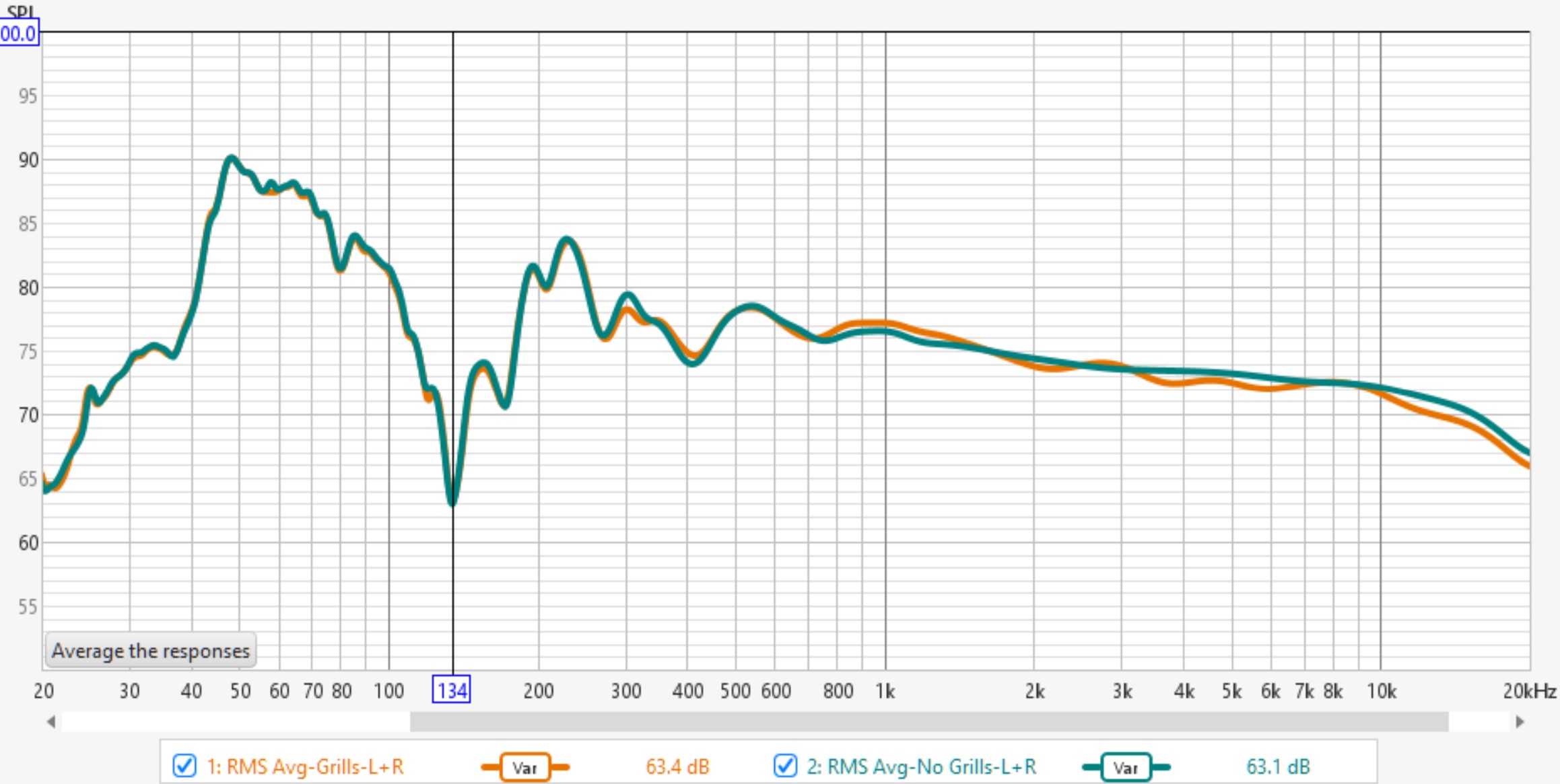
Sorry for the delay. Attached is a Screenshot of FR graphs- Grills ON & Off. Also a link to Google drive with the MDAT file.
I live in a small studio apt. The 3rd photo I posted shows the alcove with the speakers. Eight feet opposite is the LP.
Questions:
A) What FR graph smoothing should I use when creating PEQ filters?
B) Looking at the graphs, how high (freq) should I extend PEQ filtering? I've been using a 40 Hz to 600 Hz range.
C) Any advice you might have on all the other REW measurement tabs (waterfall...etc)?
Link to .MDAT file: https://drive.google.com/drive/folders/1Y8LcTHUqpYKAB1BkhghJyOqqXmOITzpU?usp=sharing
Thanks so much for the speakers & advice.
John
Posted : 17/08/2024 2:21 am
Hi @Cincyret
Just had a quick look at your mdat file. So waterfalls look at the decay of sound over time. It takes multiple slices of the frequency response one after the other, spaced a few ms apart. What this will show is the room resonances. They have large peaks and take a long time to decay, so have long tails in the graph.
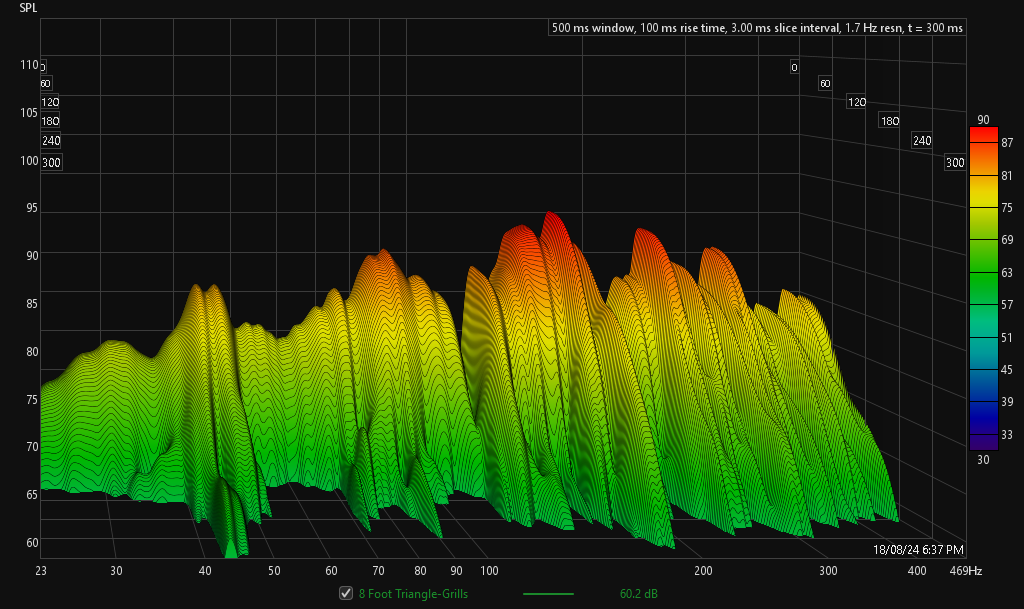
So in your graph we see the main room resonance modes. They are dictated by the room dimensions. You have major modes at 44Hz, 47Hz and 74Hz. This suggests major room dimensions of approximately 3.7m, 3.9m and 2.3m. So, you will get a bit of a bass boom at those frequencies. REW has a room simulation function that shows the expected modal frequencies based on the room dimensions and speaker/listener position.
You also see modes at multiples of the main ones.
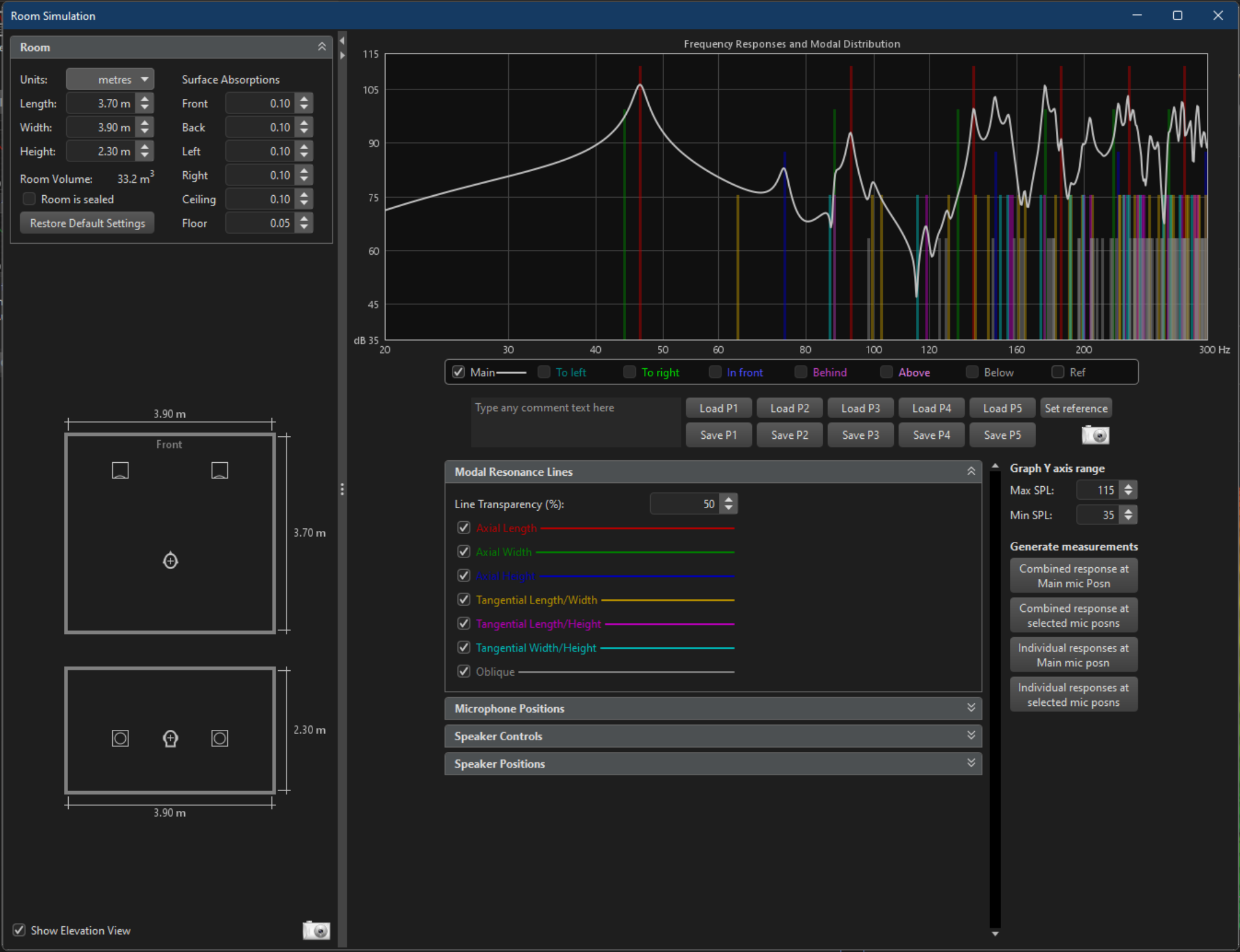
Unfortunately its difficult to control room modes. Its basic physics and unavoidable. Having a larger room obviously lowers the mode frequencies which will tend to make them less bothersome. Those foam based corner bass traps do very little to help. They would need to be meters thick as the wavelengths involved are so long. Membrane bass traps can be effective, especially if they are tuned to the mode frequencies. Otherwise its down to judicious use of DSP room EQ to null the offending frequencies. Not ideal but about the only practical solution for most people.
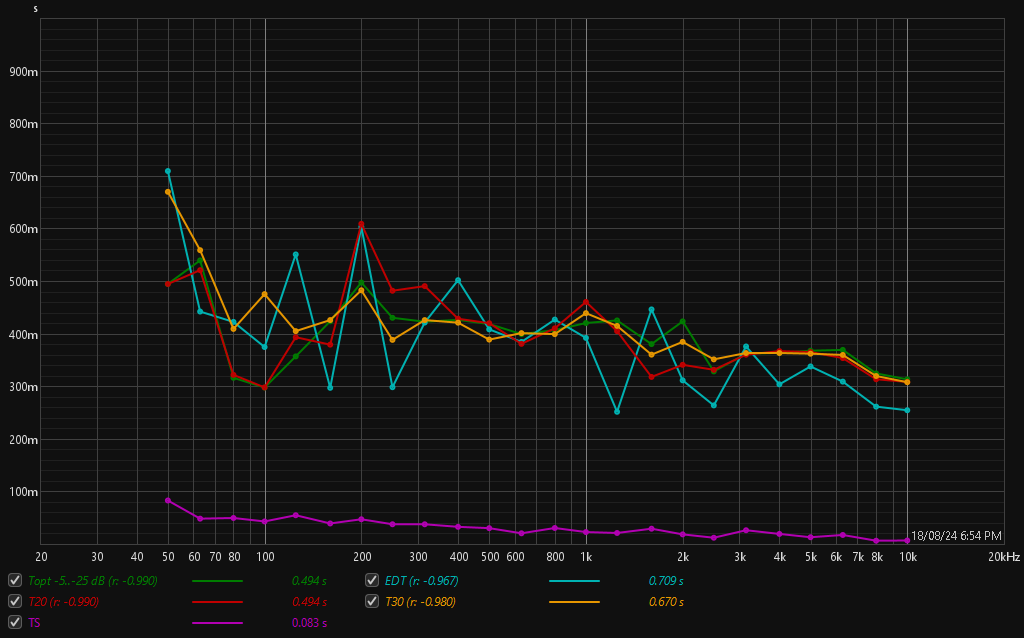
Otherwise, the decay time in the room doesnt look too bad. Too long decay time can cause a confusing and fatiguing echoey sound. It makes smaller details difficult to hear. Its a bit of a judgement call, but my preferences are for about 300ms across the frequency range. What you dont want to do is stuff the room full of additional soft material. This will absorb the high frequencies too much compared to the low frequencies and the sound will lose life. So in your case would add some diffusion in the room to scatter sound more. It will reduce the RT in the mid range more towards 300ms. The increase in RT to the low frequencies is inevitable as the room modes create the long decay time.
I have had good experience with Vicoustic products
https://vicoustic.com/hifi-and-home-cinema
Hoipe that helps.
Alan
Posted : 18/08/2024 7:00 pm
Matias reacted
Oh, just one more thing, the downward slope to the frequency response is absolutely correct. It should not be flat. The slope is caused by the speaker directivity, it's reducing sound power and the absorptive nature of the room and air with increasing frequency.
Anechoic on axis measurements of the speaker would correctky show a flat response.
Posted : 19/08/2024 8:22 am