SmartOne_2000wrote:
Their 20db/27dB noise profiles are rather clean, imo. Not unlike the 1 kHz profile of the P482 on the main page.
I wish you would change your mind about sending your amps for review to Amir, despite your history with him. Its specs would serve as a reference for all other amplifier specs and introduce you to a new customer base who do not know you. You already know his style of measurements, so if you relay your reasonable concerns to him before the review, then all misunderstandings would be prevented.
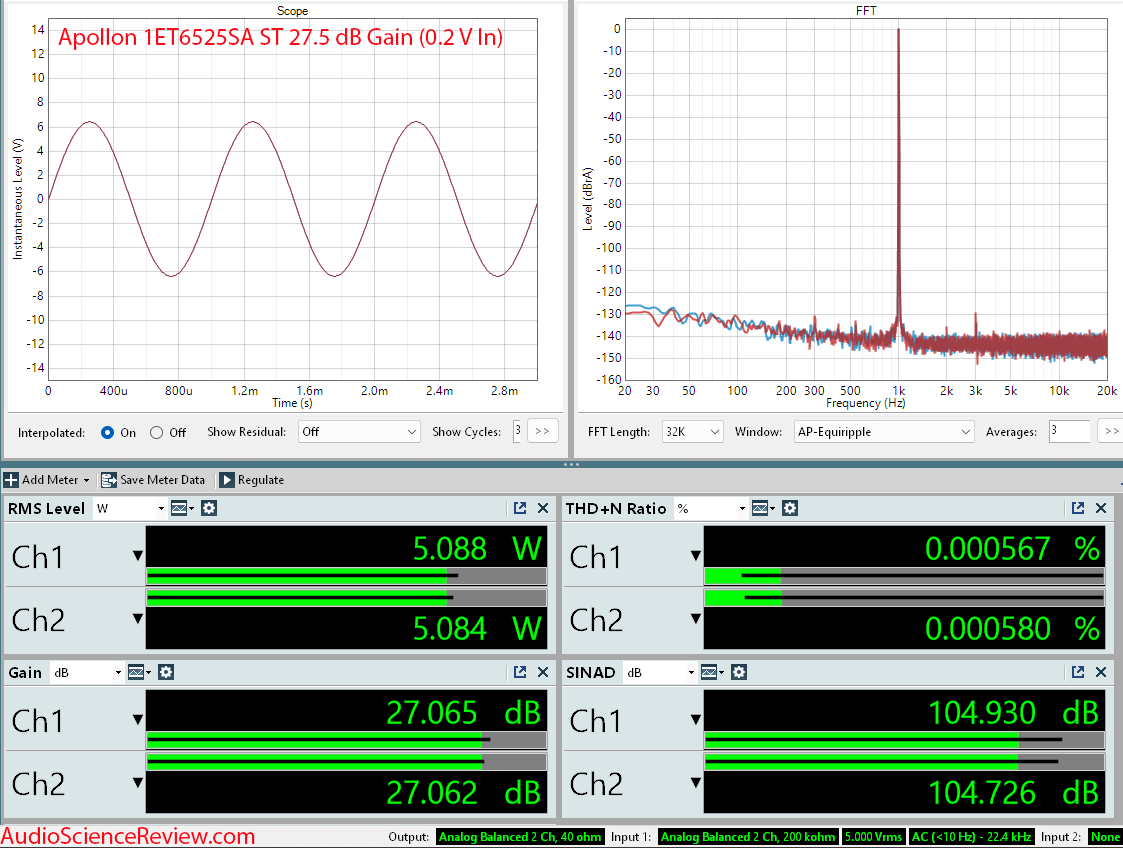
Yet again 19.8dB gain is not high enough to get the amp to full power with standard 4volt XLR sources. Just gaming the SINAD numbers with deliberately low gains.. Amirs measured 109dB will be about 107dB at 21dB gain.
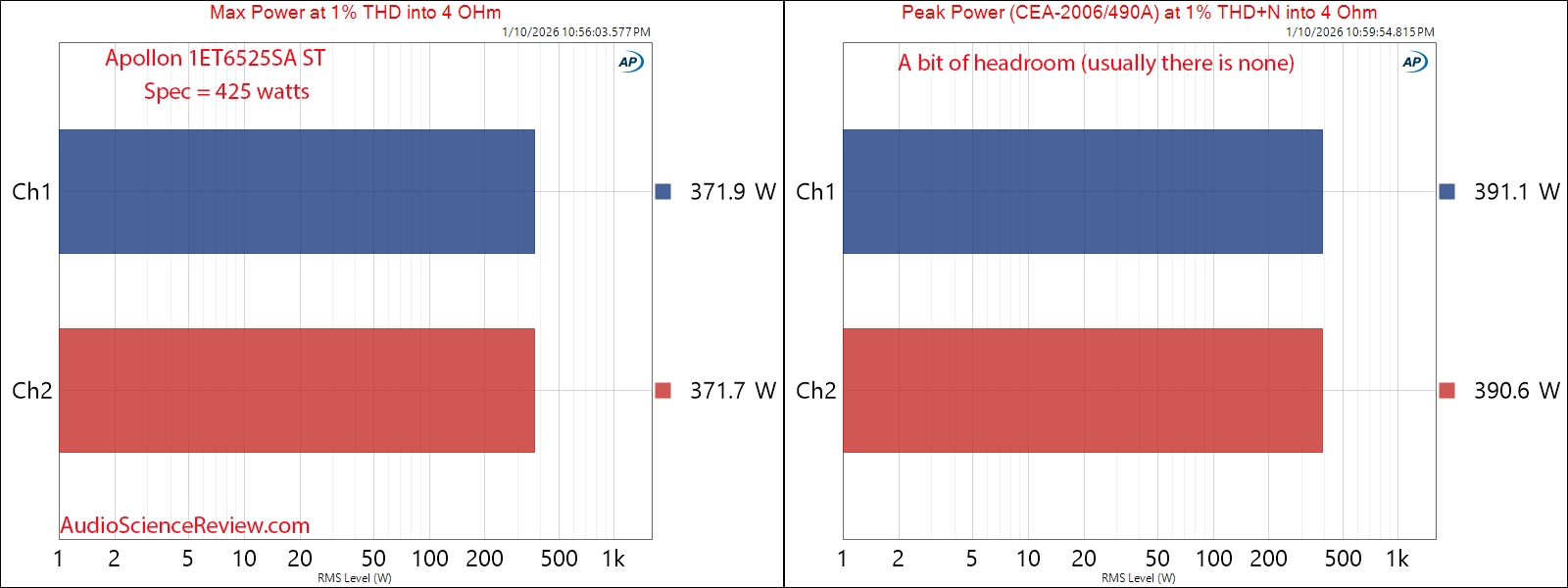
Power only gets to 370 watts. Way off the modules capability of at least 450 watts. Due to the inferior and wrong voltage Hypex PSU.
The Apollon suffers a high noise floor due to the use of op1656.
See the slope going towards low frequencies. It obscures mains pickup and harmonics thereof, but you can see 180Hz,300Hz etc.
Distortion is only OK with 3rd hitting -130dB. The overall SINAD is only 104dB. This is no better than the previous generation of Purifi modules.
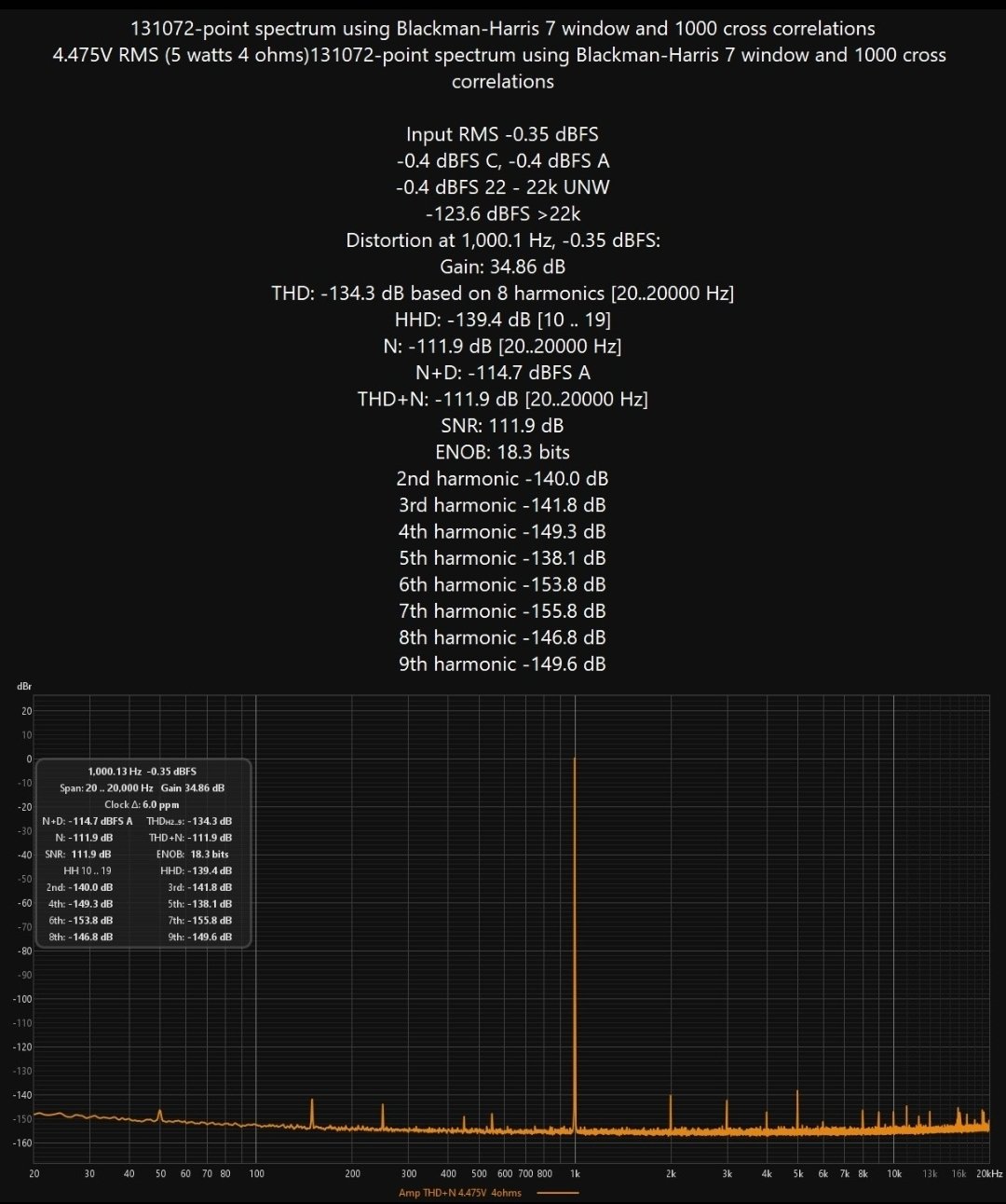
Our P482 is much lower noise, cleaner and has much higher power output. With mains noise and distortion below -140dB.
CORRECTED SINAD = -115.3dB
About -113dB at 27dB gain.
I'm sorry but there is no way our amps are going to ASR for review. Amir doesn't have the knowledge or attention to detail to accurately measure them. It is also stretching the AP555 beyond is capabilities.
Also, what you need to understand about Amir is that he is a narcissist. You just can't have a conversation with him that explains his methods are sub optimal, in some cases plain wrong, or that his conclusions are wrong. He can literally never be wrong and he will attack in return.
I have no interest in engaging with him. It's a waste of time.
Now, the -115dB spec removes the effect of noisy sources, correct? You measure the amp's noise floor (inputs shorted), then its THD as usual, then you combine the two get the true THD+N spec. IMO, this should be how amps are measured.
I believe you said a source would need a noise level of 0.4 uV or less to accurately measure your amps. So, I'm just wondering what the P482 or P801 would read if measured using the AP's noisy source, just for comparative purposes.
Just to say thank you for your continuing patience & your proper engineering answers Alan.
It's great to see your measurements too.
Although I appreciate & enjoy seeing some of the content on ASR, Amirs limitations have been pointed out many times.
From the many posts in this thread it's clear Amir's methodology isn't ideal.
Maybe over time if you publish measurements for each of your amps as above, 'Lord Amir' may include one or two of them for comparison 😉
I'm sure he'd be asked to by some members on ASR sooner or later.
Also agree sending anything to ASR is a waste of time until a better/more consistent methodology is adopted.
It's increasingly clear that equipment &/or user limits have been reached there.
Alan Marchwrote:
The Apollon is inferior in every way. Its immediately obvious from the noise profile they use an opa1656 in the buffer.
BTW, I was a little confused by your previous comment "they say the Benefit (large customer base) to-Cost ratio is not worth it anymore".
Can you elaborate? Is this cost to the manufacturer or consumer.
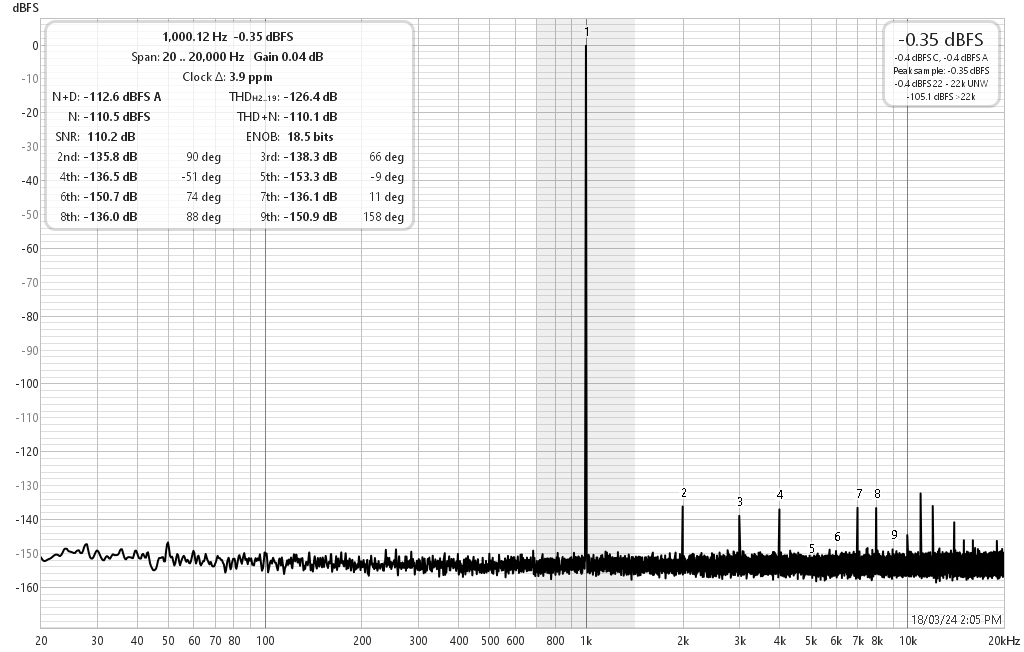
I was also curious about the differences between the P482 spectral plot above andone for the P801 below:
Is the difference in the 1 KHz harmonics (@5Watt in 4 ohms) due to the dynamic characteristics of the Purifi modules, since they both use the same power supply and Ultrabuffer board? Or is it due to something else?
The P482's noise floor looks cleaner for some reason, not that it's an issue of great concern. I assume both plots were taken with the same settings.
SmartOne_2000wrote:
I was also curious about the differences between the P482 spectral plot above andone for the P801 below:
Is the difference in the 1 KHz harmonics (@5Watt in 4 ohms) due to the dynamic characteristics of the Purifi modules, since they both use the same power supply and Ultrabuffer board? Or is it due to something else?
The P482's noise floor looks cleaner for some reason, not that it's an issue of great concern. I assume both plots were taken with the same settings.
Remember the Purifi modules in the P801 is a different architecture, being a bridge configuration. It will inherently behave differently.
Alan Marchwrote:
The Apollon is inferior in every way. Its immediately obvious from the noise profile they use an opa1656 in the buffer.
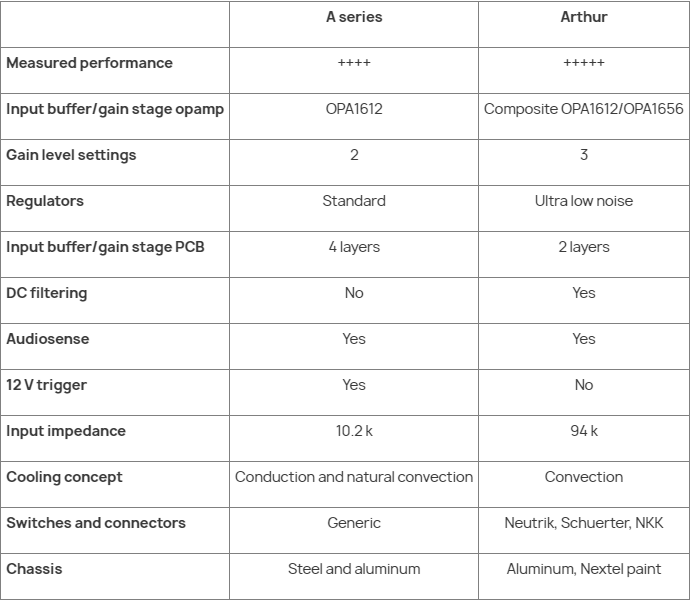
There is no question your buffer design is the best overall but was curious what you may think of Boxem's Arthur series of amplifiers where a composite OPA1612/OPA1656 design is chosen for the buffer so it maximises the benefits whilst minimising the negatives, it's undeniably a novel approach wouldn't you say?
Also a couple of political posts have appeared in the wrong thread again 😉
Well, it's not really novel. Composite amplifiers have been around for many decades. They still have limitations, but sure better than using the reference Hypex/Purifi circuit and hoping for the best like some manufacturers are doing 🙃
Alan Marchwrote:
Remember the Purifi modules in the P801 is a different architecture, being a bridge configuration. It will inherently behave differently.
I would have thought a bridged design would be cleaner than an equivalent non-bridge design. Isn't the former a balanced design by nature, greatly suppressing even-ordered harmonics?
SmartOne_2000wrote:
I would have thought a bridged design would be cleaner than an equivalent non-bridge design. Isn't the former a balanced design by nature, greatly suppressing even-ordered harmonics?
The differences are very small between the two measurements and don't forget we are still at the mercy of the signal source. The final result is a complex summation of the signal source, the device under test and the measurement system.
There is a lot more to it than expecting a "textbook" improvement. We are right at the limits of all the contributing components.
Distortion down at -140dB is really difficult to measure accurately. You will also see run to run variations with each subsequent measurement being slightly different.
Alan Marchwrote:
Well, it's not really novel. Composite amplifiers have been around for many decades. They still have limitations, but sure better than using the reference Hypex/Purifi circuit and hoping for the best like some manufacturers are doing 🙃
I should've clarified, I meant amongst Purifi OEM assemblers like yourself, the majority are using the OPA1656 and/or OPA1612 but Boxem has gone for a composite OPA1612/OPA1656 op amp design with DC filtering for his premium "Arthur" amp models but for the cheaper "A Series" models has settled on the OPA1612 like you've done without the superior buffer design & expertise. 😉