
Notifications
Clear all
Power Amplifiers
114
Posts
7
Users
92
Reactions
24 K
Views

@Alan March In the recent Apollon 1ET6525SA amp review, a member had mentioned "another thing to point out in favor of Apollon's buffer is its very healthy (stated) 100 kOhm input impedance. This kind of immunity is rare these days.", I see that most Purifi OEM assemblers opt for a higher input impedance of either 94 kOhm or 100 kOhm, is this much higher input impedance compared to the 20 kOhm of your amps simply chosen because of their use of the OPA1656 op amp or is it simply for ease of driving source components more comfortably but I recall you mentioning that 20 kOhm is more than sufficient?
Posted : 20/01/2026 2:35 pm

Topic starter
Oniiz86 wrote:
@Alan March In the recent Apollon 1ET6525SA amp review, a member had mentioned "another thing to point out in favor of Apollon's buffer is its very healthy (stated) 100 kOhm input impedance. This kind of immunity is rare these days.", I see that most Purifi OEM assemblers opt for a higher input impedance of either 94 kOhm or 100 kOhm, is this much higher input impedance compared to the 20 kOhm of your amps simply chosen because of their use of the OPA1656 op amp or is it simply for ease of driving source components more comfortably but I recall you mentioning that 20 kOhm is more than sufficient?
100k input impedance is only beneficial for a small number of badly designed tube pre amps whose Hi-Z low current outputs can't pull the skin off a rice pudding.
Totally unnecessary for any well designed tube pre amp (we have many customers using tube pre-amps) and pretty much any solid state source.
The high input impedance also cause issues with noise and DC offset. It's not a function of the 1656, it's set by input resistors.
Posted : 20/01/2026 2:44 pm
bobbyjziino and SmartOne_2000 reacted

Alan March wrote:
Is it composed of 1612s? :unsure:There are other topologies beyond the Purifi reference circuit used by most.
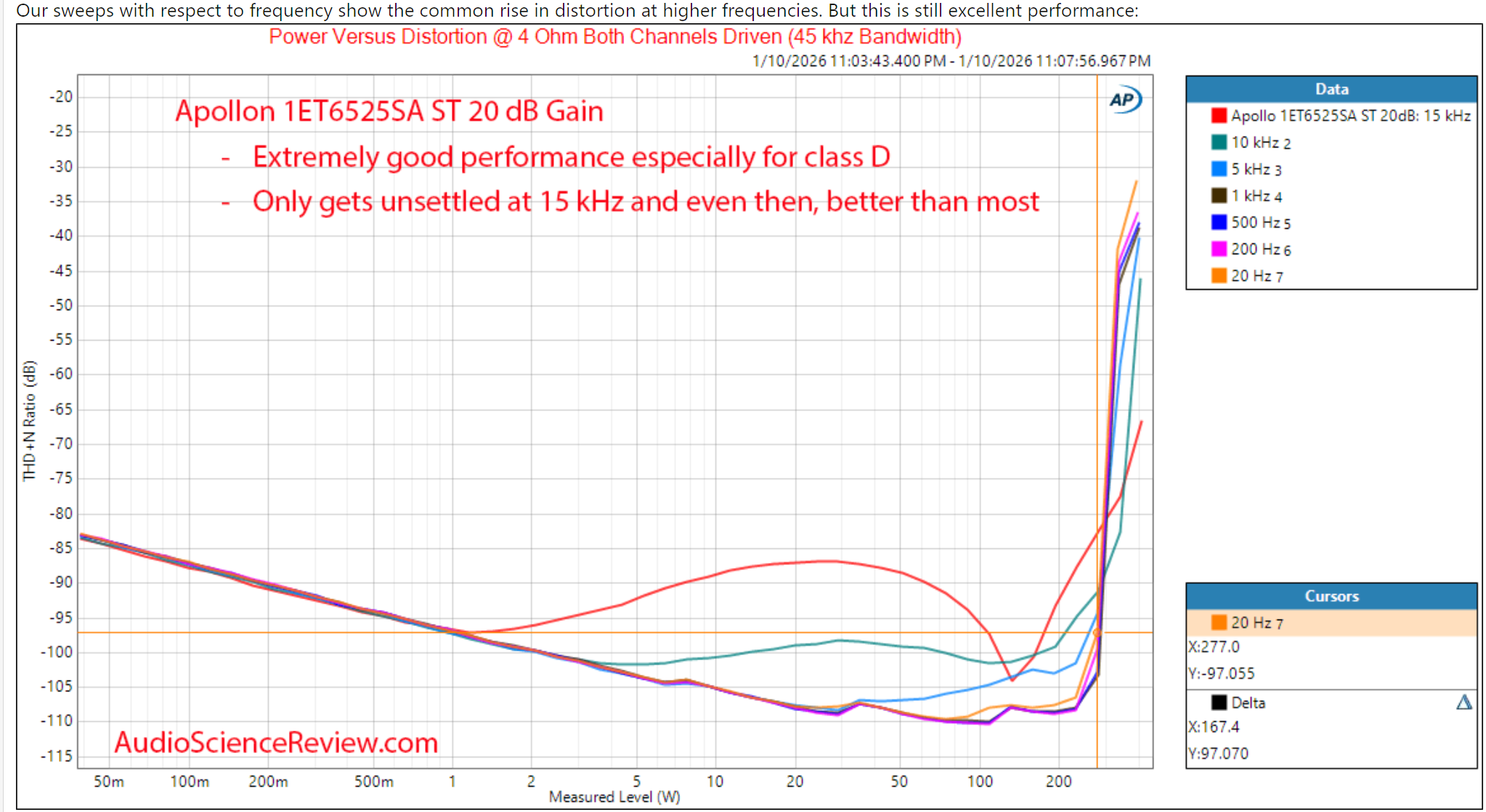
No doubt ... does this topology also prevent the sudden rise in distortion at high frequencies as is observed in all class D amps tested so far on ASR, as seen below? If so, it would be a first and make an excellent and compelling selling point to potential customers.
Posted : 20/01/2026 10:14 pm
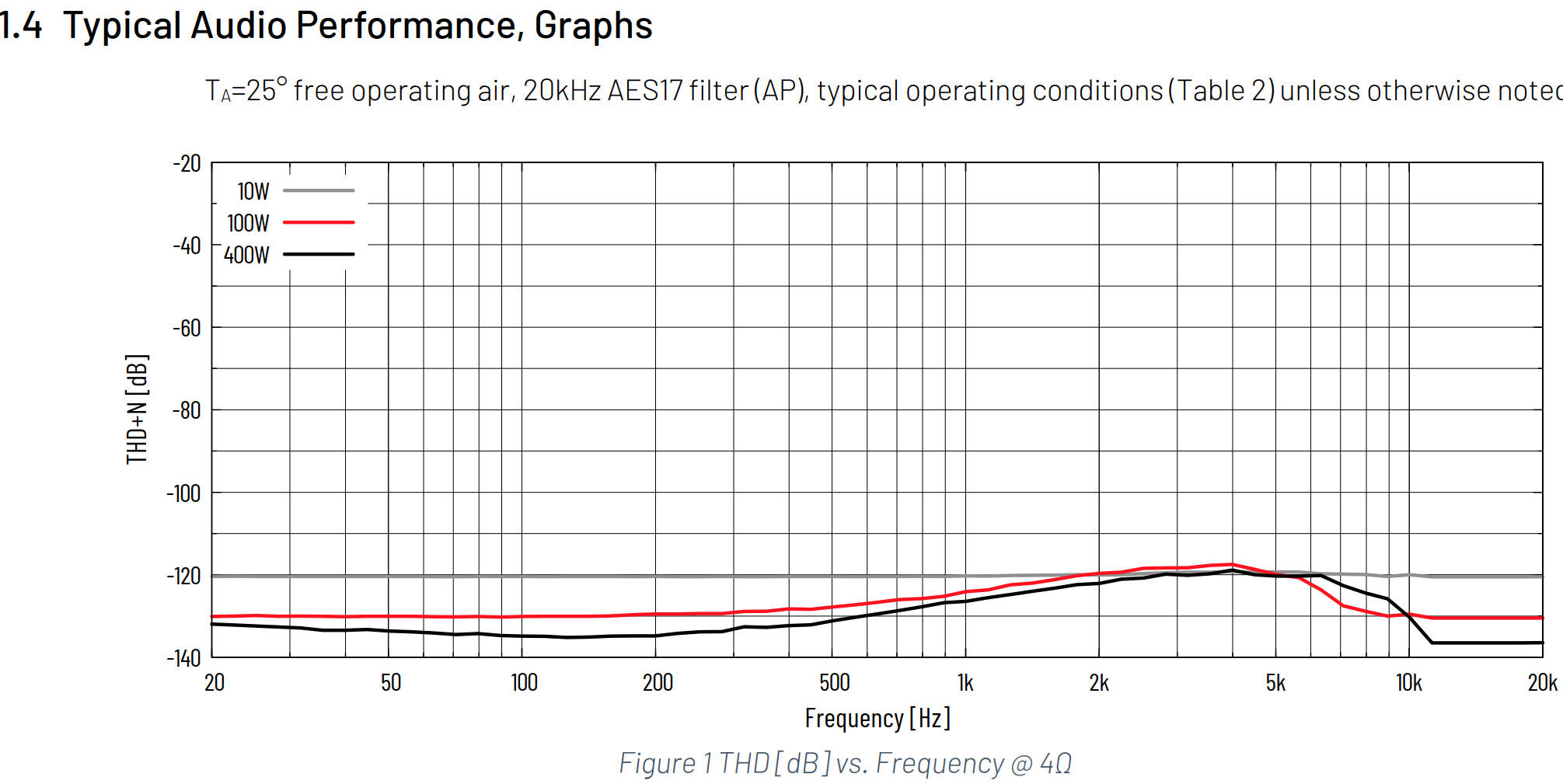
@Alan March, should time permit, would you be willing to generate the above sweeps for your Gen2 amps (p801 or p482)? Simply looking at the profiles and not the absolute values of the THD+N spec, since you said your source is quiet but still noisier than desired.
Secondly, how about the power curve below? I looked at the stated 100W THDN spec of -122dBf or the p801, and it is so darn close to the module spec itself (maybe -123dB?). This means your buffer hardly interferes with the module's performance, and its noise levels are well under -130dB at this data point, correct?
Posted : 20/01/2026 10:28 pm
Topic starter
SmartOne_2000 wrote:
No doubt ... does this topology also prevent the sudden rise in distortion at high frequencies as is observed in all class D amps tested so far on ASR, as seen below? If so, it would be a first and make an excellent and compelling selling point to potential customers.470
Not this again 😐.
There is *NO* problem with high frequency distortion in class D amps.
Again it's dumb ass Amir and others not understanding what they are doing or looking at.
If you apply a 15kHz signal as seen in the graph you posted, the 2nd harmonic is at 30kHz. The 3rd harmonic is at 45kHz.
YOU CANNOT HEAR THESE HARMONICS
YOUR SPEAKERS PROBABLY WONT REPRODUCE THEM
THEY ARE IRRELEVANT TO SUBJECTIVE QUALITY
Measurement bandwidth should be 20kHz because that's what you can hear .*Not* 45 kHz. If it were the case you would not see any rise in 10 or 15kHz distortion.
If you want to test the audible effects of distortion from high frequency signals perform an intermodulation test with 19 and 20kHz tones.
Posted : 20/01/2026 11:03 pm
Guess the answer is a hard no!:) I understand. All audio amplifier/loudspeaker measurements should be restricted to the audio band of interest.
Posted : 22/01/2026 2:30 am
Matias reacted
Topic starter
SmartOne_2000 wrote:
Guess the answer is a hard no!:) I understand. All audio amplifier/loudspeaker measurements should be restricted to the audio band of interest.
I don't mind producing data for our amps, nothing to hide. It's simply that I don't have time. Very busy preparing for the Bristol HiFi show in the UK next month.
Posted : 22/01/2026 7:11 am
SmartOne_2000 reacted
Alan March wrote:
I don't mind producing data for our amps, nothing to hide. It's simply that I don't have time. Very busy preparing for the Bristol HiFi show in the UK next month.
Good luck at the show. Hope you get many potential customers by the time it's over.
Posted : 23/01/2026 7:45 am
Keith and Alan March reacted
1. Hey @Alan March, a few Purifi vendors (BoXem and Audiophonics) have stopped shipping to the US. Essentially, they say the Benefit (large customer base) to-Cost ratio is not worth it anymore. Do you plan to do the same?
2. On another note, some vendors are dropping their 7040SA-based amplifiers from their product offerings. They cite low volume sales and also the amp module still being a Gen1, nonetheless. Do you plan to drop the P501? I realize the latter could be proprietary info, so I respect if you do not want to reveal your future business plans.
Posted : 26/01/2026 2:20 pm
Topic starter
We have no plans to stop shipping to the US. Regardless of the efforts of the tangerine idiot in the Whitehouse, we are still selling OK in the US.
The P501 is still selling so no plans to drop it.
Posted : 26/01/2026 2:48 pm
SmartOne_2000 reacted
Topic starter
The Apollon is inferior in every way. Its immediately obvious from the noise profile they use an opa1656 in the buffer.
BTW, I was a little confused by your previous comment "they say the Benefit (large customer base) to-Cost ratio is not worth it anymore".
Can you elaborate? Is this cost to the manufacturer or consumer.
Posted : 27/01/2026 8:21 am
SmartOne_2000 reacted
Alan March wrote:
The Apollon is inferior in every way. Its immediately obvious from the noise profile they use an opa1656 in the buffer.BTW, I was a little confused by your previous comment "they say the Benefit (large customer base) to-Cost ratio is not worth it anymore".
Can you elaborate? Is this cost to the manufacturer or consumer.
It's a direct quote from BoXem. I believe he came to that conclusion based on volume sales to the US and the hassle(?) to ship to the US. It may be that BoXem pays the tariffs instead of the customer, so that cuts into their profits. He is from Belgium, so I'm not sure if they pay the Belgian or EU tariff rates. Is Belgium part of the E? But his opinion (i.e, BoXem aka Arthur) is not unique. European posters on the forum say buying from the US is a hassle. Not sure why, unless the EU imposed extra tariff-based taxes beyond the usual VAT tax.
Posted : 28/01/2026 6:51 am
Alan March wrote:
The Apollon is inferior in every way. Its immediately obvious from the noise profile they use an opa1656 in the buffer.
...
Their 20db/27dB noise profiles are rather clean, imo. Not unlike the 1 kHz profile of the P482 on the main page.
I wish you would change your mind about sending your amps for review to Amir, despite your history with him. Its specs would serve as a reference for all other amplifier specs and introduce you to a new customer base who do not know you. You already know his style of measurements, so if you relay your reasonable concerns to him before the review, then all misunderstandings would be prevented.
Posted : 28/01/2026 7:04 am
Topic starter
SmartOne_2000 wrote:
It's a direct quote from BoXem. I believe he came to that conclusion based on volume sales to the US and the hassle(?) to ship to the US. It may be that BoXem pays the tariffs instead of the customer, so that cuts into their profits. He is from Belgium, so I'm not sure if they pay the Belgian or EU tariff rates. Is Belgium part of the E? But his opinion (i.e, BoXem aka Arthur) is not unique. European posters on the forum say buying from the US is a hassle. Not sure why, unless the EU imposed extra tariff-based taxes beyond the usual VAT tax.
There is no "hassle" shipping to the US. No different to anywhere else. The only issue is the tarrifs. It would be a very bad business decision if BoXem pays the tariffs.
The EU is headquartered in Brussels, Belgium. So EU tariff rate of 15%.
Equally, buying from the US is not a "hassle". Customers would just have to pay VAT. The shipping companies contact the customer for payment.
Posted : 28/01/2026 9:35 am