
Notifications
Clear all
Power Amplifiers
114
Posts
7
Users
92
Reactions
24 K
Views

Topic starter
SmartOne_2000 wrote:
Why are all these different manufacturers showing 30uV of noise, compared to your stated 8uV? Where does all this noise come from? Is the Ultra-Buffer design that good? Maybe it's secretly cryogenically cooled to reduce thermal noise, using some alien tech without drawing too much power?:)
Its primarily because I suspect they are re-using their previous buffer designs that were OK for the previous generation of Purifi modules, but inadequate for the far lower noise level of the new Purifi modules.
What they are essentially using is just a copy of the original Purifi reference circuit, which is good, but never intended to be some kind of "as good as you can get" design. Purifi have left that to OEMs to figure out, although they now another discrete buffer design.
We took one glance at the Purifi data sheet for the new modules and realised we had a big challenge. We started from scratch to engineer a buffer that is both very quite, but also high current output as the new modules have lower input impedance.
I would add on to this as a bit of a caveat. I have no idea of how Amir has set up his testing. He has possibly left the amps on the highest gain setting during the power on test, and there may be a limitation on the noise floor of the signal generator in the AP.
The buffer will obviously amplify the noise of the source. However, with the lowest gain setting this shouldn't be a problem. The AP generator is very quiet and we still see high noise levels (not in absolute terms but compared to what the Purifi modules is capable of. Plus he could also short out the amp input to take the signal generator out of the equation. Now doubt he would fight doing that 😐
Posted : 12/01/2026 10:24 am
SmartOne_2000 reacted

Alan March wrote:
Its primarily because I suspect they are re-using their previous designs that were OK for the previous generation of Purifi modules, but inadequate for the far lower noise level of the new designs.What they are essentially using is just a copy of the original Purifi reference circuit, which is good, but never intended to be some kind of "as good as you can get" design. Purifi have left that to OEMs to figure out, although they now another discrete buffer design.
We took one glance at the Purifi data sheet for the new modules and realised we had a big challenge. We started from scratch to engineer a buffer that is both very quite, but also high current output as the new modules have lower input impedance.
I would add on to this as a bit of a caveat. I have no idea of how Amir has set up his testing. He has possibly left the amps on the highest gain on the power on test and there may be a limitation on the noise floor of the signal generator in the AP.
The buffer will obviously amplify the noise of the source. However, with the lowest gain setting this shouldn't be a problem. The AP generator is very quiet and we still see high noise levels (not in absolute terms but compared to what the Purifi modules is capable of. Plus he could also short out the amp input to take the signal generator out of the equation. Now doubt he would fight doing that 😐
Excellent ... so if the same test was done on your Gen2 amps, this would not be an issue, i.e., no 30uV noise during the idle phase of the test? There would not be any output glitches as you turn the amps on or off?
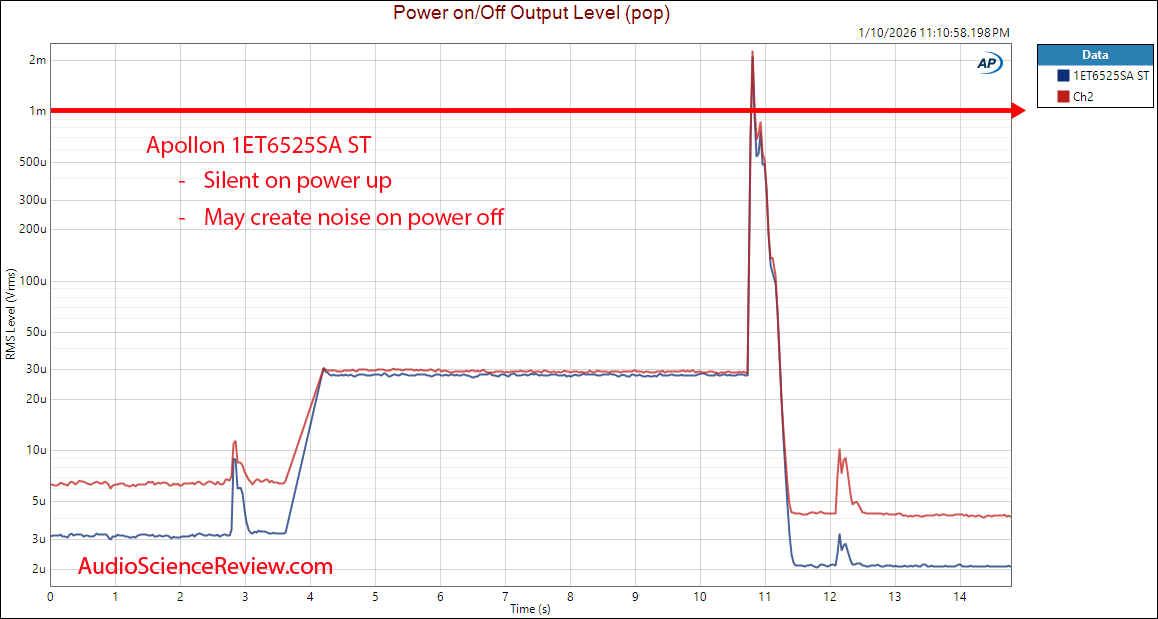
Posted : 12/01/2026 10:58 am

@SmartOne_2000 It will very much be speaker dependent, the higher the sensitivity of your speakers the greater chance of hearing a small pop through your speakers when powering up, this is my experience with my P482 connected to my Klipsch RF-7 III speakers although they are only moderately sensitive at 93dB, I'd prefer it to be completely silent like other competitors amps BoXem, Apollon & Buckeye but at least it isn't an issue when I power off the P482, it is effectively silent.
Posted : 12/01/2026 11:22 am
SmartOne_2000 reacted
Topic starter
SmartOne_2000 wrote:
Excellent ... so if the same test was done on your Gen2 amps, this would not be an issue, i.e., no 30uV noise during the idle phase of the test? There would not be any output glitches as you turn the amps on or off?430
There certainly would not be 30uV of noise. You have seen the measurements on the P482 on the first page of this thread. As I mentioned I cannot vouch for the test that Amir is doing, plenty of scope for error regarding the exact number.
Yes there will be similar low level spikes as the amp turns on/off. That's not what we have been talking about though. We have been talking about the poorer steady state noise level these other amplifiers have. The N in the THD+N (SINAD).
Posted : 12/01/2026 2:08 pm
bobbyjziino and SmartOne_2000 reacted
Topic starter
Oniiz86 wrote:
@SmartOne_2000 It will very much be speaker dependent, the higher the sensitivity of your speakers the greater chance of hearing a small pop through your speakers when powering up, this is my experience with my P482 connected to my Klipsch RF-7 III speakers although they are only moderately sensitive at 93dB, I'd prefer it to be completely silent like other competitors amps BoXem, Apollon & Buckeye but at least it isn't an issue when I power off the P482, it is effectively silent.
You are absolutely right. The audibility of any on / off clicks is very much dependant upon the speaker sensitivity, however 93dB is not just moderately sensitive, it's very sensitive. Higher than probably 95% of the hifi speakers currently on the market.
Other competitors amps are not silent. Far from it, as shown in the graph above. Also, the level of any turn on tick will be dependant on the DC offset that the source equipment exhibits.
Posted : 12/01/2026 2:12 pm
bobbyjziino and SmartOne_2000 reacted
Topic starter
@SmartOne_2000
A bit more thinking and information. We know Amirs AP is a good one with above spec performance. From his DAC measurements we see SINAD numbers up to 124dB. On the 5volt input range he typically uses, that equates to about 3.3uV noise 20Hz to 20kHz. However that number also includes the THD of any signal in the measurement, so the true ADC noise will be a little better.
This ties in very well with the 2uV number we see at the beginning of the Buckeye power on tests where there would be no audio signal.
We can therefore be confident that in the measurement system signal generator is not switched on contributing to the noise floor, and that the ADC noise floor is far, far lower than the amplifier. 2uV verses 30uV.
Considering all of this I would say the 30uV noise figure for the amp is accurate.
Posted : 12/01/2026 2:51 pm
bobbyjziino and SmartOne_2000 reacted
So the 30uV is a result of amplifying the 2uV signal?
Here is the response to the same question I asked you earlier.
Posted : 12/01/2026 10:28 pm
Topic starter
SmartOne_2000 wrote:
So the 30uV is a result of amplifying the 2uV signal?Here is the response to the same question I asked you earlier.
No. I said that the AP signal generator does not appear to be active during the power on test. That 2uV appears to be the residual noise of the AP input signal conditioning and ADC. My view is that the 30uV is a pretty accurate measurement of the amp noise floor at whatever gain setting was used in the test. I think it's just coincidence that the numbers have been so similar between different amps.
Regarding your link, Amir is an idiot. He ran the other tests at 3 different gain settings. So which one did he use for the power on test? What he is actually saying is that he was yet again being slap dash and didn't consider the effect of amplifier gain on the results..
Also, the point of the power on test is evaluate the noise of the amplifier, not the source, hence the inputs are best shorted. You don't want any influence from a signal source, connecting cables etc.
Amir is simply not the technical guru he makes himself out to be.
He is right in saying that the AP ADC noise floor is a lot lower than that of the amplifier.
However, the AP signal generator residual noise is specified as 1uV. If this is amplified by 27dB you get 23uV. So, when the AP signal generator is in use, as in the all the other tests, it most certainly does/can have an impact on the SINAD values with this latest generation of extraordinarily quiet Purifi amps
Again, Amir just doesn't understand or care about this level of detail. Even if he did he would argue black is white so he won't be ever be wrong. It's a bit like Trump 😉
Posted : 13/01/2026 8:07 am
bobbyjziino and SmartOne_2000 reacted
Topic starter
A further note.
The highest performing audio components are now starting to exceed the capabilities of the AP555. Hence why you see DACs all starting to level out at about 124dB in Amirs testing. he is measuring the performance limit of the AP and not the device under test
Amir could not measure our amps noise floor accurately using the techniques he does currently. The AP signal generator is too noisy.
Now, you can argue it's a moot because we can't hear the difference anyway, but that's not the point. ASR is only about using measurements to assess and compare products.
Amirs AP and his techniques are no longer adequate to do so with the best performing audio components.
Posted : 13/01/2026 8:34 am
bobbyjziino and SmartOne_2000 reacted
Alan, do you find the specs of this Weiss discrete opamp credible (scroll to the bottom)?
If so, does it exceed the performance of the popular OPA1612 IC amp used by many audio designers? Do you think it would be a good fit for your amps if it exceeded the noise performance of the Purifi modules?
Posted : 15/01/2026 11:43 am
@Alan March I think you got carried away there Alan, these posts belong in your "Anything Else" thread. 😉
Posted : 15/01/2026 1:17 pm
SmartOne_2000 reacted
Topic starter
Oniiz86 wrote:
@Alan March I think you got carried away there Alan, these posts belong in your "Anything Else" thread. 😉
Thank you. All moved.
Posted : 15/01/2026 3:54 pm
SmartOne_2000 reacted
Topic starter
SmartOne_2000 wrote:
Alan, do you find the specs of this Weiss discrete opamp credible (scroll to the bottom)?If so, does it exceed the performance of the popular OPA1612 IC amp used by many audio designers? Do you think it would be a good fit for your amps if it exceeded the noise performance of the Purifi modules?
I don't appear to be able to open the data sheet pdf.
Posted : 15/01/2026 3:58 pm
Topic starter
SmartOne_2000 wrote:
Oops. Then try this. Thanks!
Thanks. Just had a look, it's been a long time since I looked at the Weiss.
Essentially, whilst it is a very good performing part, I see little in the way of a compelling argument to use it over the 1612. Quite similar in fact.
The biggest detractor however is the price. Why would you pay hundreds of dollars when you can get the same performance for less than $10?
Also, our buffer outperforms it. 😉. As I have mentioned before, and as the Buckeye and Apollon amps demonstrate, a buffer based on the Purifi reference circuit using the 1612 is not high enough performance to take advantage of the new modules.
One other thing to mention is that to get the best performance out of these devices you need to pay a lot of attention to surrounding passive components and the PCB design and layout.
Just compare how "messy" the Buckeye noise floor is to our P482 or P801.
Posted : 16/01/2026 6:20 pm
SmartOne_2000 reacted