
Notifications
Clear all
Power Amplifiers
114
Posts
7
Users
92
Reactions
24 K
Views

Topic starter
Hi everyone
Exciting times at March Towers. The new Purifi 1ET6525 modules have finally arrived. A special thanks to Fedex for losing them for 4 weeks!!!
Anyway, we have been busy testing them in our new P482 amplifier. This replaces the P422 in a few weeks. The new amp has a revised power supply and features our "ultra buffer" that was developed for our flagship P801 monoblocks. The new buffer is required to take advantage of the improved performance these latest generation Purifi modules.
We are confident our engineering skills have made this is the lowest noise, lowest distortion and highest power output implementation of the Purifi 1Et6525 modules.
Headline specs (actual measured performance *NOT* Purifi module datasheet numbers):
Measurements taken with 21.0dB gain setting and BOTH channels driven.
Power:
246 Watts 8 ohm 1% THD
490 Watts 4 ohm 1% THD
540 Watts 2 ohm 1% THD
Output Noise:
7.6uV RMS (20Hz to 20kHz, input shorted)
DC Offset = 0.3074mV
THD:
-133dB (20Hz to 20kHz)
THD+N (SINAD)
-115dB @ 4.475V RMS, 4 ohm load, 5 watts
Gain Options (selectable on rear panel switch)
21.0dB (full power output with 4.0V RMS standard domestic XLR input/source)
27.0dB (full power output with 2.0V RMS standard RCA input/source)
Be wary of other manufacturers "gaming"" the SINAD figures with unusably low gain settings.
As you possibly know, we are very close to the measurement limits where it becomes difficult to discern between the noise and distortion of the measurement system and that of the device under test. Below is some of the data.
As discussed previously regarding our P801 amplifier, due to their very low noise it is very difficult to accurately measure the SINAD. The gain of the input buffer and power amp module amplifies the inherent noise of the signal generator/DAC. Most amplifiers noise masks and swamps the noise of the signal source, but with these amplifiers it needs to be taken into account.
Below I have shown the amplifiers inherent noise, measured with the input shorted. I have also shown the amp output noise with the signal source/generator connected:
Input shorted = -115.45dB
With signal generator connected = -112.45dB
Due to this the measured THD+N is lower than it should be due to the signal generator noise. Hence to calculate the actual THD+N / SINAD we need to add the measured THD and the amp noise measured with the input shorted:
(-134.3dB) + (115.34dB) = -115.3dB
As you can see, the final SINAD is dictated by the noise and not the THD.
Graphs
Output Noise with input shorted
7.6uV
Noise, Input shorted dBFS.
FS = 4.6565V rms = FS = -115.8dB
REF 4.475V RMS (5 watts 4 ohms) = -115.45dB
Noise with signal generator connected
REF 4.475V RMS = -112.45dB
THD / THD+N
REF 4.475V RMS (5 watts 4 ohms) = -111.9dB
CORRECTED = -115.3dB
Power curves to follow.
Needless to say, it sounds incredible 🙂 !
Posted : 14/11/2024 8:32 am
mschoi96 and bobbyjziino reacted
Topic starter
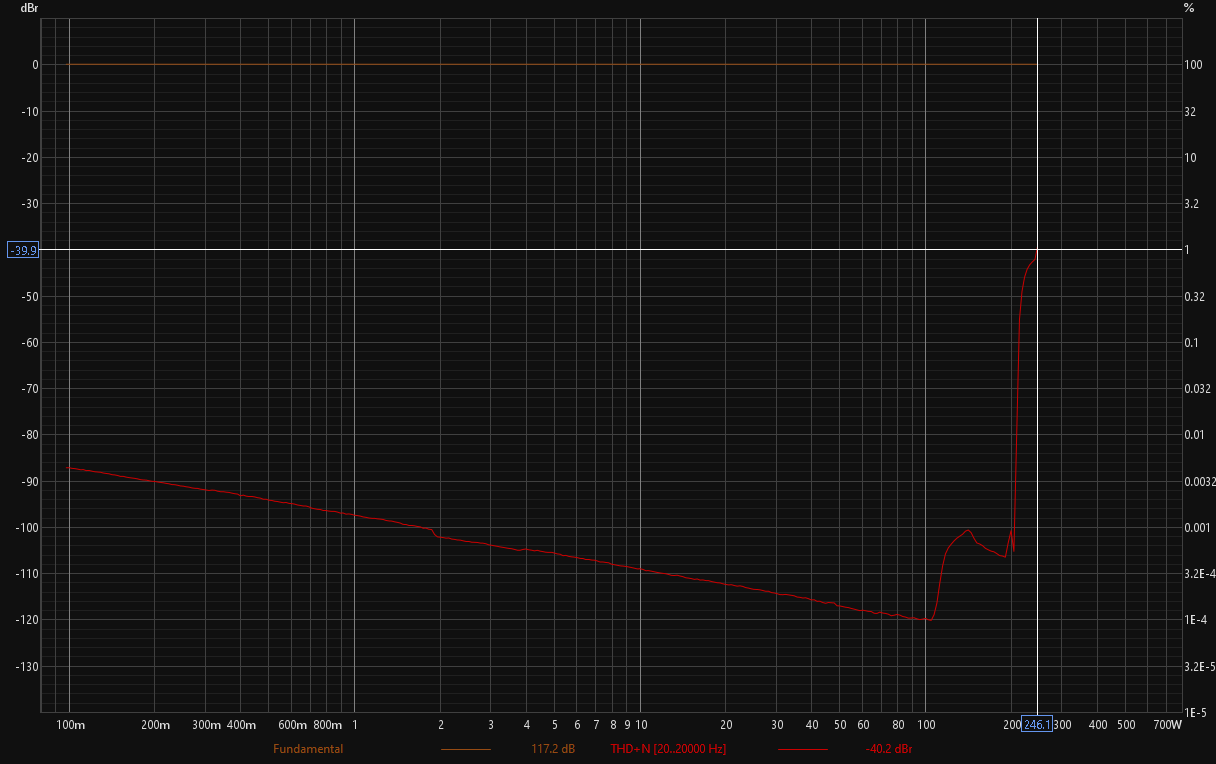
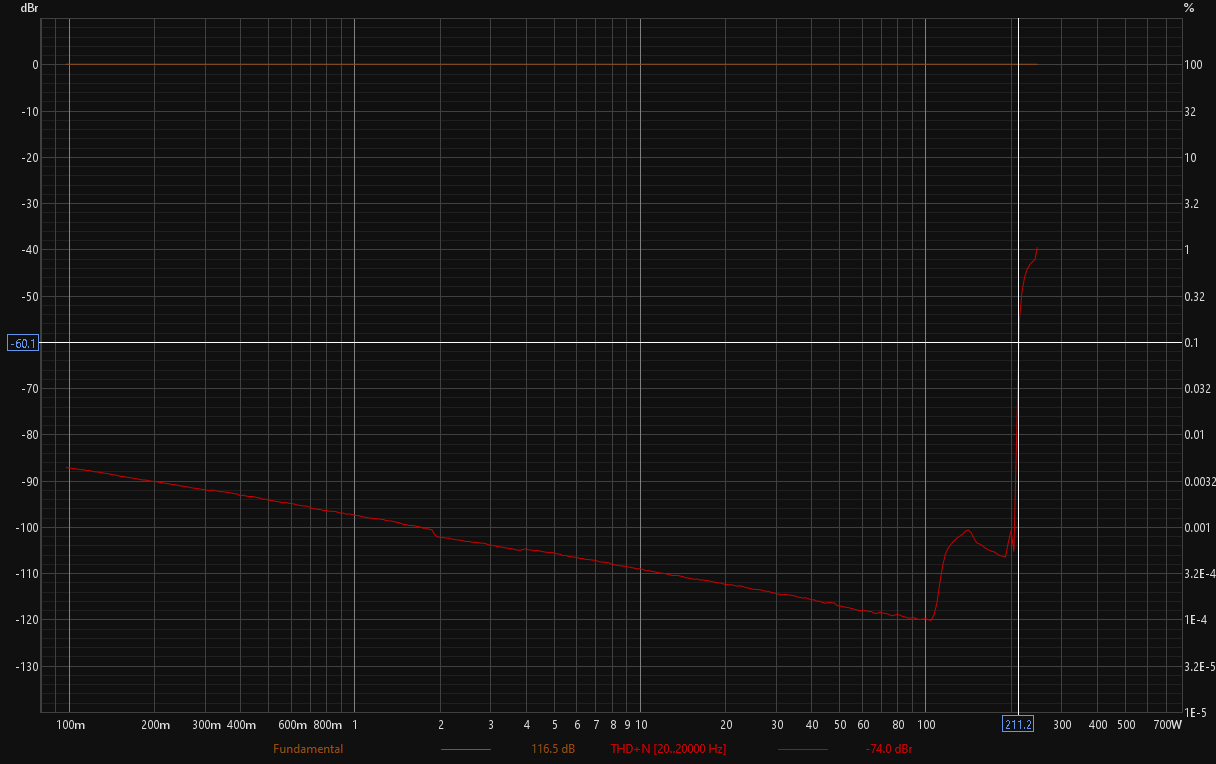
Below is the power v THD+N curve for an 8 ohm load
1% THD+N = 246 watts
0.1% THD+N = 211 watts
Posted : 14/11/2024 8:36 am
mschoi96 and bobbyjziino reacted

Hey Alan,
I thought it was time to join the community, it's Bobby here.
Looking good, anxiously waiting for this release 🙂
I had noticed the Gain stage was initially noted as 23dB & 29dB but now corrected to 21dB & 27dB, was that inadvertently copied from the P801's Ultra Buffer specifications?
Posted : 14/11/2024 12:28 pm
Alan March and james dyson reacted
Topic starter
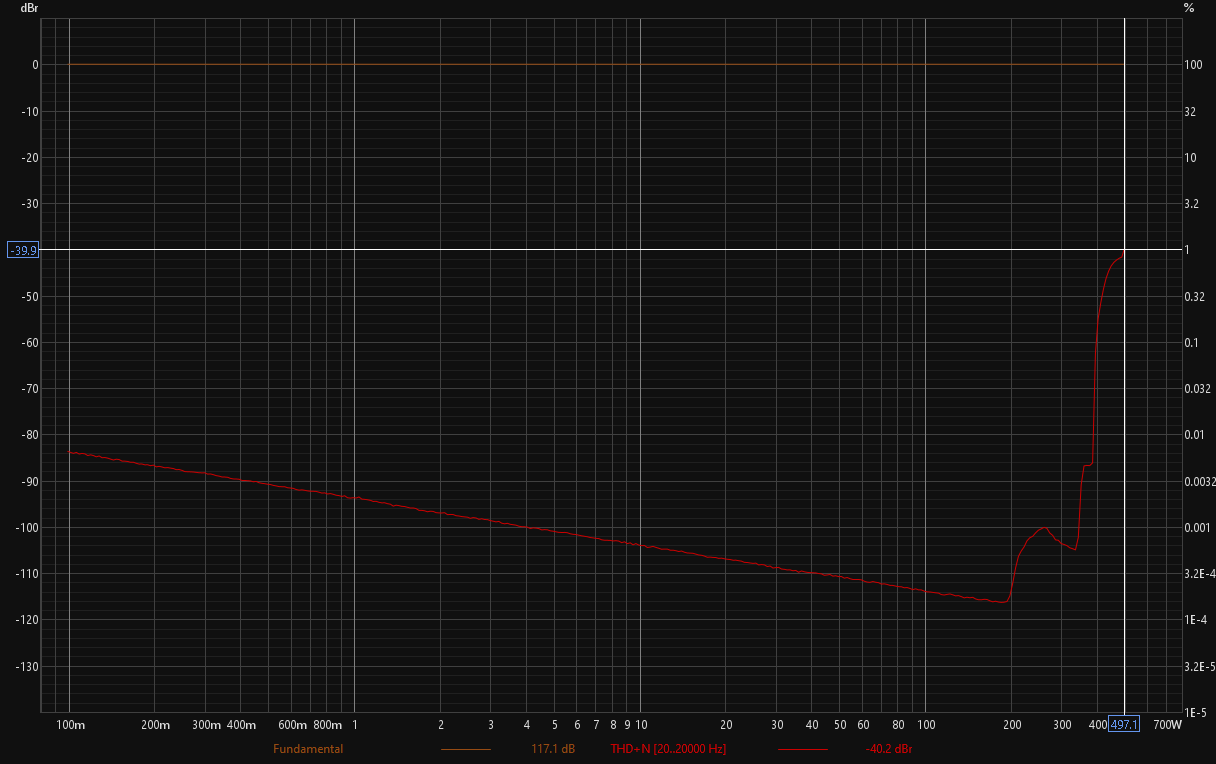
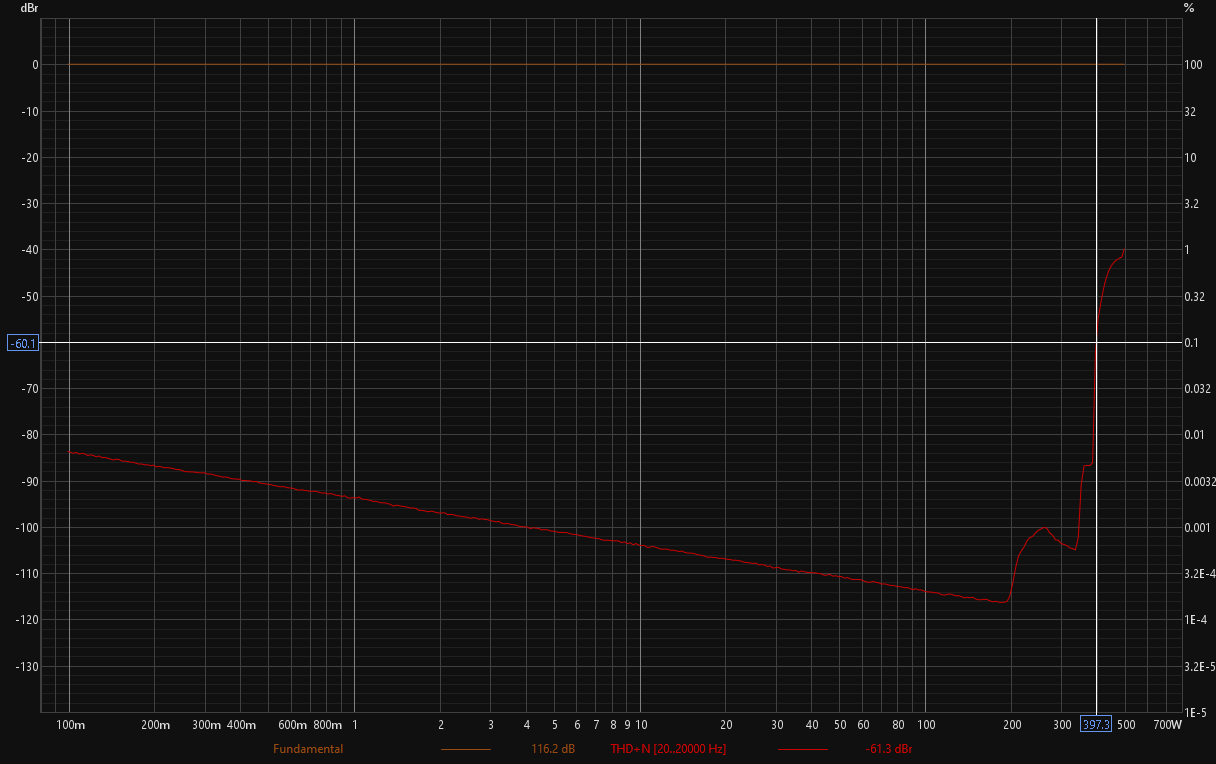
Below is the power v THD+N curve for an 4 ohm load.
1% THD+N = 497 watts
0.1% THD+N = 397 watts
Posted : 14/11/2024 12:29 pm
james dyson and bobbyjziino reacted
Topic starter
Oniiz86 wrote:
Hey Alan,I thought it was time to join the community, it's Bobby here.
Looking good, anxiously waiting for this release 🙂
I had noticed the Gain stage was initially noted as 23dB & 29dB but now corrected to 21dB & 27dB, was that inadvertently copied from the P801's Ultra Buffer specifications?
Welcome!
Yep, my bad. Brain fart, I was thinking of the P801 amps.
Posted : 14/11/2024 12:30 pm
mschoi96 and james dyson reacted

Hello Alan
I have a question if that's OK? I have been discussing your test results on Audio Science Review. One of your competitors has posted a plot showing their equivalent to the P482 having more noise, distortion and lower power. He says the difference in performance isn't statistically significant and seems to be saying the Purifi modules vary significantly in power 210 to 230 watts. Have you found this?
Thanks
Posted : 14/11/2024 3:50 pm
Alan March reacted
@james dyson I believe the difference regarding power output is because most competitors are using Hypex's SMPS1200A400 which is only 63V so cannot achieve full rated output, I believe BoXem did touch upon this but Alan's custom SMPS solution is closer to the 1ET6525SA module's rated voltage of 65V, somewhere between 64V-65V & it is the only one touted to have Active Synchronous Rectification. 😉
Posted : 14/11/2024 4:53 pm
james dyson and Alan March reacted
Topic starter
james dyson wrote:
Hello Alan
I have a question if that's OK? I have been discussing your test results on Audio Science Review. One of your competitors has posted a plot showing their equivalent to the P482 having more noise, distortion and lower power. He says the difference in performance isn't statistically significant and seems to be saying the Purifi modules vary significantly in power 210 to 230 watts. Have you found this?
Thanks
Hi James
I tend not to pay any attention to ASR, and I certainly don't want to get into an argument with another manufacturer. However, I will say that this doesn't correlate with our experience.
We have built thousands of Purifi based amps and each one is tested at production. This means we have a large database of performance results. Whilst it's true to say the modules are not identical in performance, the differences are small, very small.
Ok, we havent tested a large number of 6525 modules yet, but I see no reason why the 6525 module would be any different to the other modules. To assert that the module is varying 10% in power output is pretty out there and wrong in my experience.
@Oniiz86 hit the nail on the head. If this manufacturer is using a Hypex power supply then it is too low a voltage. 65volts is required, the Hypex is only 63volts at the nominal mains supply voltage of 230v (110v). It has very poor voltage regulation and will wander all over the place depending on the incoming mains voltage. The Hypex spec sheet says 49 volts to 72 volts! 49volts will significantly limit the power output. 72 volts actually goes above the modules recommended supply range. Bus pumping with reactive speaker loads could easily make the voltage rise to 75v which would trip its protection mechanism shutting it down. Alternatively, when heavily loaded this psu will drop in output voltage reducing power output.
So, 210 watts is about what I would expect at the nominal 63 volts. It's the psu causing the power output variations, not the module.
Our power supplies have very tight voltage regulation WRT the incoming mains voltage and output load, hence we dont see these problems. The amp performance remains consistent regardless.
Hope that helps.
Alan
Posted : 14/11/2024 5:31 pm
Thanks Alan, that all makes sense.
Posted : 14/11/2024 9:36 pm
Topic starter
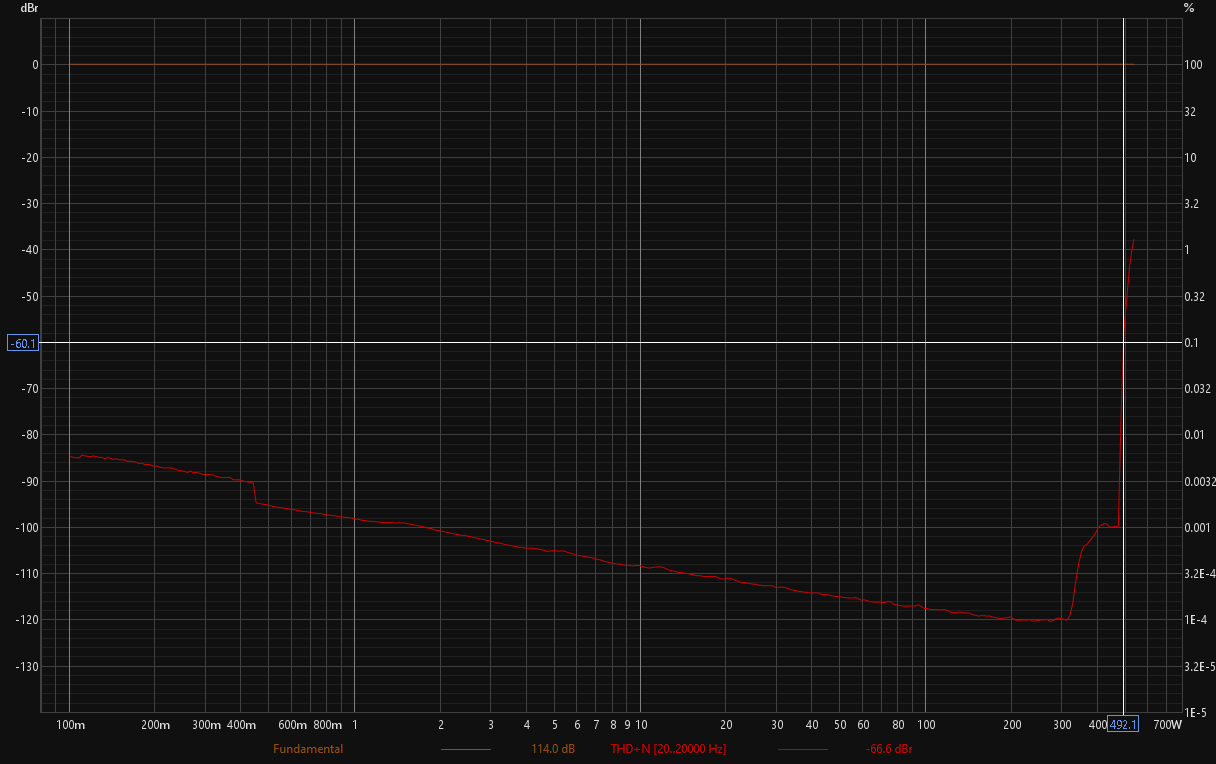
Below is the power v THD+N curve for an 4 ohm load.
1% THD+N = 528watts
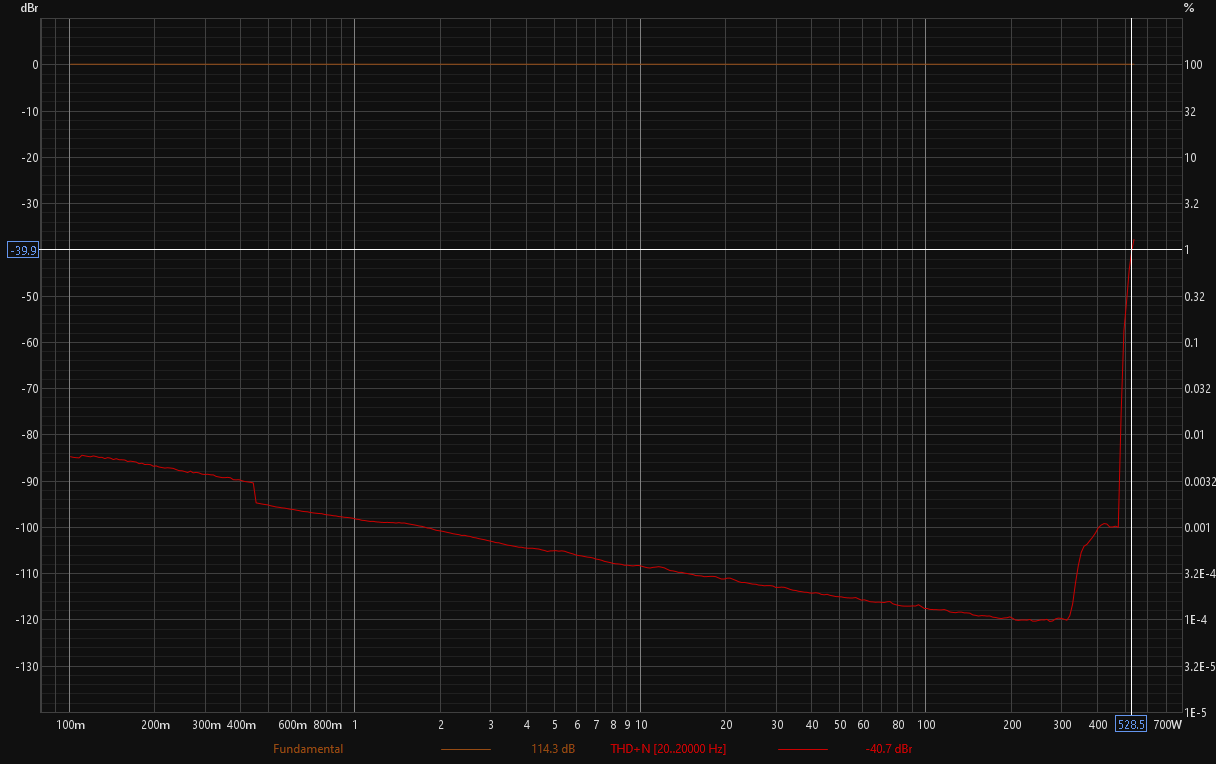
0.1% THD+N = 492watts
Posted : 14/11/2024 9:58 pm
Topic starter
@james dyson @Oniiz86 The question about power supply voltage prompted me to perform a bit more testing. I have set-up the PSU for 63volts and ran power curves on the 1ET6525 modules.
8ohm 1% THD+N = 203 watts
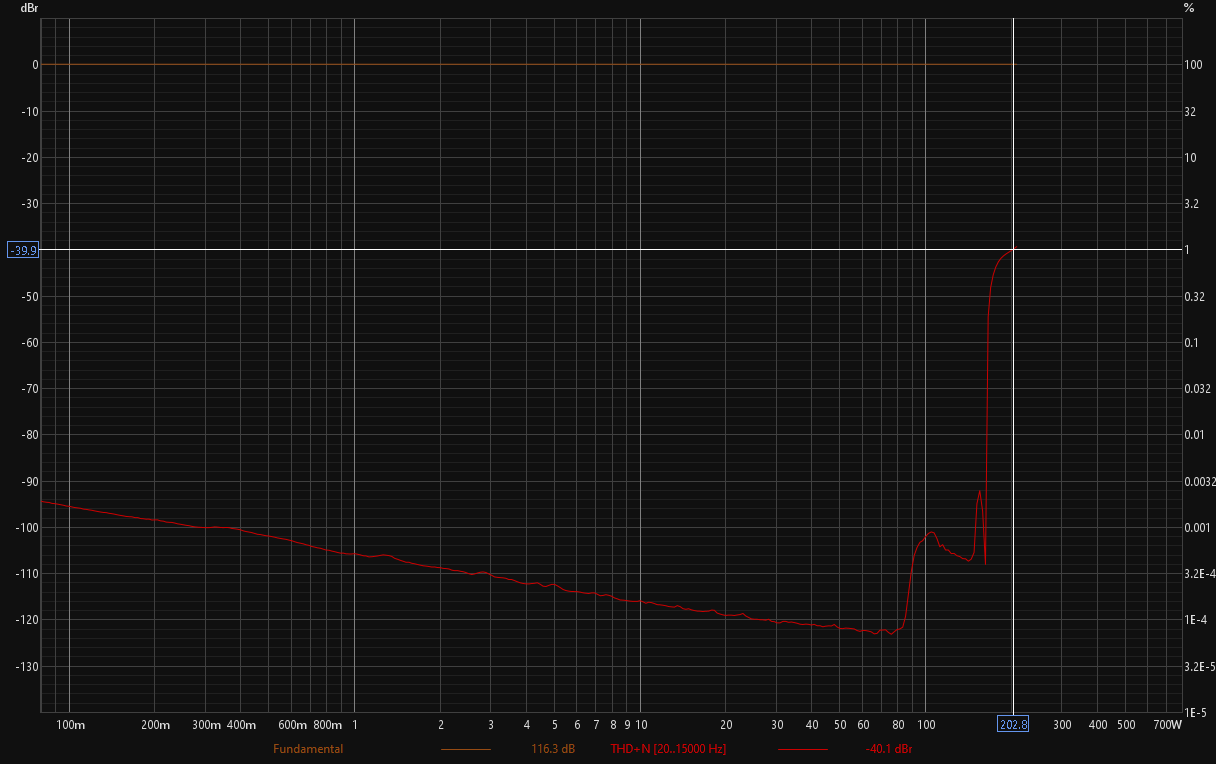
8ohm 0.1% THD+N = 165watts
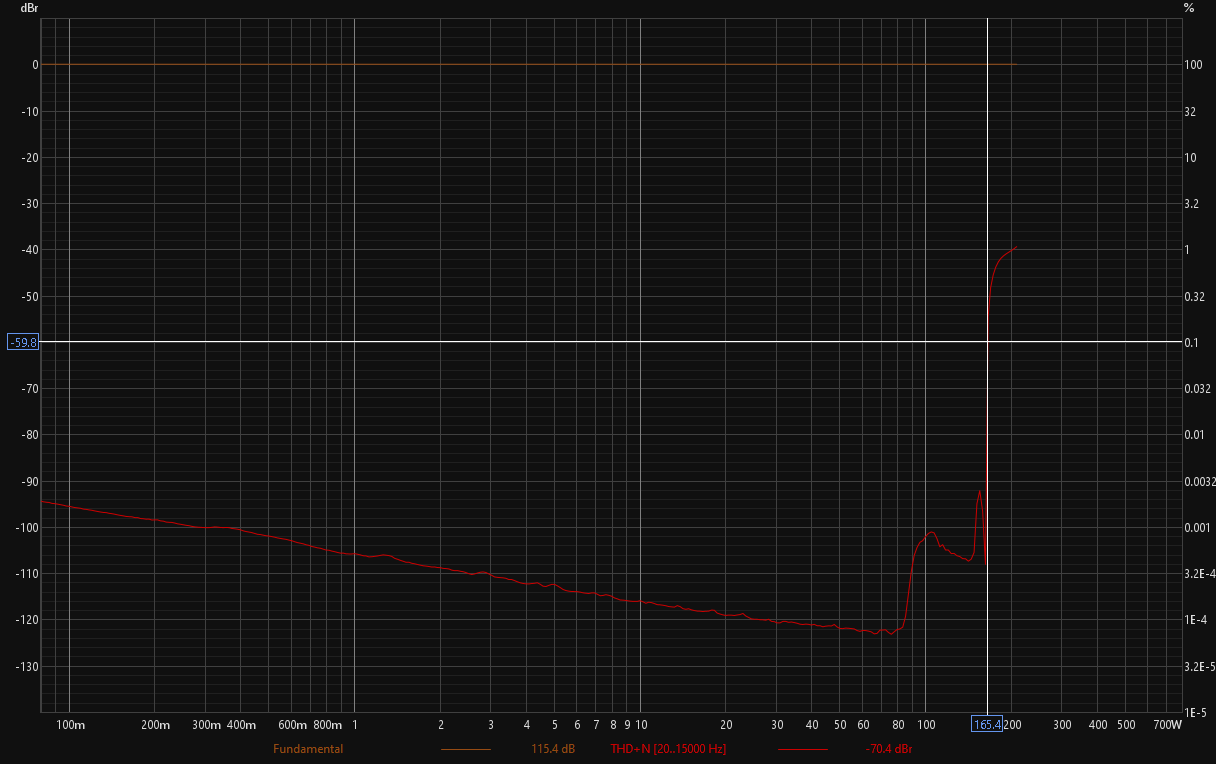
4ohm 1% THD+N=405watts
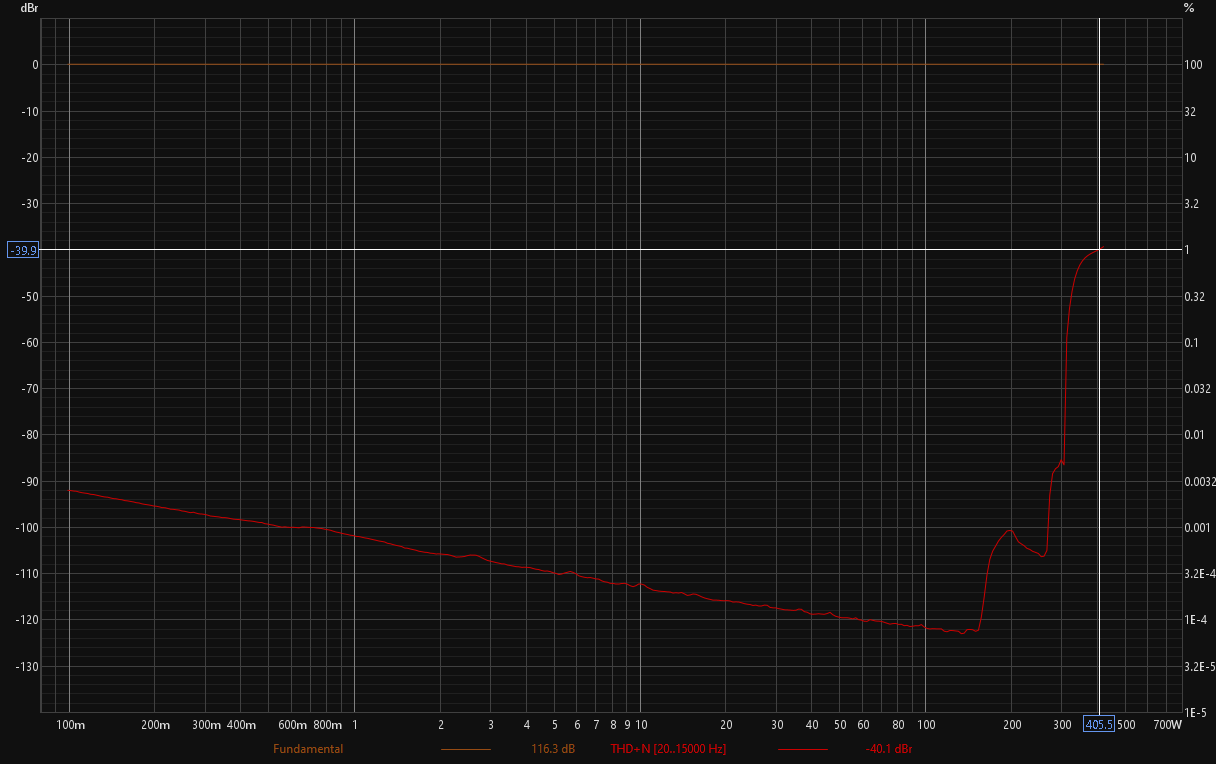
4ohm 0.1%THD+N = 311 watts
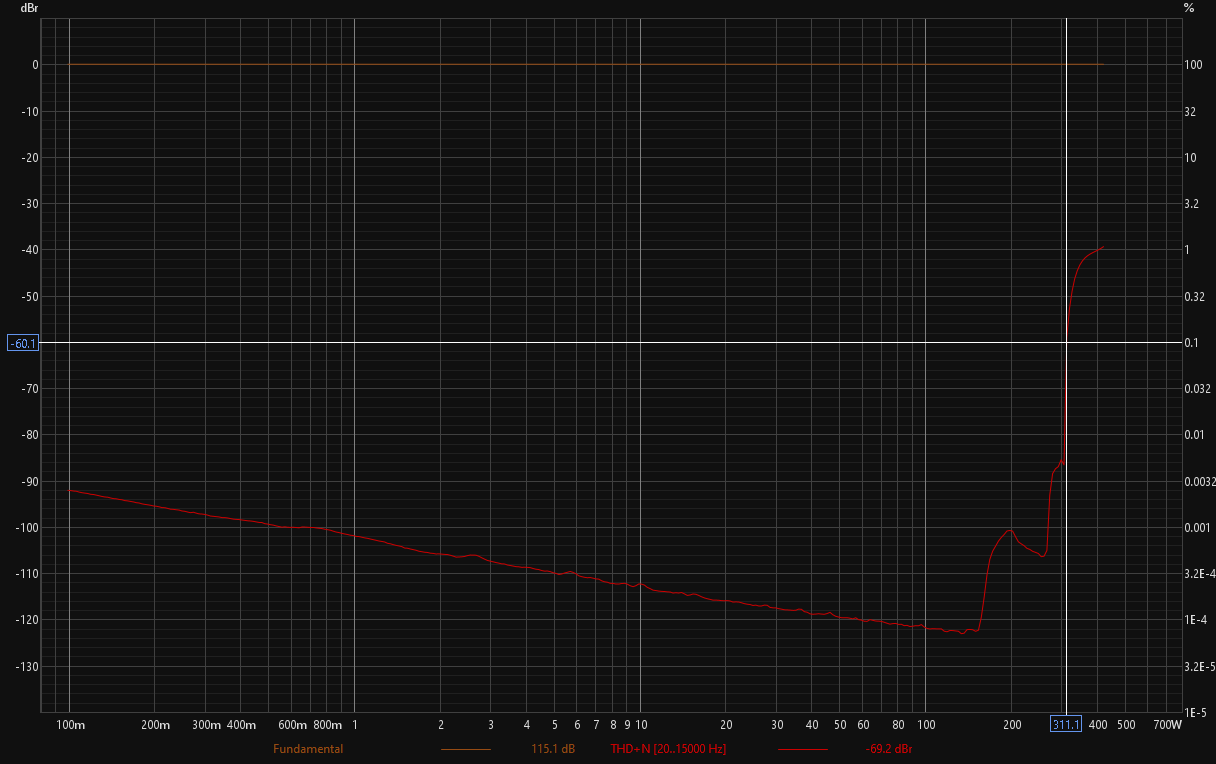
So my estimate of 210 watts at 1% THD+N into 8 ohms was about right. So thats all you will get out of a Hypex PSU running at nominal mains input voltage (230v/110v). This is just one reason why we dont use them and have our own custom PSU.
Posted : 18/11/2024 2:35 pm
mschoi96 and bobbyjziino reacted
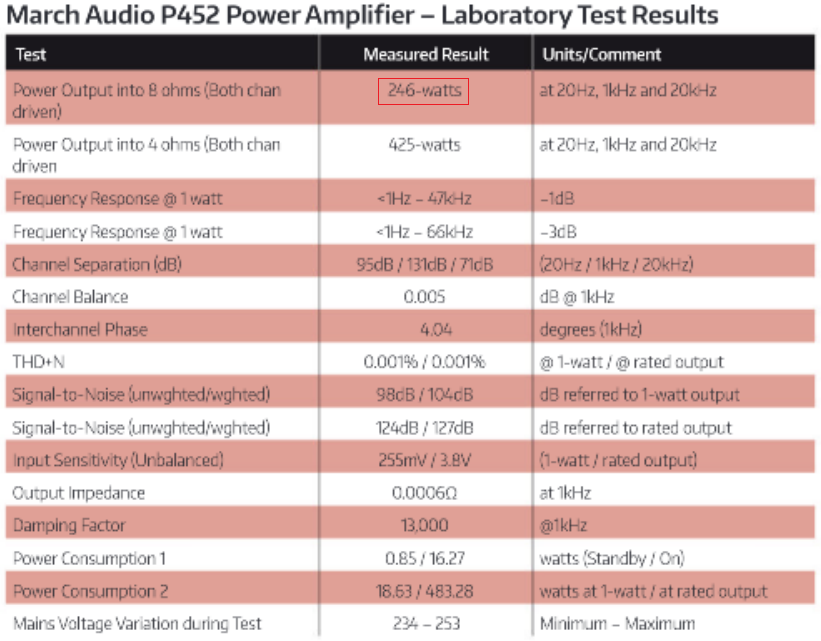
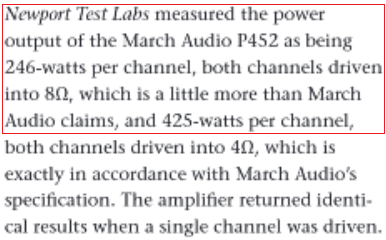
@Alan March A curious observation I noticed of when the Award-Winning P422 was reviewed by Australian Hifi, is that it also achieved 246 watts at 8 Ohms with the Hypex SMPS1200A400, perhaps the difference of 230V/240V plays a part in the final output power too, I believe this review took place before the transition to the custom PSU in late 2021.
Posted : 18/11/2024 3:55 pm
Topic starter
Oniiz86 wrote:
@Alan March A curious observation I noticed of when the Award-Winning P422 was reviewed by Australian Hifi, is that it also achieved 246 watts at 8 Ohms with the Hypex SMPS1200A400, perhaps the difference of 230V/240V plays a part in the final output power too, I believe this review took place before the transition to the custom PSU in late 2021.
187
190
Yes, the P452 did utilise a Hypex PSU. Note the mains voltage during the test - up to 253 volts! As mentioned, the Hypex supply varies its output voltage proportionally with the incoming mains voltage because its unregulated. So its a bit of a lottery depending on the mains voltage at your house as to whether the amp will reach its power output spec or not.
Taking into account voltage drop due to load, you would need over 240v (120v) for the Hypex to output enough voltage to make the 1et6525 reach full power output.
Posted : 18/11/2024 4:51 pm
bobbyjziino reacted
Alan March wrote:
Yes, the P452 did utilise a Hypex PSU. Note the mains voltage during the test - up to 253 volts! As mentioned, the Hypex supply varies its output voltage proportionally with the incoming mains voltage because its unregulated. So its a bit of a lottery depending on the mains voltage at your house as to whether the amp will reach its power output spec or not.Taking into account voltage drop due to load, you would need over 240v (120v) for the Hypex to output enough voltage to make the 1et6525 reach full power output.
Thanks for that Alan, silly me for not picking up on that, I also didn't realise that Australia is officially a 230V country from way back in 2000, I thought we were 240V, I believe WA is still 240V & Queensland only recently transitioned to 230V back in 2020, I need to educate myself with Australia's current electrical power standards. 😉
Posted : 18/11/2024 5:19 pm
Topic starter
237v here in WA as I write. Remember there is a tolerance its allowed to operate within. For example, whilst the UK is formally 230v and was supposed to drop to there from 240v to harmonise with Europe, it never did because 240v is still within the allowed tolerance.
Posted : 18/11/2024 5:26 pm
bobbyjziino reacted
Page 1 / 8
Next