Hey Alan, I looked closely at the 9040BA module and noticed it has an OPA1632 differential-in differential-out amplifier. Do you know why it would be there, considering a preceding diff-amp output section on the buffer board?
SmartOne_2000wrote:
Hey Alan, I looked closely at the 9040BA module and noticed it has an OPA1632 differential-in differential-out amplifier. Do you know why it would be there, considering a preceding diff-amp output section on the buffer board?
SmartOne_2000wrote:
Thanks for this...but initially I was more concerned with 20Hz performance not 20kHz :). I think you answered the question by saying, since there are no bus pumping issues, you guarantee full rated power performance at 20Hz with negligible distortion of -120dB or less in all impedances, correct?
I'm new to class D amps and these low frequency issues concern me. They which never existed in analog amps.
The moment when so small amount of overall power and the linear simply looks linear. the Old legacies xD
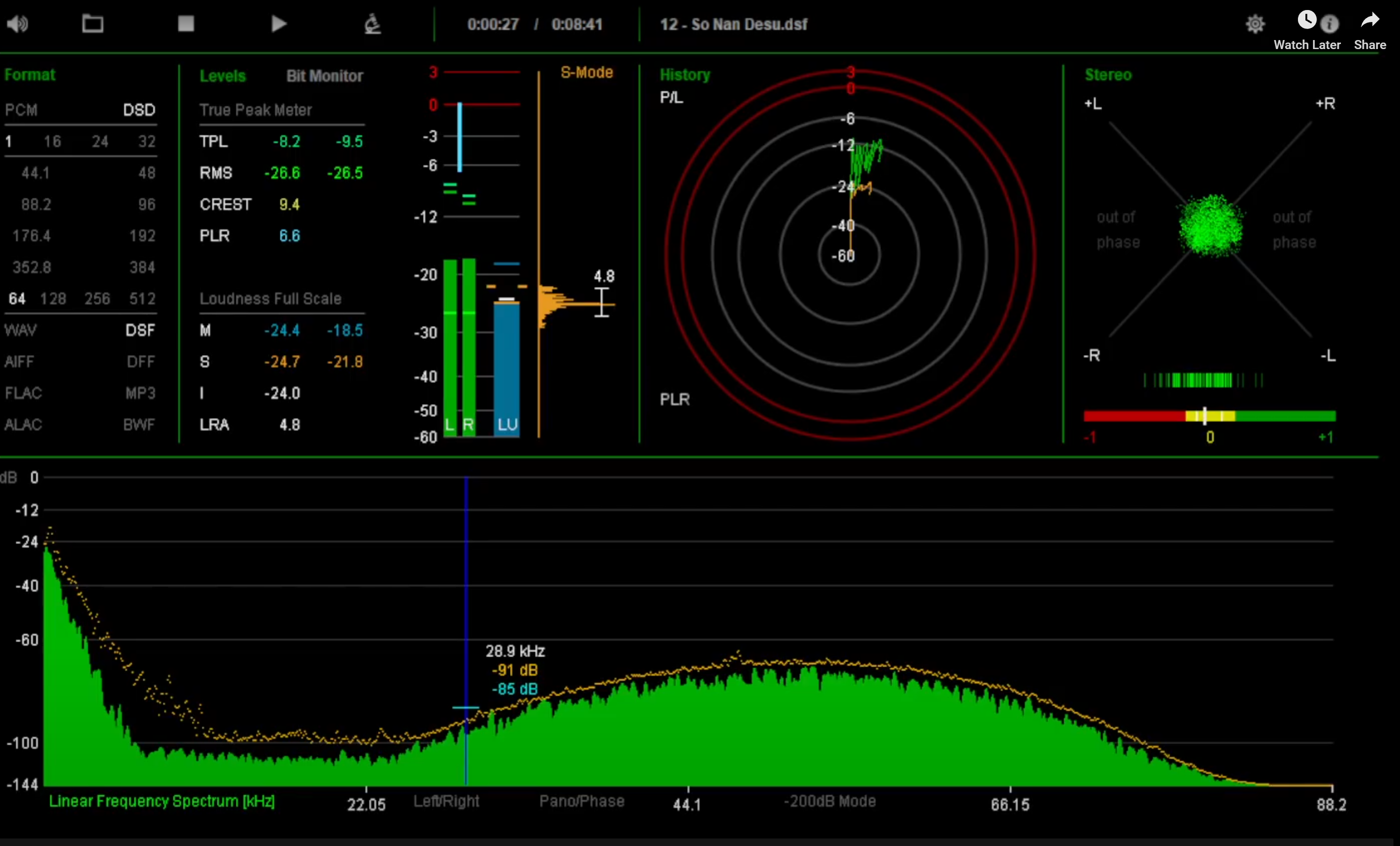
If there was ever good evidence that ultrasonic noise and distortion was of no audible consequence then look at DSD recordings. By definition they are noise shaped and put massive amounts of noise into the ultrasonic area.
Yet many audiophiles swear by DSD and say it is superior in sound quality 😉
That is a truly diabolical creation designed to produce artifacts that reach well below the start of highest audible frequency threshold and have actual negative effects.
With out proper cancellation or cut, 100% rubbish!!
Thank you for remind one of the deadliest audio hype for us.
james dysonwrote:
Hey Alan
Would you be able to post power sweeps of the P801?
I'll do that with mine, sorry for making you to be patient. I know everyone is waiting, and I myself want to see it quickly. But we know that the more we have to hurry, the slower (carefully) we have to go, and I am confident that in the long run, this is faster and the right way.
Sorry for the confusion. I mean my P482 (1ET6525SA).
P801 might be next.
SmartOne_2000wrote:
Maybe it's time to invest in an AP system, Alan :)... Please look into the E1DA Cosmos as a possible choice for your source and analyzer. Designed by an extremely talented engineer (@IVX on ASR and ASR2 and EIDA on Discord) from Eastern Europe even though he lives in China, I believe. It rivals the AP in its accuracy, noise, and distortion specs (THD+N ~ -120dB or better) and is ridiculously cheap (< $300). ADC teardown here.
Alan, I still believe my original question stands. You must have used the same (higher noise/distortion) measuring system to measure the superb online specs as you did to measure the graphs above, correct? My observation is that there is a 15dB - 18dB difference in THD+N specs at 1 KHz at 5W and 100W (4 ohms) between what is posted and what is shown above for the P801. I believe you indicated in an earlier post that the online (official?) specs were typical for the P801. The difference between the official and the ones above is the head-scratcher I'm trying to understand. Please correct me if my observations are wrong. Thanks!
In fact, In the low power range (such as 5 W), even the APx555B(Better than APx525B) already performs worse than the previous generation of finished amplifiers. This is because of the combination of the old 24-bit ADC and the pre-amps. However, since no one in the industry demands more than that, I can't expect AP to upgrade it any time soon, and I have to be relieved that my fight with our APx525B can still be valid for power sweep measurements.
However, it is still quite challenging to measure the characteristics of the amplifier itself, not the load non-linearity, while pumping the maximum output (especially at 2 ohms, entail massive heat) of a high-power product like the P801, so it is quite challenging because it requires a large investment not only in the analyser but also in the test load itself.
As a function generator, the APx555B is clearly a top-notch product, but as an analyser (a combination of automated and calibrated pre-amps and ADCs), it is not, and using other equipment as inputs makes it difficult to fully enjoy the AP’s magical automation.
Consumer products have already surpassed industry standards, something that was never expected in the past. Conversely, even poorly designed products can fool consumers by appearing to work properly to some extent these days. Yet the reality is not so simple and gentle, so testing must be harsher compared to real-world use, and only then can it provide a clue as to the likelihood of guarantee for normal working under milder conditions.
Hi Alan...would it be possible to produce a 5W spectrum plot (similar to the one in the main page) but for RCA outputs with the 29dB gain option?
Secondly, how should one accurately and fairly compare 5W @4R amp specs made at different gains? The P801 gain is at 23dB, others have gains at 25dB - 27dB, even higher and produce their respective SINAD figures. Let's ignore the lower gain amps which produce high SINAD specs.
The P801 measured -110dB THD+N from the plot at 23dB gain (yes, I know its not the true performance of the amplifier due to the noisier source). A competitor might produce -106dB at 27dB gain. Let's assume your P801 amp spec is the reference. Is their a reliable conversion formula relating the 5W @4R SINAD from a 27dB gain amp to your 23dB amp? Maybe something like each increment of 1 dB of gain results in x decrement of noise
In most cases (well for good Purifi based amps) noise is going to be the dominant component in a SINAD measurement. So lets ignore distortion for the moment.
Due to the fact that the noise level of the respective signal generators used by different manufacturers is going to be different, its very difficult to make absolute comparisons and create some kind of definitive "calculator". Also, this noise from the source will skew the result as it will be dominant over the buffers noise when the buffer amplifies it.
One way round this is to make a measurement of the amplifier alone with its input shorted at its different gain settings. It takes the signal generator variable out of the equation and tells you the performance of the buffer which is what you are interested in.
Best of luck trying to get other manufacturers to show you that info 😉.
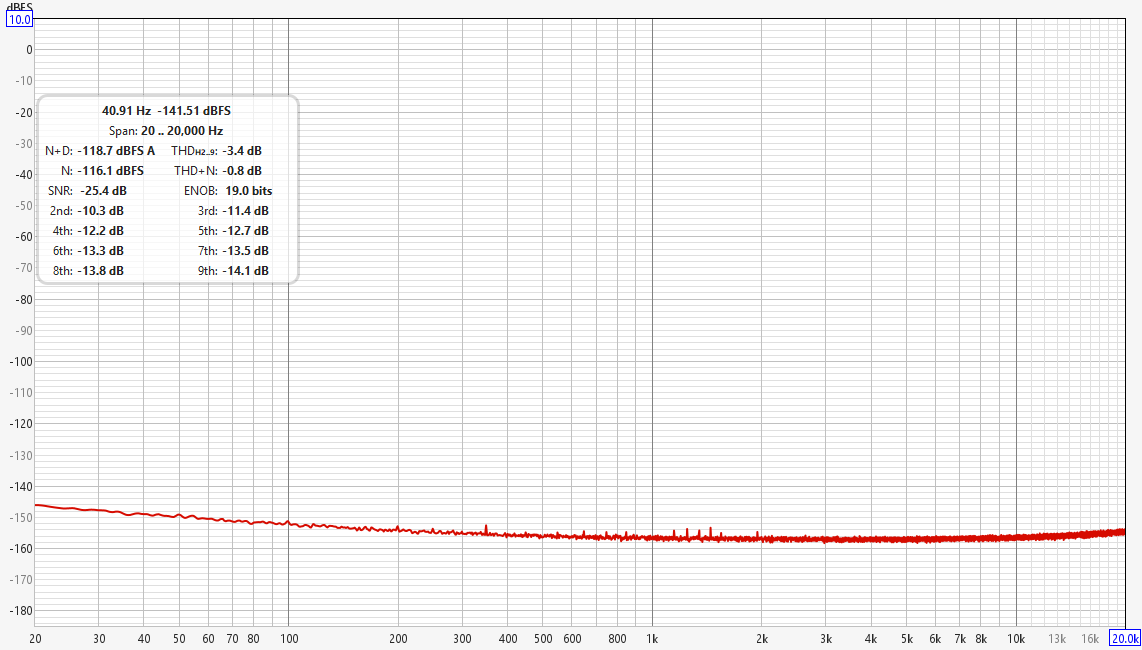
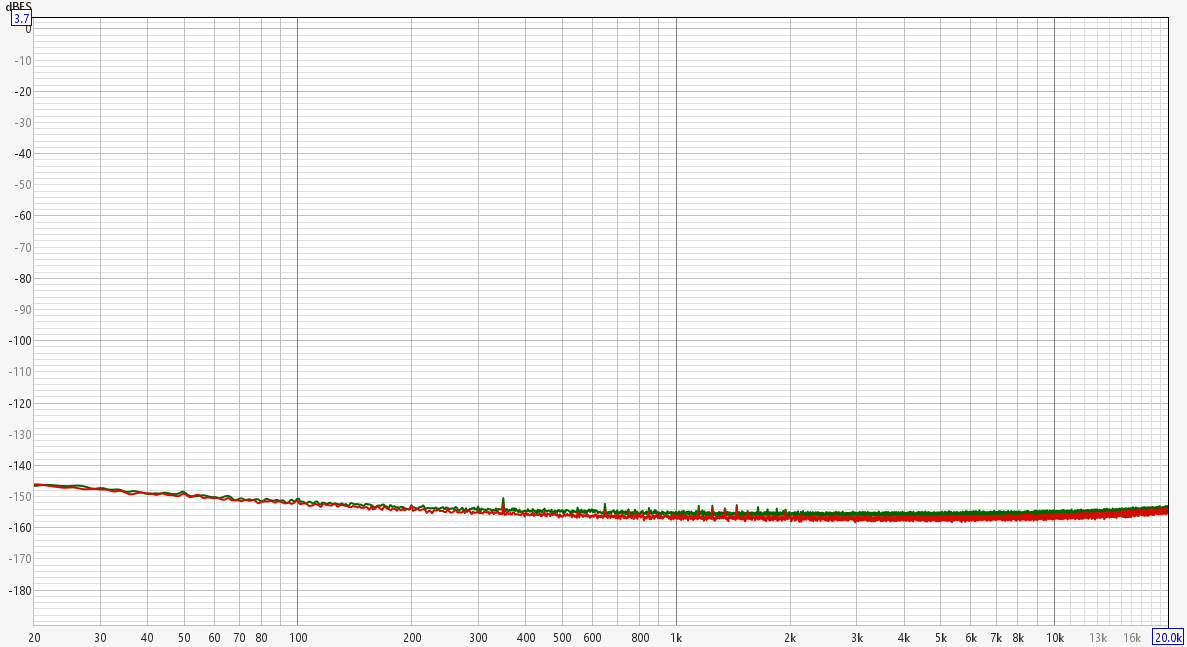
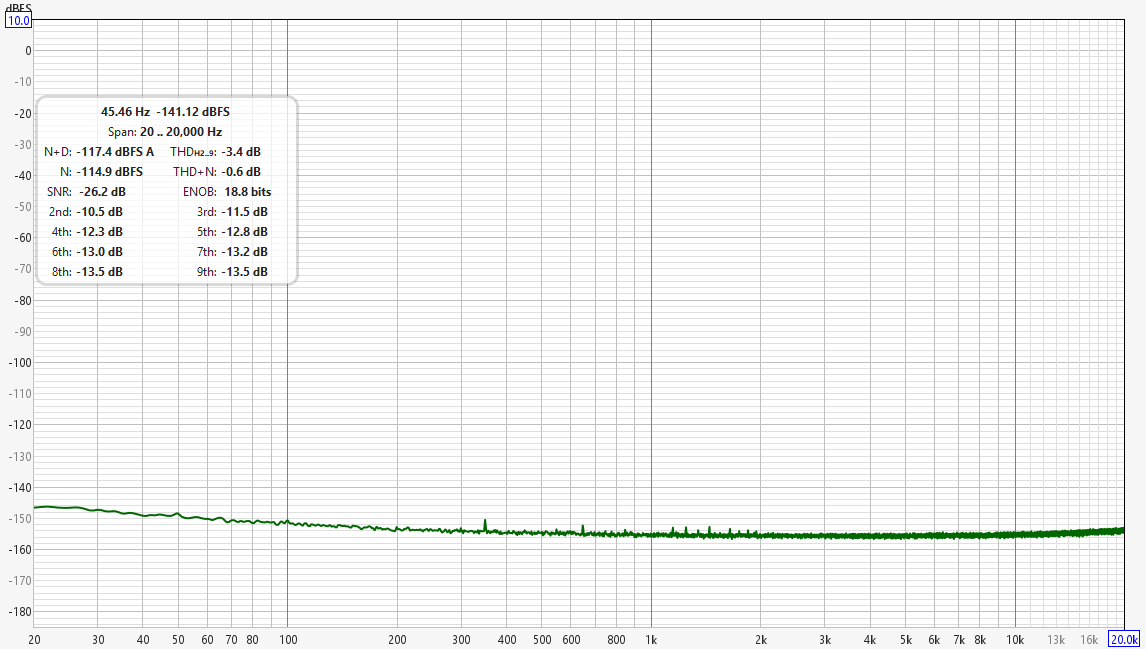
I will try and find time to post the noise floor of the high gain setting.
Bravo Alan ... I appreciate your data-driven responses! It's truly amazing what your "ultra buffer" can do. I expected a 3-4 dB penalty between the two gains. How is it that the buffer noise is not amplified by 6dB??? Visually, the difference in the noise is much less than 1.2dB, which further cements your claims for the SOTA ultra-buffer. I'm honestly stunned! Thank you... I asked a similar question on ASR from a manufacturer and was chastised for it by the manufacturer. I was placed on the 'monitor list' by the admins as a result:sneaky:. Next, will be banned I guess.
Unfortunately, my student budget will not permit me to buy your amps right now...but within a few months, I will be a student no more!:giggle: My financial situation will change and get the P801 I've been drooling over or P482 since their modules have similar performance.
PS
1. As far as noisy sources are concerned, aren't you able to use a Topping D90 or its SE version or even the Cosmos E1DA DAC as source options, since these are ultra-low noise sources? Their measured spectral plots THD+N figures are down to -123dB.
2. What does -140dB to -160dB correspond to in volts or microvolts?
3. Does the almost indistinguishable low noise floor between the low and high gain modes mean the high gain 1 KHz spectral plot will be identical to the low gain plot shown on the main page, with a THD+N of -110dB for both modes? (Source noise notwithstanding). It would be nice to show that graph too and see both low/high gain side by side. I know, maybe making too much work for you...:sneaky:
SmartOne_2000wrote:
Bravo Alan ... I appreciate your data-driven responses! It's truly amazing what your "ultra buffer" can do. I expected a 3-4 dB penalty between the two gains. How is it that the buffer noise is not amplified by 6dB??? Visually, the difference in the noise is much less than 1.2dB, which further cements your claims for the SOTA ultra-buffer. I'm honestly stunned! Thank you... I asked a similar question on ASR from a manufacturer and was chastised for it by the manufacturer. I was placed on the 'monitor list' by the admins as a result:sneaky:. Next, will be banned I guess.
Unfortunately, my student budget will not permit me to buy your amps right now...but within a few months, I will be a student no more!:giggle: My financial situation will change and get the P801 I've been drooling over or P482 since their modules have similar performance.
PS
1. As far as noisy sources are concerned, aren't you able to use a Topping D90 or its SE version or even the Cosmos E1DA DAC as source options, since these are ultra-low noise sources? Their measured spectral plots THD+N figures are down to -123dB.
2. What does -140dB to -160dB correspond to in volts or microvolts?
3. Does the almost indistinguishable low noise floor between the low and high gain modes mean the high gain 1 KHz spectral plot will be identical to the low gain plot shown on the main page, with a THD+N of -110dB for both modes? (Source noise notwithstanding). It would be nice to show that graph too and see both low/high gain side by side. I know, maybe making too much work for you...:sneaky:
Thats one additional reason why Audio Science Review is a joke. It is biased. Certain manufacturers are promoted and protected, others attacked. Its not just the particular member fan boys, its also the moderators and Amir. You can quickly ascertain the technical knowledge and capabilities of the manufacturers (and the relative performance of their products) if they deflect, refuse to answer questions or provide test data. Remember some of them (not all, one knows what he's doing😉) are just throwing off the shelf modules in cheap boxes.
The noise doesnt increase by 6dB because the buffer isnt amplifying an external input. Shorting the input (almost) provides a noiseless source.So what you see is the "internal" noise of the buffer (plus the Purifi module and its gain) which has numerous sources, not all at the front end and not correlated.
1. Topping D90 and the like are all very low noise DACs, but not low enough. Their 20Hz to 20kHz noise figures are around 1uV. Yes thats low, but then you amplify it by 23dB! That equals 14uV. Guess what, that calculates out at -110dB when referenced to 4.475v (5 watts into 4 ohms).
Hence you would need a source with noise lower than 0.4uV to accurately assess the noise performance of an amp with 23dB gain.
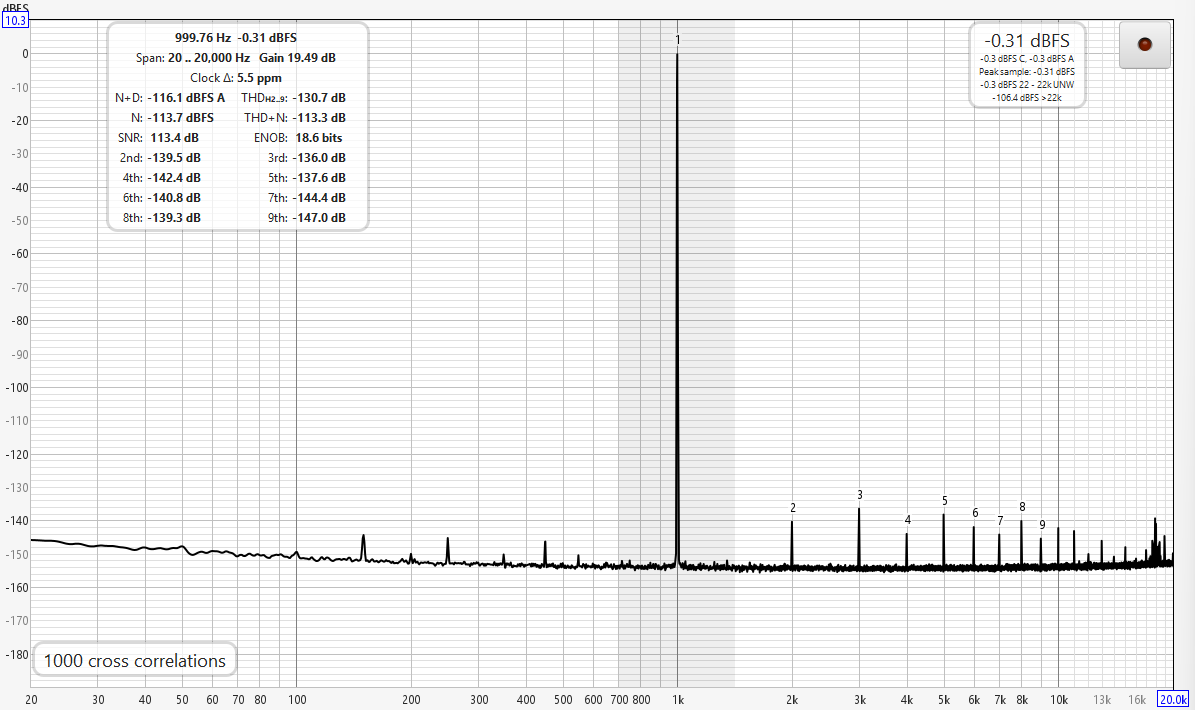
2. You are looking at the FFT noise floor which is not the 20Hz to 20kHz overall noise figure. As discussed in previous posts, this figure will be dependant on the FFT resolution and FFT gain. That was a 128k point FFT. That means you are looking at the noise in a very small part of the spectrum, only 0.015Hz wide (ignoring windowing). Noise is not at one frequency, it is spread across the whole bandwidth. If you were discussing a sine wave signal just at one frequency it would equate to 0.44uV at -140dB and 0.044uV at -160dB.
3. No, the noise would increase, reducing the THD+N figure with the 29dB gain as you are amplifying the noise from the source.
I appreciate the thoughtful answers. Thanks! Care to give a rough figure of what the THDN will be in the 29dB gain mode, using your current sources?
Also, you mentioned earlier that you had an RFI filter at the inputs. Since it's made of reactive components, what does the input impedance with frequency curve look like? Mostly, interested in min/max values over the 20kHz bandwidth. Thanks again!
Alan Marchwrote:
random amp at 23dB. N=-111.4dB
261
29dB. N=-106.7dB
260
Difference 4.7dB.
The impedance is something I would have to check. The RF filter shouldnt be impinging on the audio band in a significant way.
What is the concern there?
My old tube (valve) preamp unfortunately has rather high output impedance (~ up to 1 kohm) and not sure if it can handle low impedance loads of 5K or under. My former amp had a 100K input impedance so it was a non issue.
Excellent numbers before and after the source fix, imho. Are the new numbers also 2dB better (-108.7dB) for high gain after the fix?
SmartOne_2000wrote:
My old tube (valve) preamp unfortunately has rather high output impedance (~ up to 1 kohm) and not sure if it can handle low impedance loads of 5K or under. My former amp had a 100K input impedance so it was a non issue.
Excellent numbers before and after the source fix, imho. Are the new numbers also 2dB better (-108.7dB) for high gain after the fix?
I wasnt happy with the results above (edit: now removed to avoid confusion). I had recently made improvements to the noise levels in our signal generator and these seem to have disapeared. After a bit of investigation I found a problem. Fixed now.
Had to deal with something else last night so didnt finish. Re-ran the tests this morning.
23dB gain. N= -113.7dB
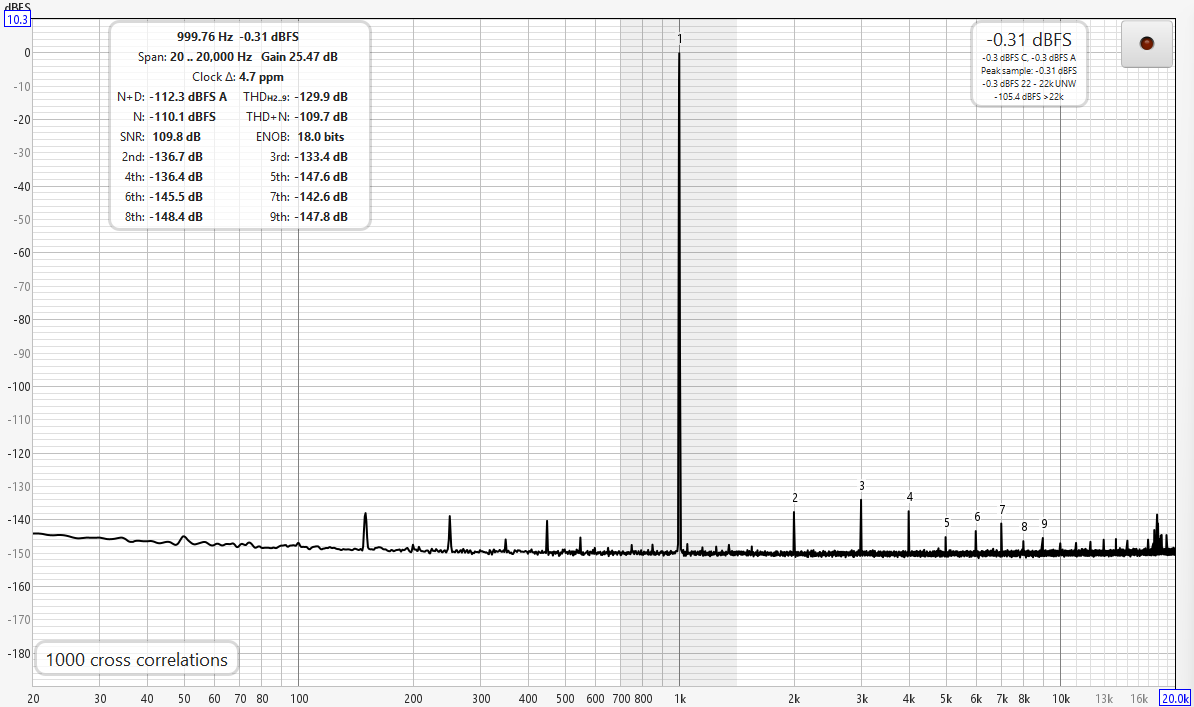
29dB gain. N= -110.1dB
Difference 3.6dB
So as you can see, the more we reduce the noise from the source, the closer we come to the stated specification figure of 115/116dB THD+N (SINAD).
So if you want to know how well a competitors input buffer is performing you will need to convince them to measure the noise with the input shorted (at their different gain levels) then add (dB addition) this number to the THD figure measured at those different gains. I'll wager they wont do it 😉 .
Regarding the input impedance, I will check. As mentioned the design of the filter should not impinge on the audible band, in which case 20k shouldnt cause any issues. We have many customers using tube pre amps without issue. However, I have to say that my view is that we should not compromise the design to suit a small number of tube pre amps that have deficient output drive capabilities. Low input impedance is a non issue for any (competent) solid state design source.