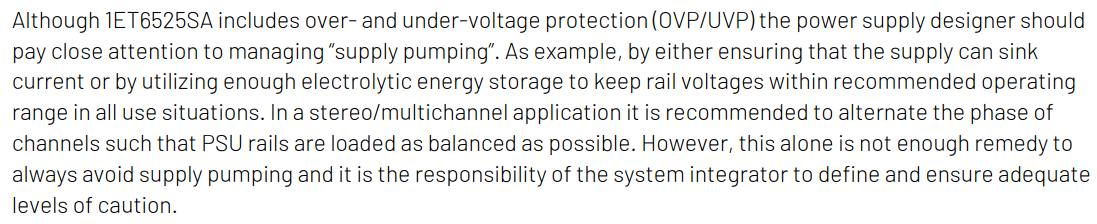
@Alan ... Purify recommends the following, regarding the 1ET6525 module:
1. I know it may not be needed for the P801(?) but is the P482 also running out of phase, which is corrected in phase in the end?
2. Can you ground the - output terminal of the P801 or on the speaker end or is it a fully differential output?
3. Is your Ultra buffer a composite amplifier or not?
SmartOne_2000wrote:
@Alan ... Purify recommends the following, regarding the 1ET6525 module:
1. I know it may not be needed for the P801(?) but is the P482 also running out of phase, which is corrected in phase in the end?
2. Can you ground the - output terminal of the P801 or on the speaker end or is it a fully differential output?
3. Is your Ultra buffer a composite amplifier or not?
1. No. Our PSU doesn't suffer bus pumping.
2. No. Differential.
3. Sorry we dont discuss design detail 😉
Alan Marchwrote:
1. No. Our PSU doesn't suffer bus pumping.
2. No. Differential.
3. Sorry we dont discuss design detail 😉
1. Though Purifi used out-of-phase wiring to avoid bus pumping issues, this technique is popular in standard linear amplifiers which don't suffer from bus pumping issues, to balance current loads on the +ve and -ve power rails.
2. Ok, cannot ground the -ve terminal because the amp treats the speaker as a differential load, right?
SmartOne_2000wrote:
1. Though Purifi used out-of-phase wiring to avoid bus pumping issues, this technique is popular in standard linear amplifiers which don't suffer from bus pumping issues, to balance current loads on the +ve and -ve power rails.
2. Ok, cannot ground the -ve terminal because the amp treats the speaker as a differential load, right?
Alan Marchwrote:
1. Linear amps with unregulated PSUs.
2. Yep
Ok, but if both left/right channels are in phase (as is in most amplifier designs) and use the same power rails all the time, those rails could be drained of needed current when a powerful transient occurs. Make them out of phase, and then the current draw requirements are shared by both positive and negative rails simultaneously, reducing stress on each rail and chances of clipping.
If that were the case (to be clear its not) it could not drive both channels to max power on a bench test. The PSU has plenty of capacity. It's over sized for the task.
Running OOP is only required if you have a PSU that suffers bus pumping, and/or has poor/no voltage regulation and/or has inadequate output capacitance.
Alan Marchwrote:
If that were the case (to be clear its not) it could not drive both channels to max power on a bench test. The PSU has plenty of capacity. It's over sized for the task.
Running OOP is only required if you have a PSU that suffers bus pumping, and/or has poor/no voltage regulation and/or has inadequate output capacitance.
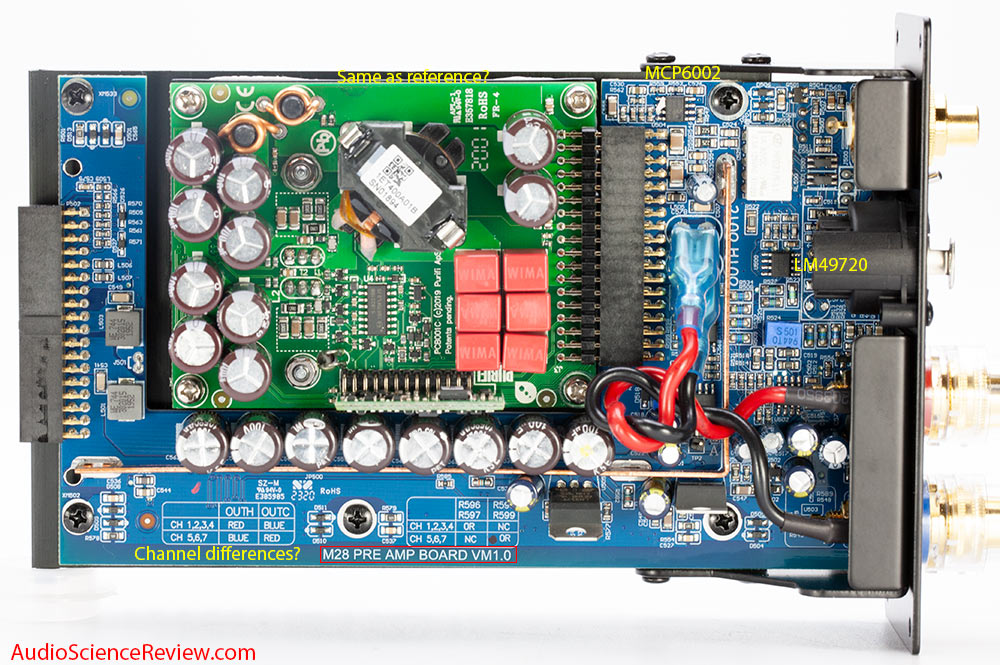
In the ASR teardown for the NAD M28, a 7-channel amplifier, they had a few channels (5,6,7) OOP with the main channels (1,2,3,4) per the silkscreen on its modules.
SmartOne_2000wrote:
In the ASR teardown for the NAD M28, a 7-channel amplifier, they had a few channels (5,6,7) OOP with the main channels (1,2,3,4) per the silkscreen on its modules.
Not surprised as it will be trying to make the most of the limited PSU capacity. 1600 watts is only 230 watts per channel if all driven.
Alan Marchwrote:
Not surprised as it will be trying to make the most of the limited PSU capacity. 1600 watts is only 230 watts per channel if all driven.
Still that's plenty loud in a HT system. Do you plan on making multichannel amplifiers using the 1ET6525 modules as carrier boards, similar to the NAD design? I think this may be the next frontier for you and will look good in your boxes.
SmartOne_2000wrote:
Still that's plenty loud in a HT system. Do you plan on making multichannel amplifiers using the 1ET6525 modules as carrier boards, similar to the NAD design? I think this may be the next frontier for you and will look good in your boxes.
Some would disagree with that. Very much depends on the speakers, application, room size etc. Also, with all channels driven it has no capability to scale into lower impedances. The PSU is way too small, but that's all you can do with a US 110v 15 amp single supply.
There are many compromises in the NAD design, just look at the SINAD. Very average.
SmartOne_2000wrote:
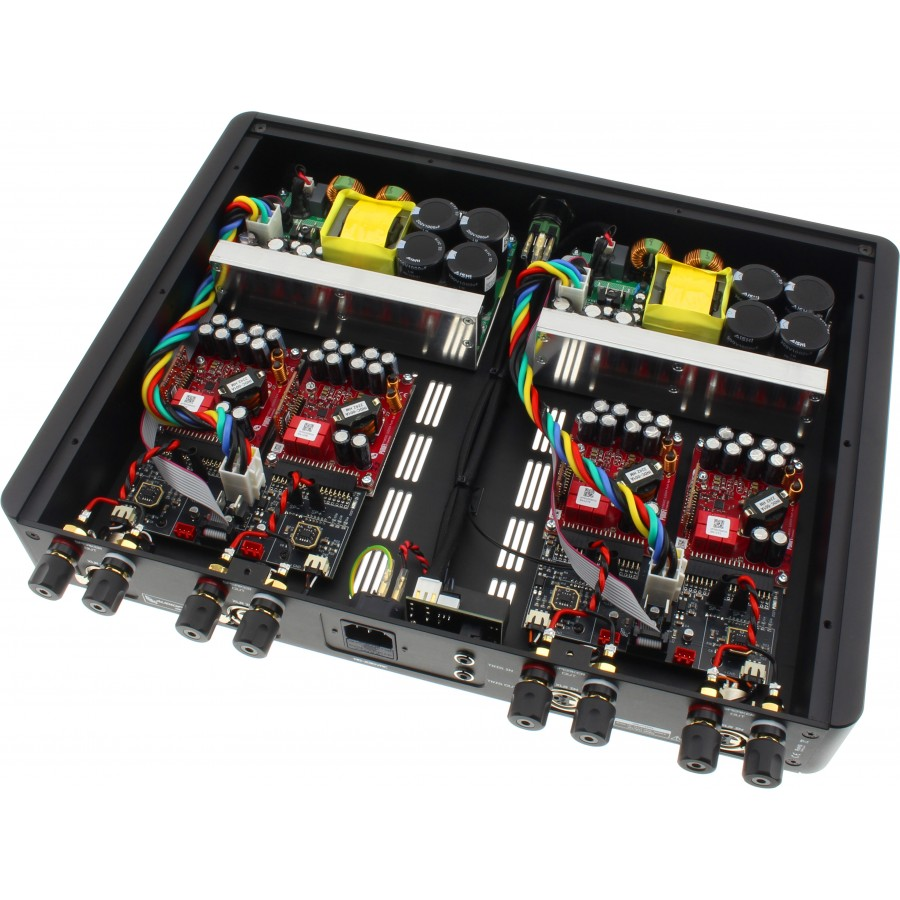
Maybe another possible MCh design option could be like the one below from Audiophonics (1ET6525SA-based):
Yep, another design that will have limited power output in 110v territories.
It won't do 450w x4 into 4 ohms as claimed let alone 510watts x4 into 2 ohms. A single US mains socket/lead won't handle that.
510 watts x4 = 2040watts. Add on to this efficiency losses of the PSU and amp module you will need more like 2200 watts from the mains. At 110v supply that's 20amps. That's way beyond the current rating of the IEC socket, a standard IEC mains cable and US power socket.
Even at 4 ohms it would exceed the ratings of the socket, cable etc at about 18 amps.
So if the IEC socket was correctly fused for its capability, the fuse would blow when approaching full power. If fused incorrectly to attempt to get to full power, the iec socket might well overheat.
So, allowing the amp to operate without power restriction is a non starter. You would need to lower the PSU output voltage to restrict potential power output. With 4 channels driven that's about 380 watts/ channel into 4 ohms with no attitude to increase into 2 ohms. If you rate for 2 ohms you would have to drop the psu voltage enough to limit the 4 ohm power to 190 watts.
What this means is for the 6525 modules you are realistically limited to 3 channels if you want to use them to their full capability.
It's very concerning that some manufacturers don't seem to understand these basics.
Alan Marchwrote:
Yep, another design that will have limited power output in 110v territories.
It won't do 450w x4 into 4 ohms as claimed let alone 510watts x4 into 2 ohms. A single US mains socket/lead won't handle that.
510 watts x4 = 2040watts. Add on to this efficiency losses of the PSU and amp module you will need more like 2200 watts from the mains. At 110v supply that's 20amps. That's way beyond the current rating of the IEC socket, a standard IEC mains cable and US power socket.
Even at 4 ohms it would exceed the ratings of the socket, cable etc at about 18 amps.
So if the IEC socket was correctly fused for its capability, the fuse would blow when approaching full power. If fused incorrectly to attempt to get to full power, the iec socket might well overheat.
So, allowing the amp to operate without power restriction is a non starter. You would need to lower the PSU output voltage to restrict potential power output. With 4 channels driven that's about 380 watts/ channel into 4 ohms with no attitude to increase into 2 ohms. If you rate for 2 ohms you would have to drop the psu voltage enough to limit the 4 ohm power to 190 watts.
What this means is for the 6525 modules you are realistically limited to 3 channels if you want to use them to their full capability.
It's very concerning that some manufacturers don't seem to understand these basics.
Thanks for the analysis, Alan ... so is it safe to say that your future MCH amplifiers for 110v territories will have none of the issues you've brought up here? How many channels are you looking at?
As an aside, since the stated power ratings for the Purifi modules will come into play when playing peak transients, while also these US sockets are allowed to exceed their 15A rating to 20A or more for some few seconds, won't these MCH amps meet their specs for these brief time intervals?
SmartOne_2000wrote:
Thanks for the analysis, Alan ... so is it safe to say that your future MCH amplifiers for 110v territories will have none of the issues you've brought up here? How many channels are you looking at?
As an aside, since the stated power ratings for the Purifi modules will come into play when playing peak transients, while also these US sockets are allowed to exceed their 15A rating to 20A or more for some few seconds, won't these MCH amps meet their specs for these brief time intervals?
If we did decide to make a multi channel amp we wouldnt be making false claims about its power capabilities.
How long is it safe to exceed the rated current capability of the iec mains socket or mains cable by 33%? How many times exceeding this, or how long can you do that for before a correctly rated integral fuse blows?