SmartOne_2000wrote:
Nice ... really nice. Thank you. Care to offer an explanation for the hump beyond 100W for the 2 ohms load (not that it matters much)?
Also, the Purifi datasheets show the lowest distortion between -120dB and -130 dB for the 2, 4, and 8-ohm loads vs the -105dB to -110dB shown in the graphs above. Is that because it was tested at the lowest default gain of 14.4dB and the additional noise gain (9dB ?) from the buffer contributed to what we see above?
Finally, looking at the 4 ohm load plot at 1 kHz, its 100W THD+N is about -109dB but the published specs say -123 dB. Can you help explain the difference? If I'm mistaken, please let me know.
Thanks for volunteering these graphs. I'm quite sure they took a long time to generate and on a Sunday at that!
Yes the buffer and additional gain will increase the noise and distortion over the measurements of the module in a stand alone configuration with an oversized PSU as tested and shown in the Purifi datasheets.
However a major impact is the measurement system. Our system is not ideal in terms of noise and distortion when on the very high input range required to measure these high power levels.
These plots are more for indicating the max power output where distortion of the amp is the dominant factor.
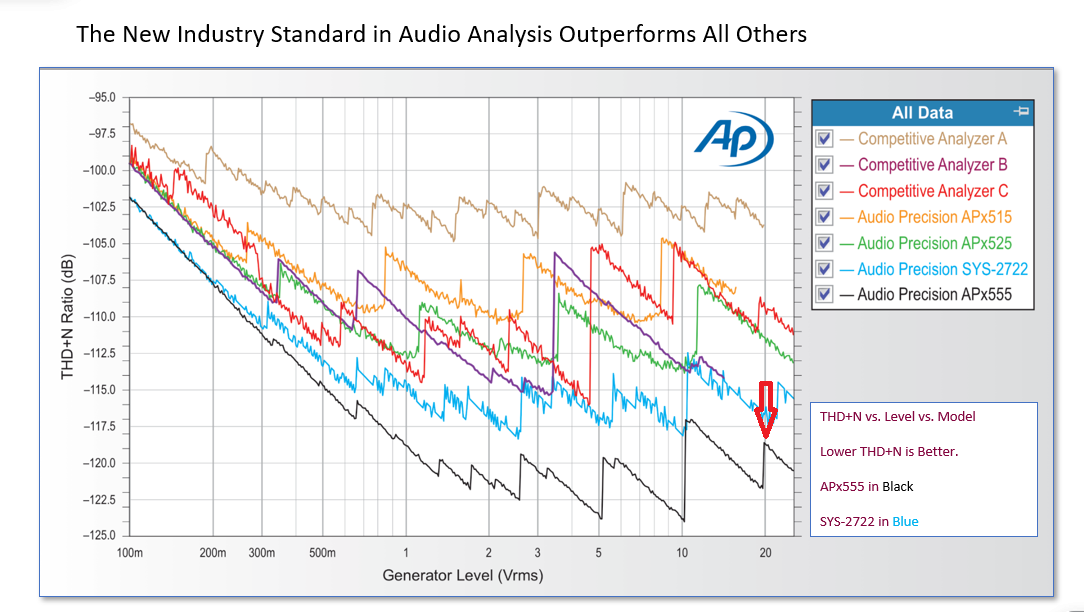
An AP555 would indicate better thd+N through out the power range until you hit the knee.
Alan Marchwrote:
Revel don't publish any long term power handling figures for the salon2, so it's difficult to estimate what their power handling really is. However Im sure 750 watts will exceed your requirements.
BTW I used the 4 ohm power rating for the P801 (750 watts) as the impedance of the salon 2 is around 4 ohms throughout the frequency range where most power is required.
241
Based on that information, this would remove the need to biamp the Salon2. Just run the P801 bridged mono.
Would bridging the 2 monoblocm p801 for the bass speaker terminals and running one p482 for the mid/high terminals give me any benefits sonically? Protection of the tweeter? Hate to spend USD$1K to replace a blown tweeter.
luvchampagnewrote:
Based on that information, this would remove the need to biamp the Salon2. Just run the P801 bridged mono.
Would bridging the 2 monoblocm p801 for the bass speaker terminals and running one p482 for the mid/high terminals give me any benefits sonically? Protection of the tweeter? Hate to spend USD$1K to replace a blown tweeter.
Thank you
The p801 is already a bridged design internally. To be honest, I think you may be over estimating the power handling capability of the salon2. The P801 will deliver transients of around 1100watts into that load. I would be surprised if this didn't make the drivers laterally hit their end stops at low frequencies (excursion increases dramatically with low frequencies).
You may want to email Revel for further advice on power handling.
My experience is that bi amping is only of small benefit, so I would suggest the following:
We have a 14 day satisfaction guarantee, so you can try out a pair of P801 amps and see how you get on. If they don't go loud enough, or you find they are just not for you, then they can be returned for a refund.
BTW we are very proud to say that we have never had anyone return an amp 😀.
If you like them, then of course you could explore biamping to see if it adds improvements. We would still honour the satisfaction guarantee if you tried an additional P482 for the mids/tweeter but found it didn't make a worthwhile improvement.
As a general comment, the best protection for tweeters is common sense. If the sound is becoming strained or overtly distorted, then turn the volume down 😀. To an experienced audiophile with good kit, a scenario where the tweeter could become damaged through overdriving the amp or speaker should be obviously audible.
Otherwise the amplifier does also have comprehensive protection systems that instantly shut it down in the case any abnormal conditions are experienced. Here is a video of the speaker cables being shorted at max output.
Alan Marchwrote:
Yes the buffer and additional gain will increase the noise and distortion over the measurements of the module in a stand alone configuration with an oversized PSU as tested and shown in the Purifi datasheets.
However a major impact is the measurement system. Our system is not ideal in terms of noise and distortion when on the very high input range required to measure these high power levels.
These plots are more for indicating the max power output where distortion of the amp is the dominant factor.
An AP555 would indicate better thd+N through out the power range until you hit the knee.
Maybe it's time to invest in an AP system, Alan :)... Please look into the E1DA Cosmos as a possible choice for your source and analyzer. Designed by an extremely talented engineer (@IVX on ASR and ASR2 and EIDA on Discord) from Eastern Europe even though he lives in China, I believe. It rivals the AP in its accuracy, noise, and distortion specs (THD+N ~ -120dB or better) and is ridiculously cheap (< $300). ADC teardown here.
Alan, I still believe my original question stands. You must have used the same (higher noise/distortion) measuring system to measure the superb online specs as you did to measure the graphs above, correct? My observation is that there is a 15dB - 18dB difference in THD+N specs at 1 KHz at 5W and 100W (4 ohms) between what is posted and what is shown above for the P801. I believe you indicated in an earlier post that the online (official?) specs were typical for the P801. The difference between the official and the ones above is the head-scratcher I'm trying to understand. Please correct me if my observations are wrong. Thanks!
SmartOne_2000wrote:
Maybe it's time to invest in an AP system, Alan :)... Please look into the E1DA Cosmos as a possible choice for your source and analyzer. Designed by an extremely talented engineer (@IVX on ASR and ASR2 and EIDA on Discord) from Eastern Europe even though he lives in China, I believe. It rivals the AP in its accuracy, noise, and distortion specs (THD+N ~ -120dB or better) and is ridiculously cheap (< $300). ADC teardown here.
Alan, I still believe my original question stands. You must have used the same (higher noise/distortion) measuring system to measure the superb online specs as you did to measure the graphs above, correct? My observation is that there is a 15dB - 18dB difference in THD+N specs at 1 KHz at 5W and 100W (4 ohms) between what is posted and what is shown above for the P801. I believe you indicated in an earlier post that the online (official?) specs were typical for the P801. The difference between the official and the ones above is the head-scratcher I'm trying to understand. Please correct me if my observations are wrong. Thanks!
Not at the price it is. Very bad value for money. We do have a Cosmos here. It's input range is 10 volt Max and 43volt max on the less performant high range input. You need about 60 volts to test the P801 to full power. It's very good as a straight ADC, but it's not a complete measurement system. We are looking at other options. I suspect I am going to have to design my own input front end
On our current system the power sweep is run on a single high input range. It doesn't automatically range as the AP555 does to optimise noise and distortion for the current input voltage. We use different techniques, such as described for the 5 watt measurement at the start of the thread to account for the measurement system in the published spec.
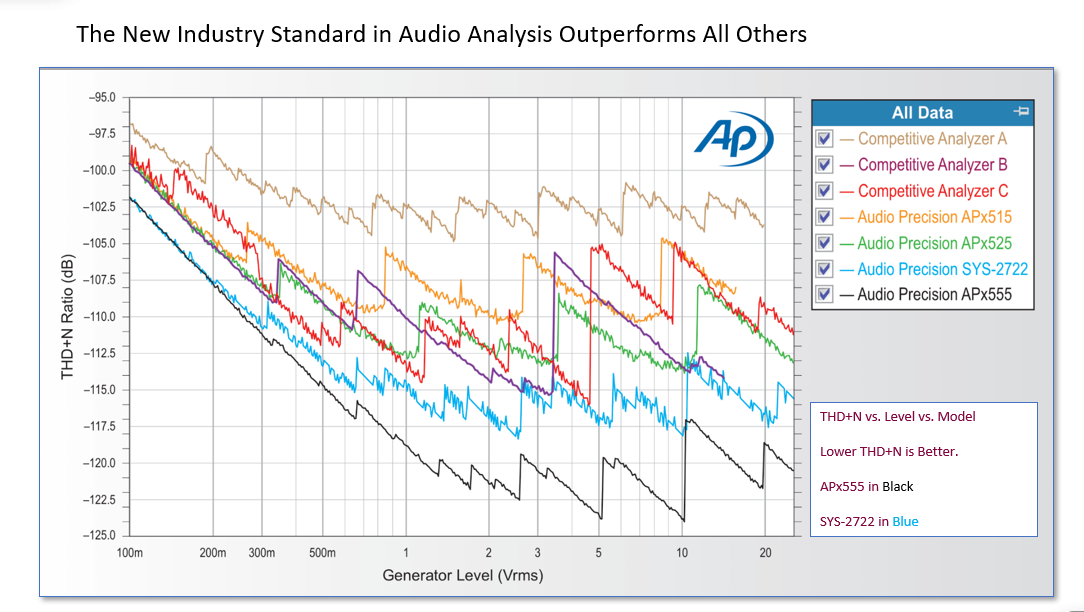
For info AP555 range changing and its effect on SNR. The sudden steps are a range change. 6dB difference if you are on the wrong range.
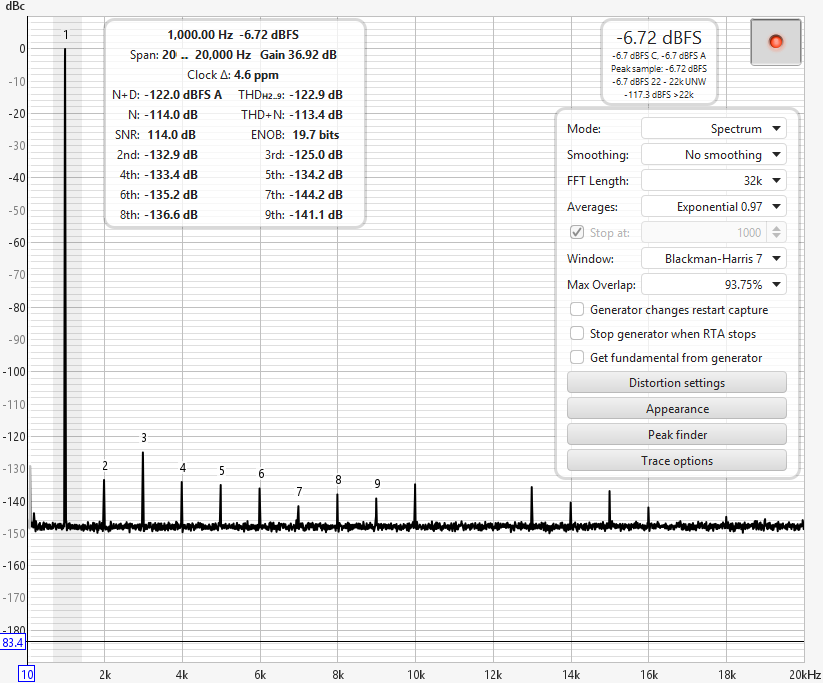
Hi @SmartOne_2000 Just for info I performed a quick and dirty test at 100 watts into 4 ohms using the cosmos on its 43v input. Same amp.
This shows about 7dB better THD+N than the sweep measurement. When trying to get very accurate measurements at extremely low THD and N is challenging. As mentioned, noise is usually the limiting factor in the measurement. THD above is -123dB, whilst noise is only -114dB.
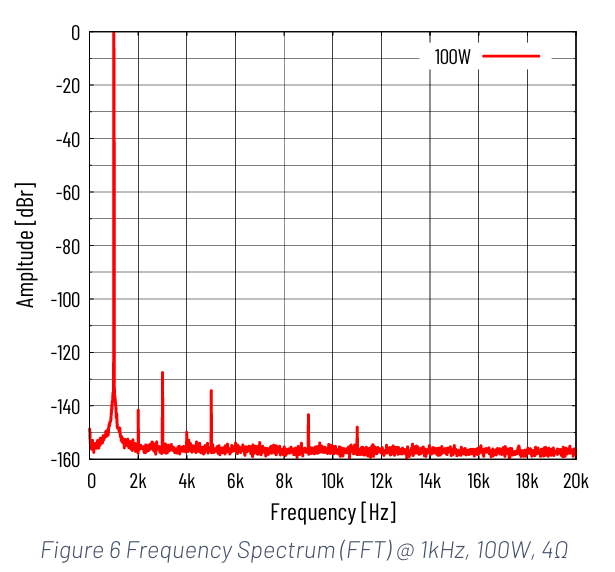
For comparison here is the Purifi data for the 9040 module stand alone without input buffer.
The THD from the visible harmonics adds up to about -126dB, so we are not far behind. The datasheet says THD+N is -124.5dB. So we can calculate that the noise component must be about -129dB.
As mentioned above, you cant compare the relative level of the noise floor line in the plots. This is dependant on the FFT resolution. I used a low 32k resolution on this plot. We have no idea what Purifi used.
When using a highly optimised 5 volt range we can achieve low noise levels that are comparable to an AP555, but we cant acheive that at the higher levels necessary to do 750 watt power sweep. I am looking at ways to cost effectively achieve this and have a number of ideas 😉
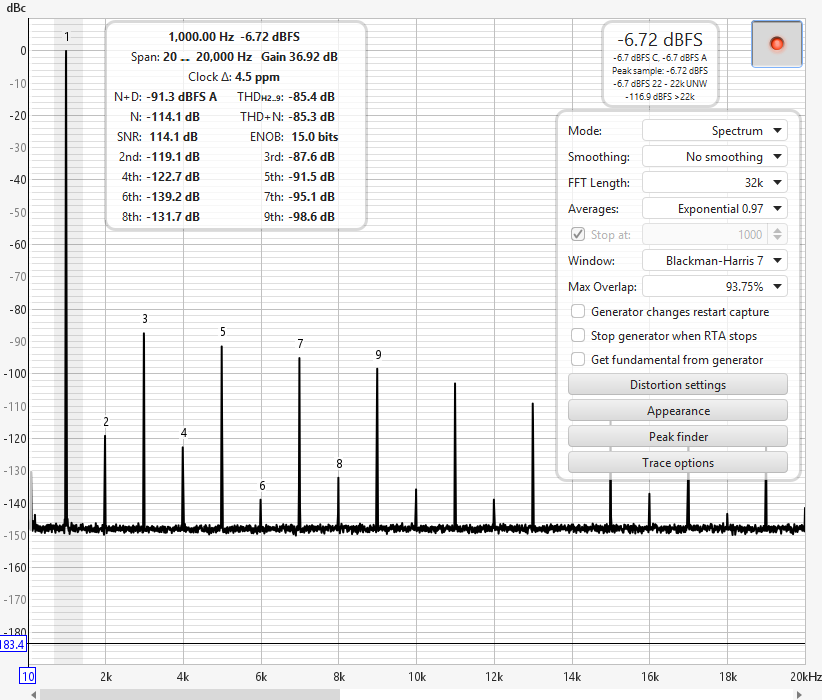
Another thing to consider is the effect of the load resistors. These can have a massive effect on THD levels. We have use different resistor type for low power and high power testing.
This is an example of how a bad load resistor (typical wirewound power resistor) can affect the data. Same conditions as above.
So there are a lot of variables. As such please dont read to much into the power sweeps shown above other than an indication of full power output.
.
Thanks for letting us know not to read too much into the distortion numbers shown in the power sweeps. They simply indicate the maximum power available from an amplifier. And all the best to you in designing your own "AP" system. That would be great! Yeah, the > USD 55K price of the APx555 is simply ridiculous, and I hope you give them a run for their money!
How were you able to measure these superb very low noise numbers listed on the main page for the P801?
The 9040 module alone has a datasheet noise spec below:
THD + N – 0.00006% / -124.4dB @ 100 Watts, 4 Ohms, F=1kHz (measured on an AP system since they used a 20kHz AP filter)
So this means the buffer (+whatever) only adds a noise/distortion penalty of about 2.5 dB. Correct?
Not trying to give you a hard time 🙂 but simply trying to reconcile the two THD+N readings of -122dB (main page) and the newer -113.4dB (but is lower in real life due to instrumental noise limitations as indicated at the start of this forum) measured with the Cosmos system at 100W.
It seems this latter spec is more in line with the 5W measurements listed on the main page. What am I missing?
Thanks for the "keeps coming back" awards as well😂...some would view me as a pest that needs to be swatted!
I just seem to find your site fascinating, that's all...
SmartOne_2000wrote:
Thanks for letting us know not to read too much into the distortion numbers shown in the power sweeps. They simply indicate the maximum power available from an amplifier. And all the best to you in designing your own "AP" system. That would be great! Yeah, the > USD 55K price of the APx555 is simply ridiculous, and I hope you give them a run for their money!
How were you able to measure these superb very low noise numbers listed on the main page for the P801?
The 9040 module alone has a datasheet noise spec below:
THD + N – 0.00006% / -124.4dB @ 100 Watts, 4 Ohms, F=1kHz (measured on an AP system since they used a 20kHz AP filter)
So this means the buffer (+whatever) only adds a noise/distortion penalty of about 2.5 dB. Correct?
Not trying to give you a hard time 🙂 but simply trying to reconcile the two THD+N readings of -122dB (main page) and the newer -113.4dB (but is lower in real life due to instrumental noise limitations as indicated at the start of this forum) measured with the Cosmos system at 100W.
It seems this latter spec is more in line with the 5W measurements listed on the main page. What am I missing?
Thanks again Alan, for being patient!
As I said, it's doing similar process to measuring the 5 watt looking at the noise floor separately. You have to do a few more things, but don't want to give that away 😉
Alan Marchwrote:
As I said, it's doing similar process to measuring the 5 watt looking at the noise floor separately. You have to do a few more things, but don't want to give that away 😉
Fair enough ... so if it was measured on an APx555 system or some high-end audio analyzer with super low noise/distortion, the published numbers bear out?
SmartOne_2000wrote:
Fair enough ... so if it was measured on an APx555 system or some high-end audio analyzer with super low noise/distortion, the published numbers bear out?
Yep...well.... sort of....probably not 🙂 . Don't forget that you are also at/beyond the limits of the AP555.
100 watts into 4 ohms is a signal level of 20 volts. At this level the AP555 only manages a THD+N of -119dB!
So its a problem even with the best analysers and you have to get inventive with the techniques.
As an aside from this, the SINAD figures you see on those DAC measurements on ASR are all coming out at around123dB simply because of this limitation. Amir is measuring the performance of the AP555, not the DACs ;).
.
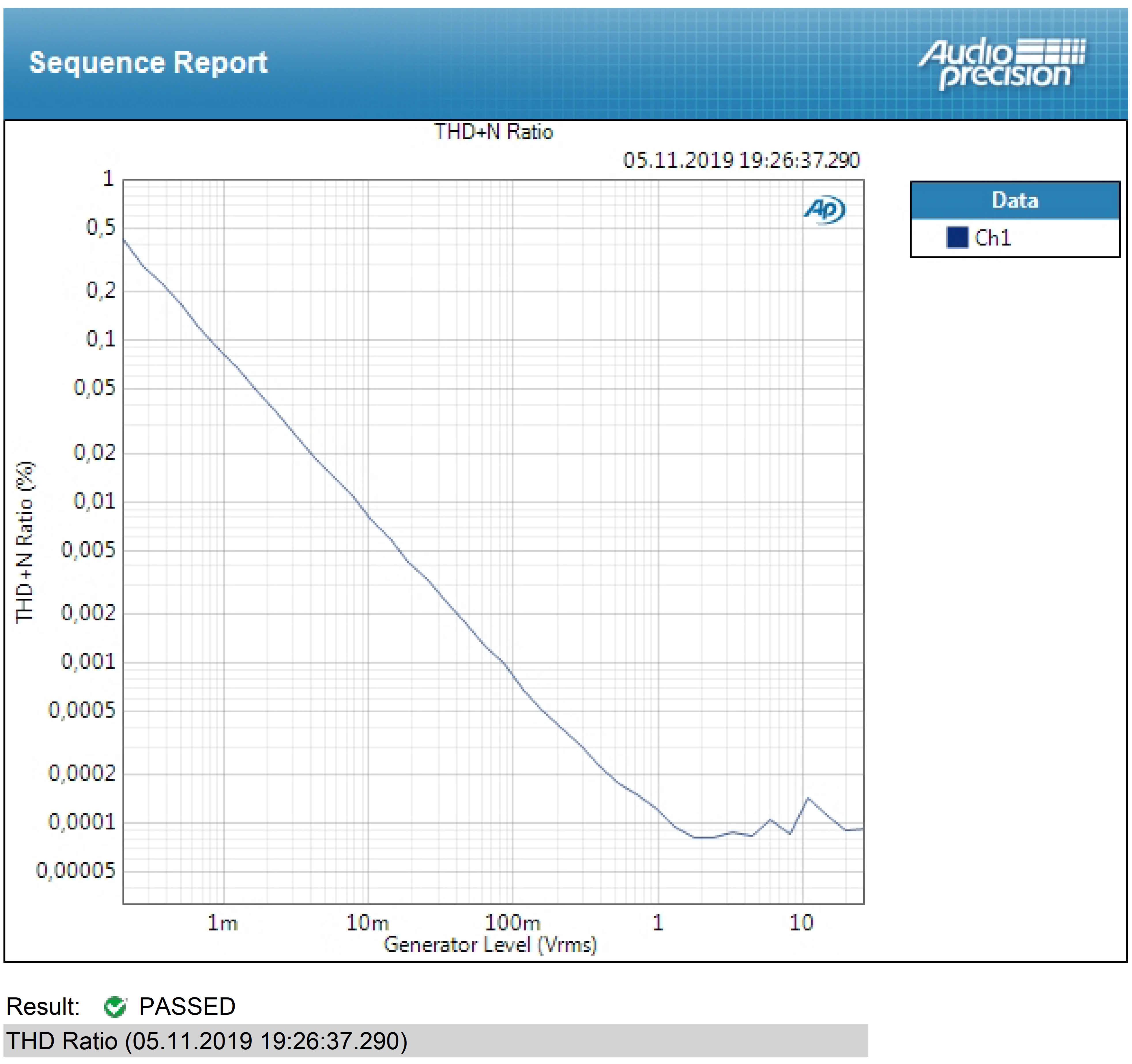
Oh wow...ok, didn't take that into account the possible limitations within the AP system. BTW, I know that AP system specs are not consistent. The posted graph above shows a -119dB THD+N. Others read differently, like the one below at better than -120dB. So, it's a crap shoot of sorts. You get what you get.
Alan Marchwrote:
Yep...well.... sort of....probably not 🙂 . Don't forget that you are also at/beyond the limits of the AP555.
100 watts into 4 ohms is a signal level of 20 volts. At this level the AP555 only manages a THD+N of -119dB!
So its a problem even with the best known analyser and you have to get inventive with the techniques.
As an aside from this, the SINAD figures you see on those DAC measurements on ASR are all coming out at around123dB simply because of this limitation. Amir is measuring the performance of the AP555, not the DACs ;).
.
I think Amir has a golden AP system. I recall a loopback test he did and it had a THDN spec greater than -120dB, closer to -123dB, iirc. But if I buy, one, I may get a worse spec'd one, even though it may be technically within their spec.
SmartOne_2000wrote:
Oh wow...ok, didn't take that into account the possible limitations within the AP system. BTW, I know that AP system specs are not consistent. The posted graph above shows a -119dB THD+N. Others read differently, like the one below at better than -120dB. So, it's a crap shoot of sorts. You get what you get.
Yes they do vary. Inevitable tolerances.
123dB seems to be as good as the AP555 will get, but only when you are in the sweet spot, typically top of the 5 volt range.