@SmartOne_2000 Being rather bleary-eyed this morning, I have realised that I misread the frequencies against the colours on the graph.
What it shows is increasing distortion with frequency. Any amplifier will tend to do this but the rise on this amp seems excessive.
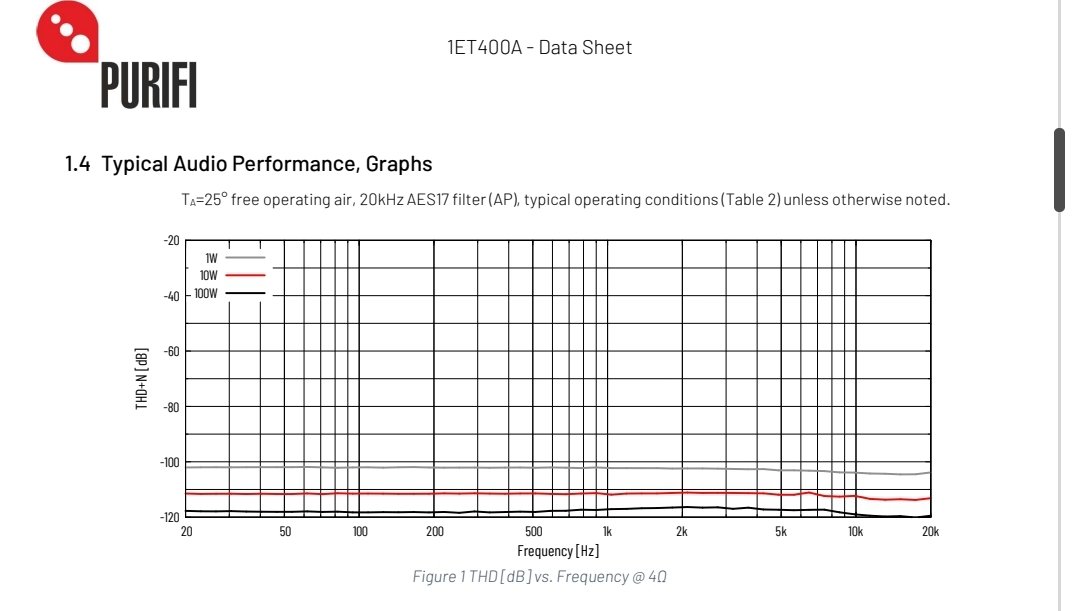
I gather this amp uses the Purifi 1et400 module. The hump we see above in high frequency distortion centred around 30watts is not a characteristic of the Purifi module.
We can see from this chart that the Purifi module stays flat in distortion level through various power levels. The distortion at 100watts is way higher than it should be on the boxem.
As such this is indicative of a problem (most likely) in this amps input buffer.
Alan Marchwrote: @SmartOne_2000 Being rather bleary-eyed this morning, I have realised that I misread the frequencies against the colours on the graph.
What it shows is increasing distortion with frequency. Any amplifier will tend to do this but the rise on this amp seems excessive.
I gather this amp uses the Purifi 1et400 module. The hump we see above in high frequency distortion centred around 30watts is not a characteristic of the Purifi module.
We can see from this chart that the Purifi module stays flat in distortion level through various power levels. The distortion at 100watts is way higher than it should be on the boxem.
As such this is indicative of a problem (most likely) in this amps input buffer.
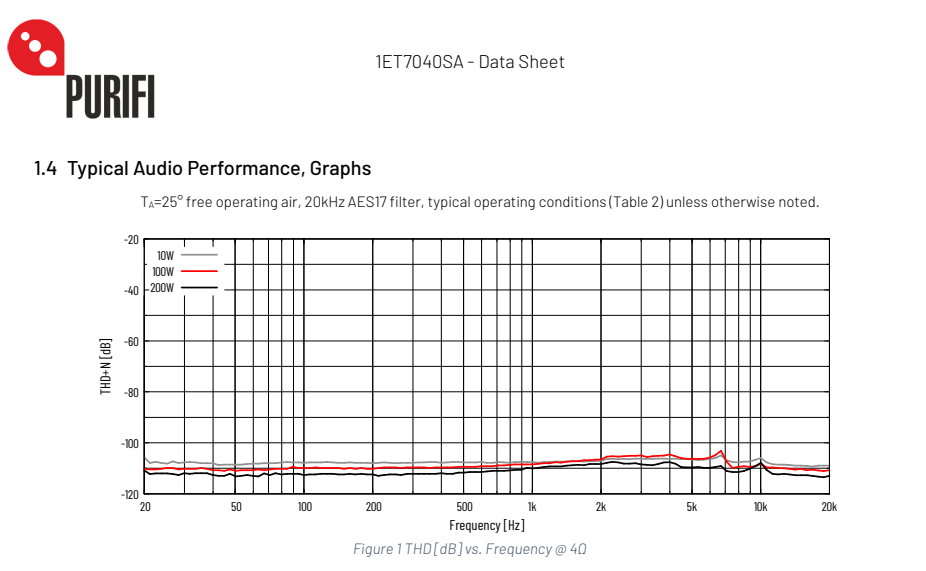
The amp uses the new 1ET7040 module, not the 1ET400A as I indicated earlier in my post. Anyways, do your new amps exhibit this behavior as well?
SmartOne_2000wrote:
The amp uses the new 1ET7040 module, not the 1ET400A as I indicated earlier in my post. Anyways, do your new amps exhibit this behavior as well?
7040 doesnt do it either.
I am tied up in a meeting for the next few hours but I will post some data later for our amps.
I think the difference in the graphs is due to the measurement bandwidth. One is made with 45kHz bandwidth, while Purifi has a 20kHz filter. Do you see this behavior as well in your amps? Just curious, that's all.
SmartOne_2000wrote:
I think the difference in the graphs is due to the measurement bandwidth. One is made with 45kHz bandwidth, while Purifi has a 20kHz filter. Do you see this behavior as well in your amps? Just curious, that's all.
It is a possibility, hower the numbers still seem high to me. If it were the case it is a great example of why you need to be cautious with measurements. The harmonics that create that higher distortion measurement would be completely inaudible. Therefore the measurement is misleading unless you really do understand its composition. Something you can't tell from that single line. You need to look at an FFT to see the composition.
In many ways I think this sort of thing is the reason measurement gets such a bad rap in some audiophile circles. Many measurements, especially when used in isolation, have little bearing on the subjective sound quality.
@Alan March Sorry to mention it here but you may have missed it over in the P482 thread, it would be really great to see those measurements of the P482's on how the noise floor changes with the output level, perhaps you can post this along with the other data you mentioned above?
Oniiz86wrote: @Alan March Sorry to mention it here but you may have missed it over in the P482 thread, it would be really great to see those measurements of the P482's on how the noise floor changes with the output level, perhaps you can post this along with the other data you mentioned above?
Hi
Really pressed for time at the moment, can't commit to a time frame on that. Bottom line is that the change is small.
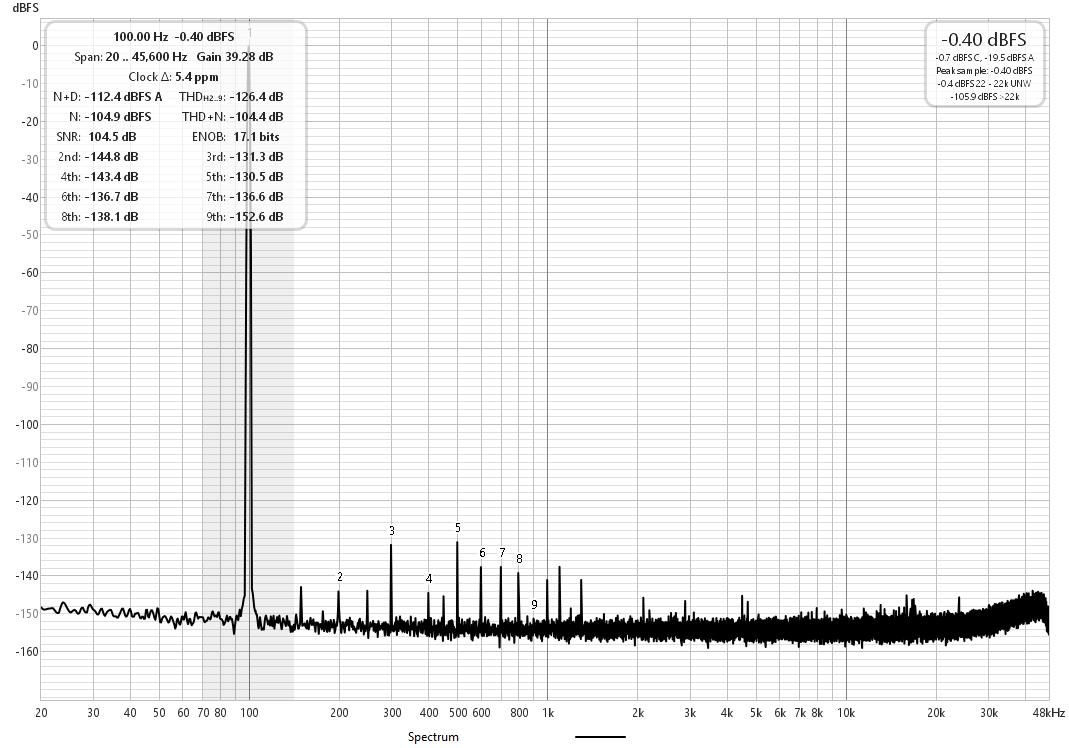
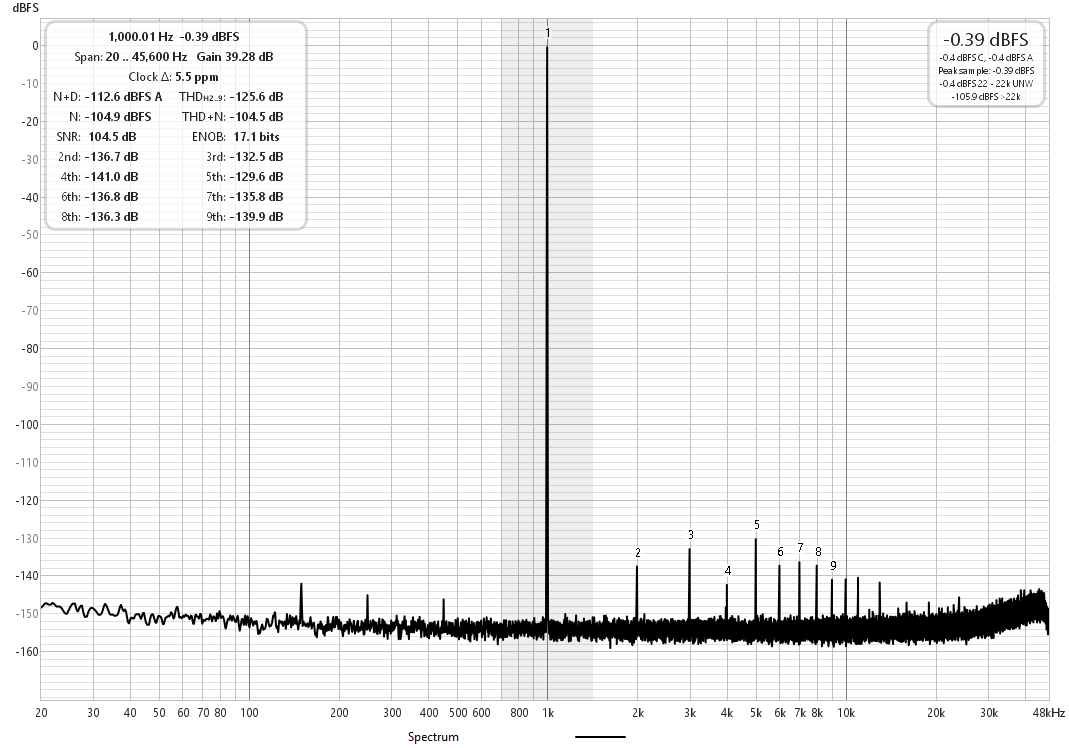
@SmartOne_2000 I have very quickly thrown a P482 (Purifi 1ET6525SA) on the bench and performed some tests to demonstrate the things mentioned above. Our high power dummy load is being used on other work so with these tests I was limited to 10 watts, but this is well into the "hump" range shown in the plot you provided. It was quick and dirty so please dont take this as any difinitive indication of the amps performance.
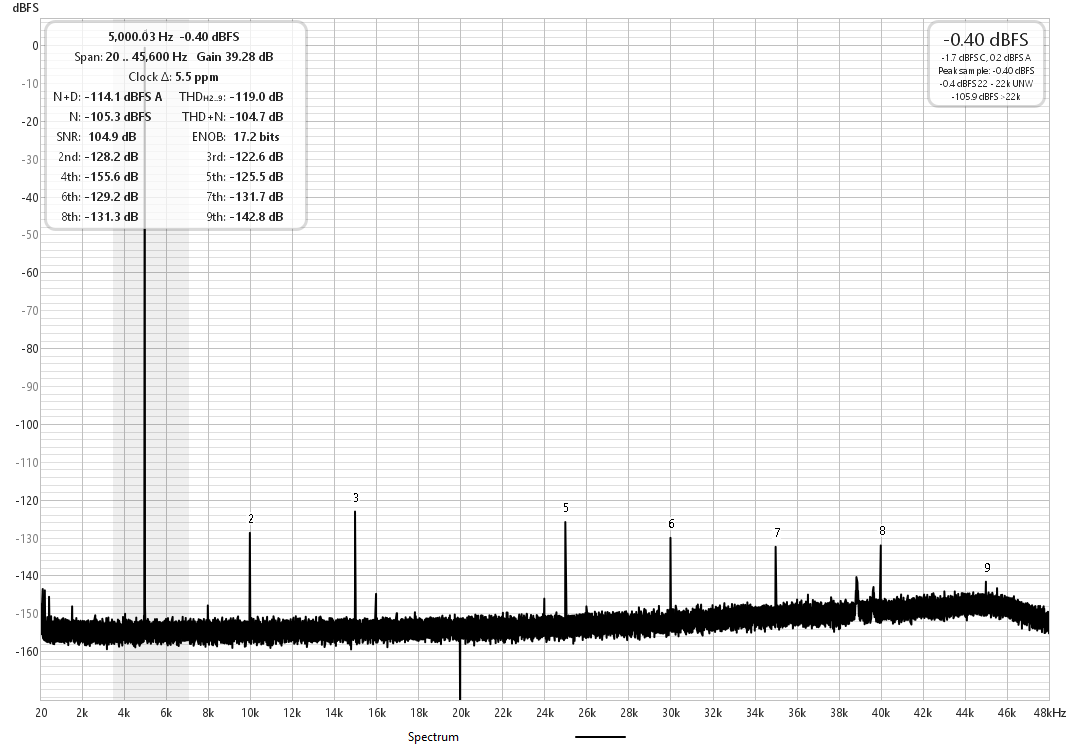
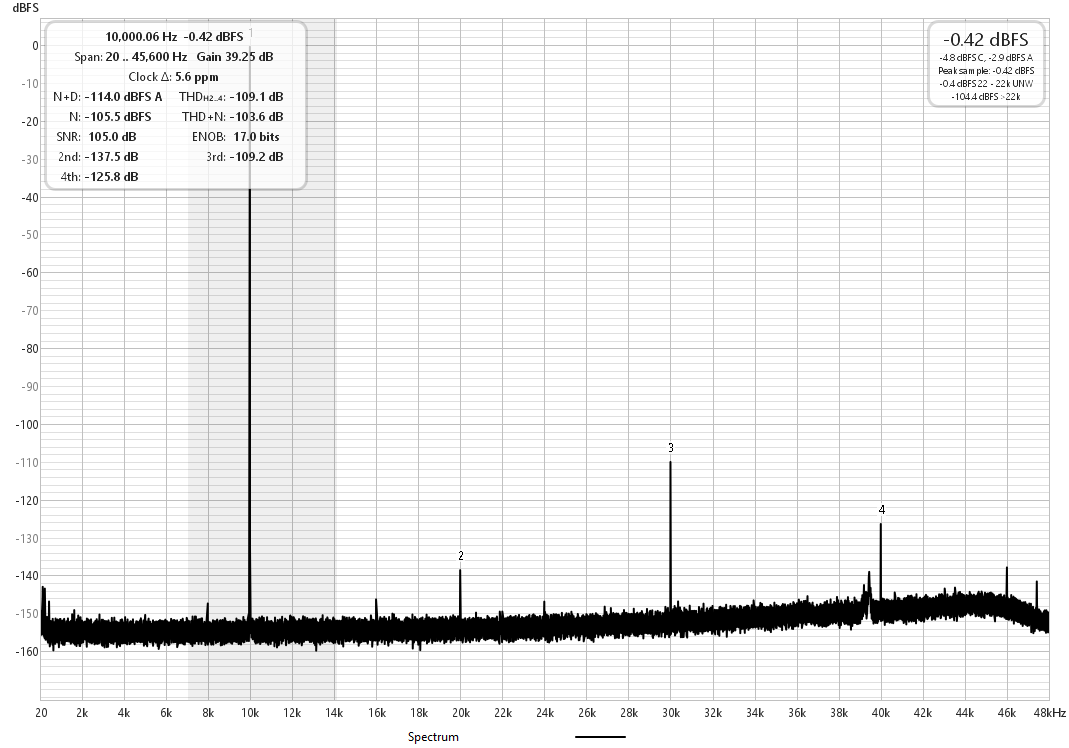
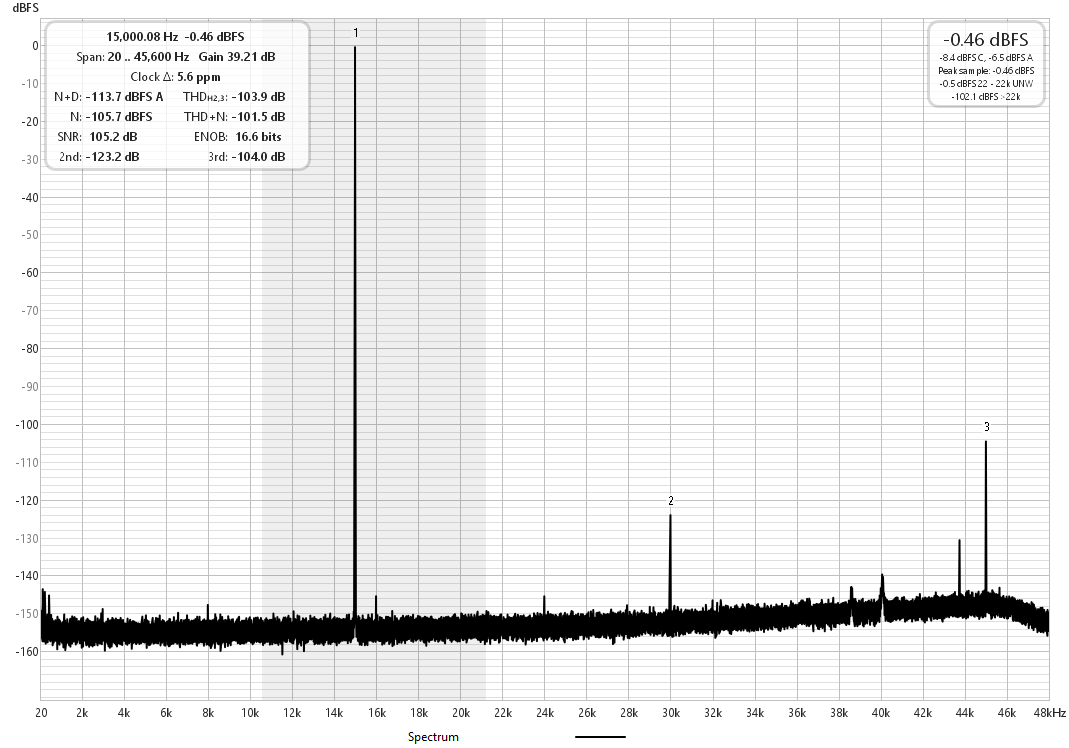
So we have 5 FFT plots at 100Hz, 1kHz, 5kHz, 10kHz and 15kHz at 10 watts.
1kHz
5kHz
10kHz
15kHz
Firstly, noise. You can see it has a small rise towards 45kHz, but is exceptionally low and remains constant regardless of the test signal frequency.
Secondly, the number of harmonics. As discussed, the number of harmonics included in the THD reduces as frequency increases.
Thirdly, harmonic amplitudes. Yes they increase with increasing frequency, but no where near as much as seen in the example you provided. The THD went from -125dB to -103dB.
So to conclude, yes the additional bandwidth of measuring to 48kHz has made the measurement indicate a rise in THD. However, this rise is misleading from a subjective point of view because the harmonics which cause the rise are well above the audible range. They are also still very low in level. They could never be heard. So again, limiting THD+N measurements to 20kHz is the correct thing to do.
Another thing to consider is that due to the spectral nature of music, i.e. there is very little content at high frequencies, you would never actually be making the amp produce 10 watts at 20kHz. Possibly 2 watts tops. Testing at 5 watts at 20kHz more than covers any real world situation.
Alan Marchwrote:
So to conclude, yes the additional bandwidth of measuring to 48kHz has made the measurement indicate a rise in THD. However, this rise is misleading from a subjective point of view because the harmonics which cause the rise are well above the audible range. They are also still very low in level. They could never be heard.
Thanks for that Alan, I know us mere mortals cannot discern this but what about the supernatural beings that proclaim to have "Golden Ears" :p
Oniiz86wrote:
Thanks for that Alan, I know us mere mortals cannot discern this but what about the supernatural beings that proclaim to have "Golden Ears" :p
Indeed, cough :).
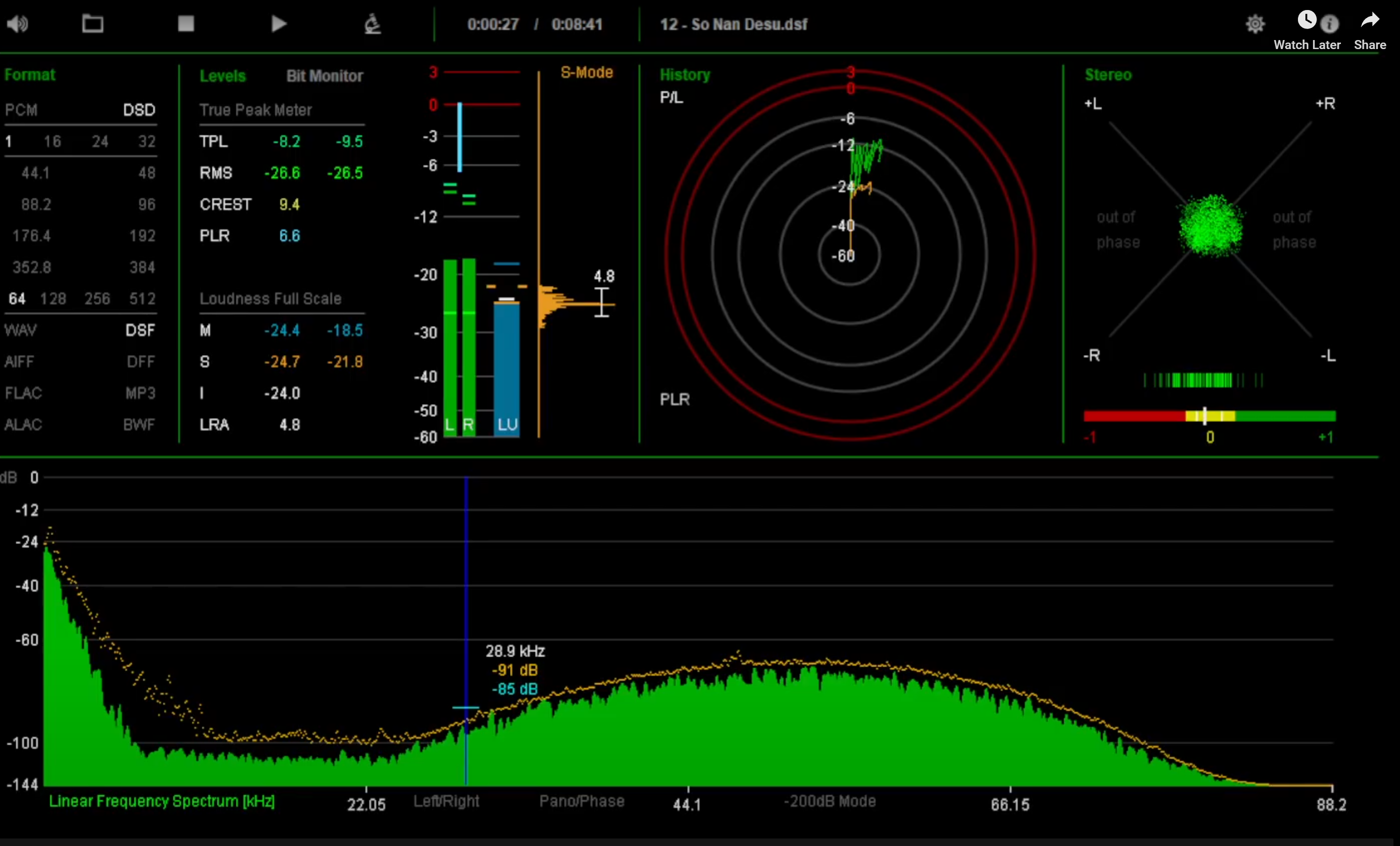
If there was ever good evidence that ultrasonic noise and distortion was of no audible consequence then look at DSD recordings. By definition they are noise shaped and put massive amounts of noise into the ultrasonic area.
Yet many audiophiles swear by DSD and say it is superior in sound quality 😉
Alan Marchwrote: @SmartOne_2000 I have very quickly thrown a P482 (Purifi 1ET6525SA) on the bench and performed some tests to demonstrate the things mentioned above. Our high power dummy load is being used on other work so with these tests I was limited to 10 watts, but this is well into the "hump" range shown in the plot you provided. It was quick and dirty so please dont take this as any difinitive indication of the amps performance.
So we have 5 FFT plots at 100Hz, 1kHz, 5kHz, 10kHz and 15kHz at 10 watts.
220
1kHz
216
5kHz
217
10kHz
218
15kHz
219
Firstly, noise. You can see it has a small rise towards 45kHz, but is exceptionally low and remains constant regardless of the test signal frequency.
Secondly, the number of harmonics. As discussed, the number of harmonics included in the THD reduces as frequency increases.
Thirdly, harmonic amplitudes. Yes they increase with increasing frequency, but no where near as much as seen in the example you provided. The THD went from -125dB to -103dB.
So to conclude, yes the additional bandwidth of measuring to 48kHz has made the measurement indicate a rise in THD. However, this rise is misleading from a subjective point of view because the harmonics which cause the rise are well above the audible range. They are also still very low in level. They could never be heard. So again, limiting THD+N measurements to 20kHz is the correct thing to do.
Another thing to consider is that due to the spectral nature of music, i.e. there is very little content at high frequencies, you would never actually be making the amp produce 10 watts at 20kHz. Possibly 2 watts tops. Testing at 5 watts at 20kHz more than covers any real world situation.
This is more than definitive proof Alan. Your modules are definitely designed differently! Thank you so much for making the time and effort to produce these read-them-and-weep graphs. Your are correct to state that limiting the bandwidth to 20kHz is best, not only because ultra-sonics are inaudible but the loudspeaker itself is also a huge low pass filter, starting to fall off at 10kHz and beyond, depending on the design of the speaker.
Pander to guess why so many other class D designs have the original hump? Its not the first time I've seen it, so I assumed it was normal behavior.
It will be a lot noisier. Basically OK fo the old 1ET400, but wont get the most out of the new 1et6525. Plus it only has gains suitable for 10 volt and 2 volt inputs. Nothing best suited for XLR 4 volt so sub optimal for noise again.
Not saying it is a problem in this implementation, but the LM4562 he uses can be sensitive to RF and cause lots of issues and spurious signals in the noise floor.
He has RF filters on his inputs, if you look at the circuit topology tab. My main impression were the IMD and noise floor plots, which look impressive.