Absolutely not. The FTC tests are an irrelevant joke. They are simply not fit for purpose and dont help the consumer.
Understandable ... so what happens if a reviewer tests your new amps per this new standard and finds issues and publishes the results. Will you ignore the results or attempt to fix whatever issues they may have found? The reason I ask this is that many amplifier manufacturers are gearing up to have their latest amp designs pass tested using the new FTC standard, and so will major reviewers like Audioholics as well.
I believe the reason these tests exist is not to see if an amp can play music reliably into all loads, but to ensure the amps are robustly designed for extended reliability over many years, if not decades, all for the sake and benefit of the consumer. This weeds out lesser designs that would never be sold to the public (hopefully).
SmartOne_2000wrote:
Understandable ... so what happens if a reviewer tests your new amps per this new standard and finds issues and publishes the results. Will you ignore the results or attempt to fix whatever issues they may have found? The reason I ask this is that many amplifier manufacturers are gearing up to have their latest amp designs pass tested using the new FTC standard, and so will major reviewers like Audioholics as well.
I believe the reason these tests exist is not to see if an amp can play music reliably into all loads, but to ensure the amps are robustly designed for extended reliability over many years, if not decades, all for the sake and benefit of the consumer. This weeds out lesser designs that would never be sold to the public (hopefully).
The FTC tests simply dont do what they claim. The tests are meaningless. Conditions that simply dont exist in real world use.
Any informed reviewer will know this. I would avoid reviews from people who use this test as it demonstrates their lack of understanding of the subject.
The FTC tests do not test reliability. A 5 minute test on one unit does not in any way demonstrate long term reliability of the design.
Like most manufacturers, we will carry on ignoring the tests as has been the case for many decades. Seriously, no one, consumers or manufacturers pay any attention. They have no credibility and are unenforceable.
They do not provide consumers with any useful or meaningful information regarding performance or reliability.
Understood...would you mind answering a query I posted in the Kuoro forum a while ago, regarding its performance relative to the Ukkonen? When is the release date of this speaker? Thanks!
Happy New Year, @Alan March. Hope this year brings good tidings (and then some) to you and your family:).
It just so happened that ASR just reviewed Buckeye's 9040BA amplifier. I was wondering how its noise and power specs (ignoring the 15dB low-gain measurements) would compare to your P801 (noticed ~ $200 price reduction, btw???). It uses a non-hypex power supply from Micro Audio to achieve an impressive ~ 1600 watts into 2 ohms. I know its medium (20dB - 21dB) and high gain (25dB - 26dB) settings are different than yours (23dB), but could you extrapolate your measured amp specs and compare the two?
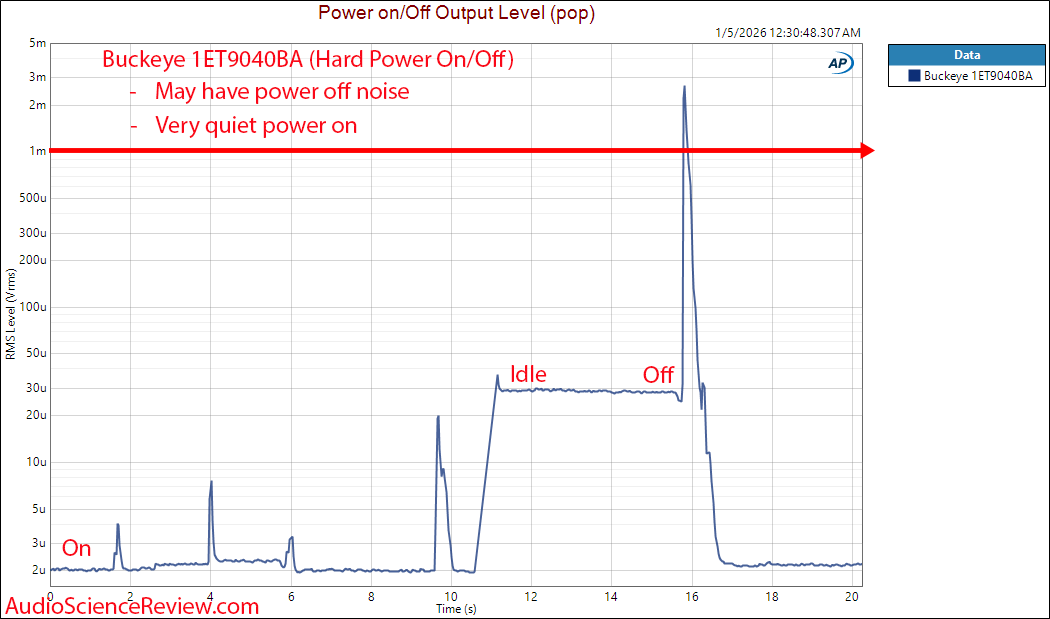
How does its noise floor of ~ 125dB (referenced to a 4 Vrms output, based on the power on/off plot showing a 2uV floor)? It could be that the 2uV was the instrument's noise floor, and the amp is capable of generating a lower noise floor?
Again, as discussed previously the gain settings are wrong and too low for standard 2volt and 4volt sources, so the Buckeye amp will not reach full power output. The 15 dB gain setting is a total waste of time as very few sources can output the necessary 10+ volts to drive it. Even fewer that can do so at a low enough level of noise and distortion.
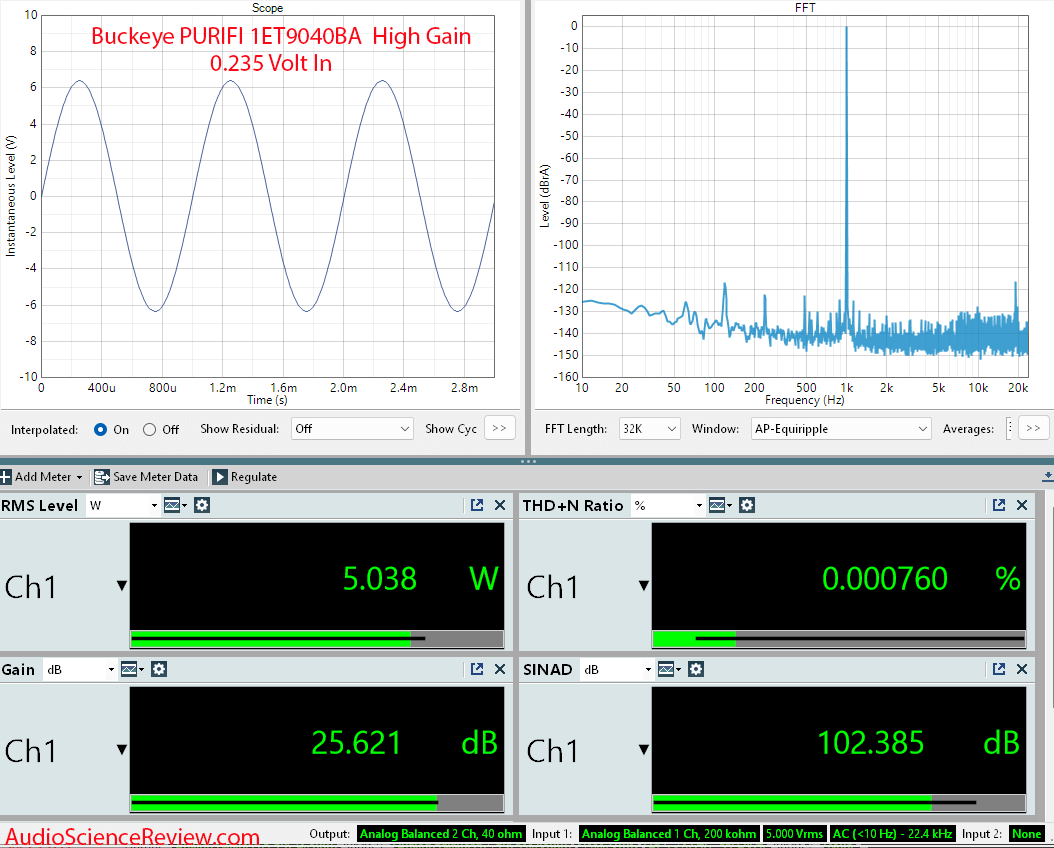
You would have to use the high 25dB gain setting, even with a 4 volt XLR source, to get the amp to full power. The Buckeye SINAD at 25dB gain is woeful at only 102dB. It's way off the mark.
As usual Amir doesn't get it, doesn't compare like with like and publishes misleading data in the SINAD chart. You simply can't compare amps with different gains in the same chart, well not without qualifying and clarifying information. The devil is in the detail and Amir just isn't thorough, or professional enough in what he does.
I expect Buckeye have just thrown the same input buffer in the box that they used with the previous generation of Purifi modules without understanding it would be the wrong gain and have inadequately high noise and distortion for the 9040 Purifi modules.
The noise floor is very "dirty" and rises significantly towards low frequencies. Note the 120Hz mains spuria around -118dB with additional harmonics at 240Hz and 480Hz. Also the odd spuria at 20kHz.
So, I'm not clear on how you have derived -125dB noise floor. Also it can't be 2uV as the Purifi modules own noise is 4.5uV without the noisy Buckeye buffer in front of it.
The noise floor shown here is about -103dB 20Hz to 20kHz and is the main component in the SINAD figure. Its not due to the AP measurement system which has a much lower noise floor. That's over 30uV ref the 4.475 v (5 watt signal into 4 ohms).
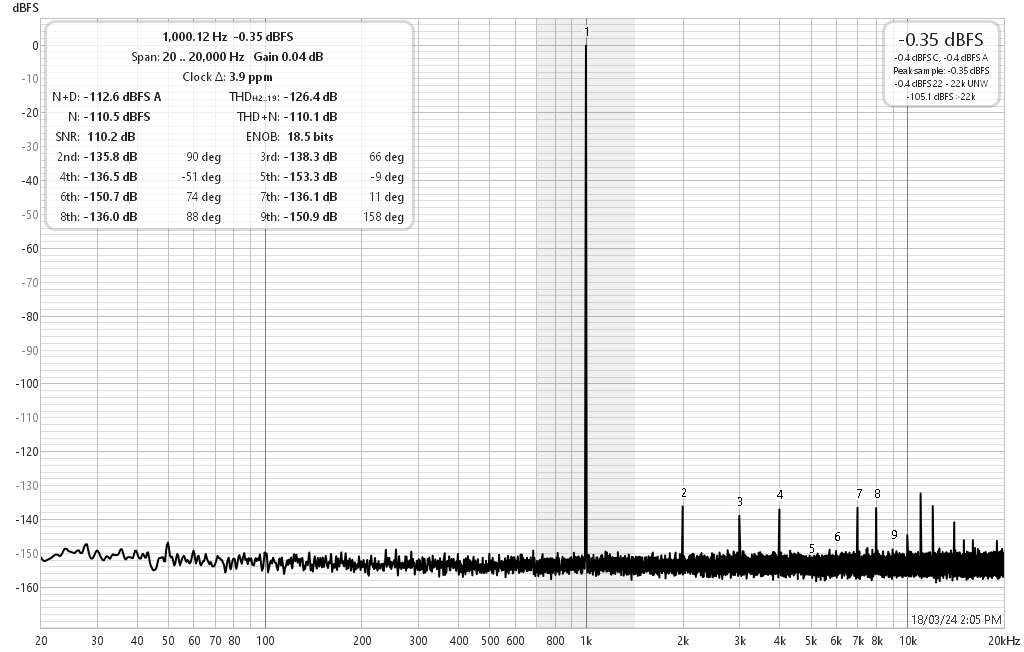
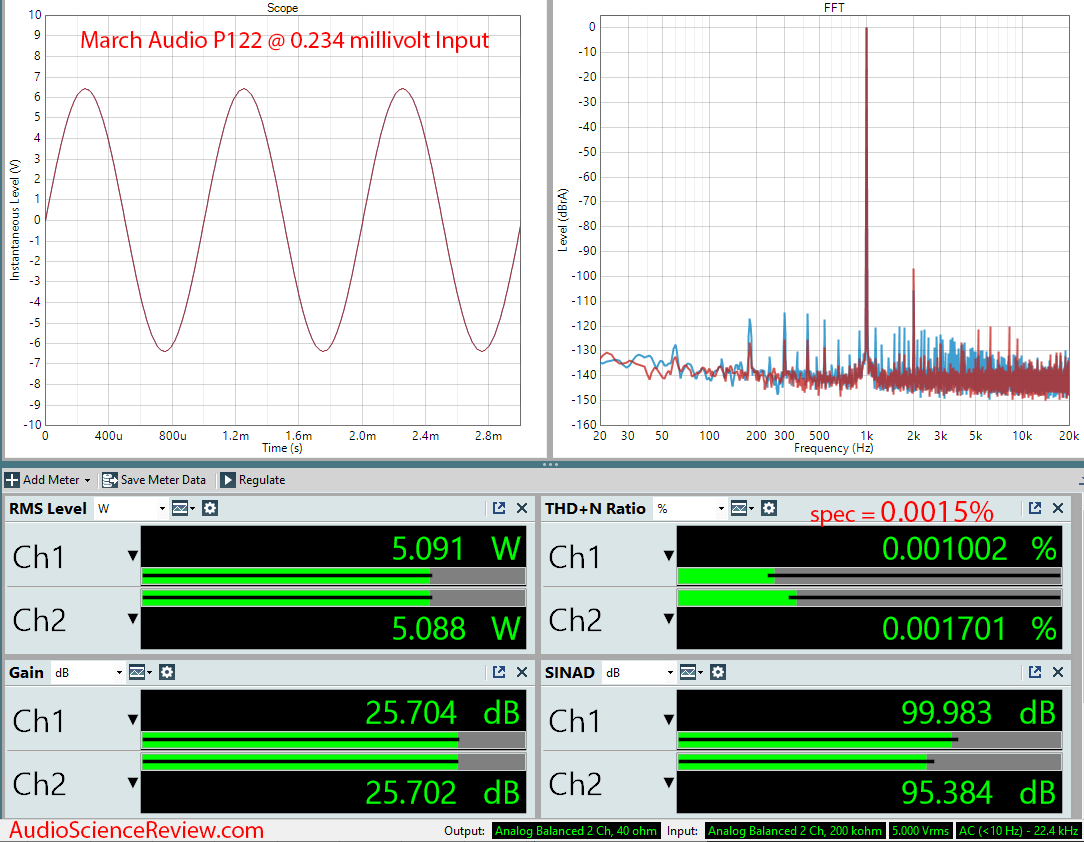
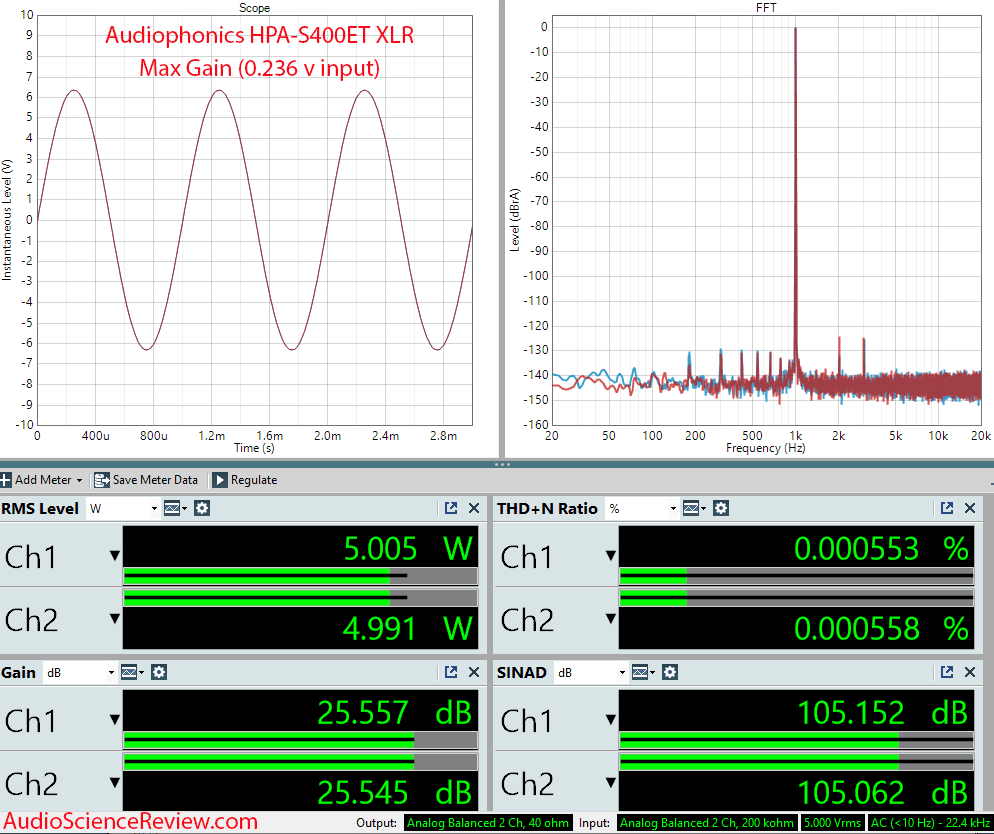
So the Buckeye is around 13dB worse SINAD than our P801 shown below.
From a previous post:
I wrote above about the SINAD figure for the P801 being higher than indicated in the measurement. This being due to our signal generator source, although excellent (<1uV 20Hz to 20kHz), being too noisy.
The P801, with 23dB of gain, is essentially amplifying the noise that is present in the source. The measurement is showing this noise, and not what the amplifier is actually capable of.
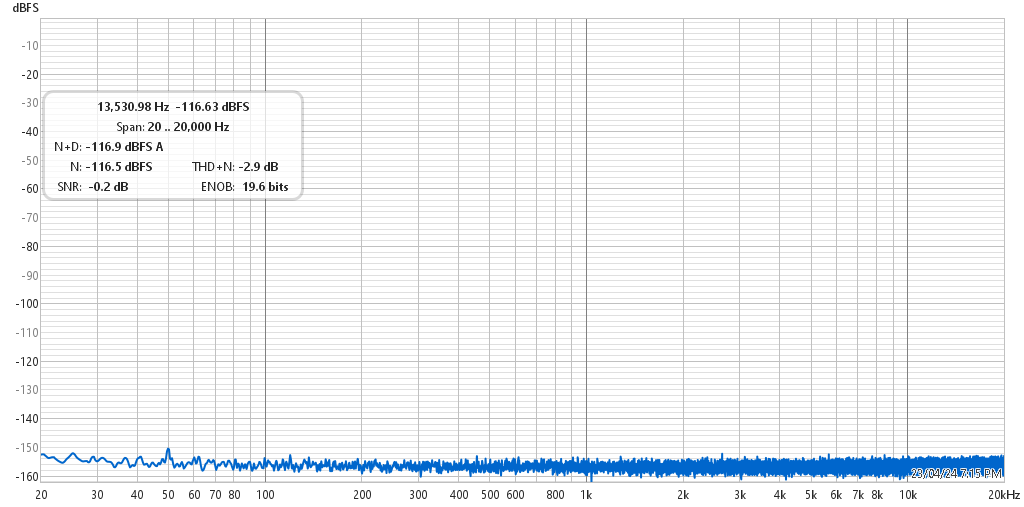
Just to demonstrate this, below is a measurement of the noise floor of the P801 with its input shorted.
We can see that the noise, measured 20Hz to 20kHz is at -116.5dB (7uV rms). 6dB better than with the signal source attached.
From the first measurement we know that the THD is -126.4dB.
From these 2 figures we can calculate the SINAD, which works out at -116.0dB.
In conclusion, Buckeye - cheap for a reason. There is of course a market for that. Although I do wonder how they are coping now the tariffs have added 25% to their build/component costs further challenging their already non existent profit margins.
Oh BTW, the reduction in price on the P801 is because we have a January sale on at the moment.
Again, as discussed previously the gain settings are wrong and to low for standard 2volt and 4volt sources, so the Buckeye amp will not reach full power output. The 15 dB gain setting is a total waste of time as very few sources can output the necessary 10+ volts to drive it. Even fewer that can do so at a low enough level of noise and distortion.
The Buckeye SINAD at 25dB gain is woeful at only 102dB. It's way off the mark. You would have to use this high gain setting even with a 4 volt source to get the amp to full power.
As usual Amir doesn't get it, doesn't compare like with like and publishes misleading data in the SINAD chart. You simply can't compare amps with different gains in the same chart, well not without qualifying and clarifying information. The devil is in the detail and Amir just isn't thorough enough in what he does.
I expect Buckeye have just thrown the input buffer in the box that they used with the previous generation of Purifi modules without understanding it would be the wrong gain and have inadequately high noise and distortion for the 9040 Purifi modules.
399
The noise floor is very "dirty" and rises significantly towards low frequencies. Note the 120Hz mains spuria around -118dB with additional harmonics at 240Hz and 480Hz. Also the odd spuria at 20kHz.
So, I'm not clear on how you have derived -125dB noise floor. Also it can't be 2uV as the Purifi modules own noise is 4.5uV.
The noise floor shown here is about -103dB 20Hz to 20kHz and is the main component in the SINAD figure. Its not due to the AP measurement system which has a much lower noise floor. That's over 30uV ref the 4.475 v (5 watt signal into 4 ohms).
So the Buckeye is around 13dB worse SINAD than our P801 shown below.
From a previous post:
I wrote above about the SINAD figure for the P801 being higher than indicated in the measurement. This being due to our signal generator source, although excellent (<1uV 20Hz to 20kHz), being too noisy.
The P801, with 23dB of gain, is essentially amplifying the noise that is present in the source. The measurement is showing this noise, and not what the amplifier is actually capable of.
Just to demonstrate this, below is a measurement of the noise floor of the P801 with its input shorted.
We can see that the noise, measured 20Hz to 20kHz is at -116.5dB (7uV rms). 6dB better than with the signal source attached.
401
From the first measurement we know that the THD is -126.4dB.
400
From these 2 figures we can calculate the SINAD, which works out at -116.0dB.
In conclusion, Buckeye, cheap for a reason. There is of course a market for that. I do wonder how they are coping now the tariffs have added 25% to their build/component costs and their already non existent profit margins.
Oh BTW, the reduction in price on the P801 is because we have a January sale on at the moment.
Good morning Alan, and your detailed analysis is well appreciated. Thank you!
I derived the 2uV number from the power on/off graph used to show how an amp behaves when idle, when turned on or off, but with no signal input. But your analysis is correct, and thanks for the corrections.
I get your point on the meaningless comparisons of amplifier specs with different gains. A 21dB gain amp will be quieter than a 25dB gain amp, of course. But couldn't one argue that since they both are producing the same 5W output signal, wouldn't the quieter one win the day? Yes, it would require a higher input voltage to produce that output, but that voltage would be well within most preamp output ranges. Though I realize it would require a much higher output voltage for full power, which might not be typical for most preamps.
Not sure where Amir's 5W spec rating came from, but I recall reading somewhere that at typical (sane) listening levels, in an average-sized room, an amp outputs an average of 10W or so. Peaks are another matter of course. Does this sound reasonable to you?
Have you ever measured the P801 maximum power at the 1% level? I know the plots you generated earlier at the 0.1% level. I'm not asking you to drag out an amp and perform the measurements, but can you give a rough estimate? I know Purifi doesn't rate its 9040BA module at that distortion level.
Thanks for the January sale ... may I suggest you advertise it with more 'flair' (e.g., "New Year's Day sale for January 2026") 🙂 ?
And yes, as promised before, I plan to get some P801s once this grad school thing is over and I'm more liquid than I currently am (sigh!). Hope you'd have another 'sale' by then :)!
Care to submit your amp for review with Amir😱? I realize your history with him might be a turn-off.
Aaahhh, I missed the on / off graph. The 2uV is essentially the AP measurement system noise floor. When the amp is on (idle portion of the graph) the noise level ties up with my calculation of 30uV. This is REALLY noisy for a 9040 based amp. Our P801 is about 7uV.
As you can see from this example, it doesn't necessarily follow that a lower gain amp will be quieter than a higher gain one. The Buckeye is noisier at its lowest gain of 15dB than the P801 is at its 23dB gain and even 29dB gain setting.
The Buckeyes inappropriate gain settings are just bad design, or just an attempt at "gaming" the SINAD tables to dupe customers that don't fully understand the implications.
The 5 watt test point isn't unreasonable in itself, but it is just one test point. To put so much emphasis on SINAD at this one test point, as Amir does, is pretty dumb. It is most certainly not a measure of how good an amp is overall. It is just one small part of the picture.
It's this sort of simplistic testing that gives "measurements" a bad name.
Amir heaped praise on the amp, but when you start digging in terms of noise and distortion at 5 watts it's barely performing any better than a basic Hypex integrated PSU/amp module. It's typical of Amirs slap-dash misleading reviews.
Hypex NC122
And certainly worse than the previous generation of Purifi 1ET400 module.
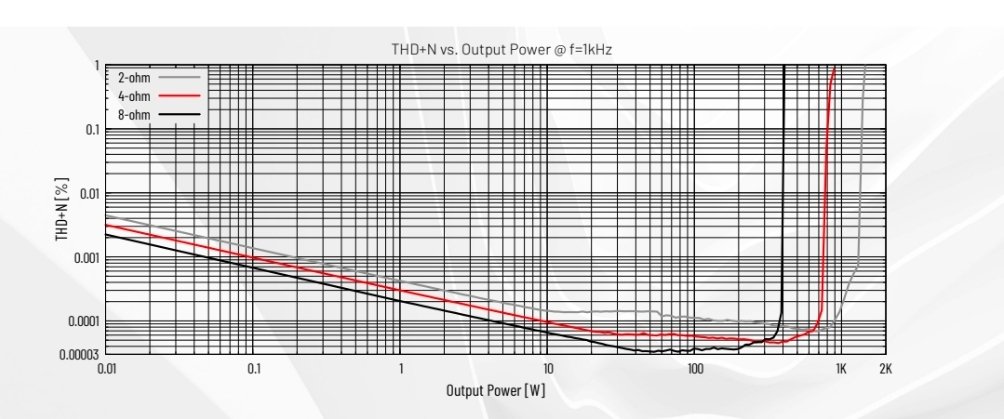
The P8011% 2 ohm rating is about 1500 watts. Consistent with the Purifi data sheet.
There is absolutely no chance I would send an amp to Amir for review. He is just not thorough / professional enough.
Aaahhh, I missed the on / off graph. The 2uV is essentially the AP measurement system noise floor. When the amp is on (idle portion of the graph) the noise level ties up with my calculation of 30uV. This is REALLY noisy for a 9040 based amp. Our P801 is about 7uV.
As you can see from this example, it doesn't necessarily follow that a lower gain amp will be quieter than a higher gain one. The Buckeye is noisier at its lowest gain of 15dB than the P801 is at its 23dB gain and even 29dB gain setting.
The Buckeyes inappropriate gain settings are just bad design, or just an attempt at "gaming" the SINAD tables to dupe customers that don't fully understand the implications.
The 5 watt test point isn't unreasonable in itself, but it is just one test point. To put so much emphasis on SINAD at this one test point, as Amir does, is pretty dumb. It is most certainly not a measure of how good an amp is overall. It is just one small part of the picture.
It's this sort of simplistic testing that gives "measurements" a bad name.
Amir heaped praise on the amp, but when you start digging in terms of noise and distortion at 5 watts it's barely performing any better than a basic Hypex integrated PSU/amp module. It's typical of Amirs slap-dash misleading reviews.
Hypex NC122
And certainly worse than the previous generation of Purifi 1ET400 module.
The P8011% 2 ohm rating is about 1500 watts. Consistent with the Purifi data sheet.
There is absolutely no chance I would send an amp to Amir for review. He is just not thorough / professional enough.
Understable, and thanks for the response. Nice to know your custom power supply does not limit the module performance. It is voltage-regulated, right?
I assume you would not like, not prefer, or permit your customers to have your amps reviewed by ASR? This is understandable, as you would not have a way to respond to any queries or comments from the forum, which can be very frustrating.
SmartOne_2000wrote:
Understable, and thanks for the response. Nice to know your custom power supply does not limit the module performance. It is voltage-regulated, right?
I assume you would not like, not prefer, or permit your customers to have your amps reviewed by ASR? This is understandable, as you would not have a way to respond to any queries or comments from the forum, which can be very frustrating.
Yes the PSU is regulated.
Thats correct, we really don't want Amir anywhere near our products. This is for multiple reasons, the lack of care and expertise he frequently demonstrates in his reviews, but also because of his generally unprofessional and unpleasant attitude.
He won't accept any criticism of his methods, which is the reason why he banned me in the first place. A professional reviewer would also give the manufacturer an opportunity to respond. A right to reply and comment. He doesn't contact manufacturers regarding results prior to publication. This is a problem because he does screw up and publish erroneous results/conclusions.
Look up the one where Andrew Jones (extremely highly regarded speaker designer) ripped Amirs review to shreds and showed Amirs incompetence. Amir did not retract the review or apologise. Again a total lack of professionalism for an erroneous review which would have damaged the sales of said speaker
Amir has frequently demonstrated a grudge towards myself in the forum because I have called him out on his methods and conclusions.
As such our products would not received a fair and balanced review.
In any case I am quite confident he would refuse to review our products anyway.
Also, it has to be said that ASR has a certain population of fan boys who like to pile on given the opportunity. Unfortunately the nature of social media, so I really don't want to waste my time with it.
Somebody mentioned you here, and Buckeye responded here :). Oh boy!
Well, we don't discuss the details of our designs quite deliberately. Lesser capable manufacturers such as Buckeye would love to copy what they don't know how to do 😜.
Somebody mentioned you here, and Buckeye responded here :). Oh boy!
@SmartOne_2000 Well that somebody also happens to be a member here @Matias, I believe he was the eagle-eyed one that discovered the striking similarities between Micro Audio & March Audio's Custom SMPS solution here https://www.audiosciencereview.com/forum/index.php?threads/boxem-arthur-4222-e1-amplifier-review.37930/page-9#post-1337290 , perhaps at some point March Audio were utilising Micro Audio's SMPS1K-PFCR2 but I believe this is not a 2 Quadrant design nor does it have Active Synchronous Rectification to avoid Power Supply Bus Pumping, the only Micro Audio SMPS that have these features are the SMPS1K-SN & SMPS2K-SN but since they're unregulated & March Audio's are regulated then that seems to confirm they are no longer from Micro Audio & perhaps from some other OEM manufacturer, anyway it would be great to have an updated image of the current Custom SMPS on the amplifier product pages for that extra bit of transparency.
Oniiz86wrote: @SmartOne_2000 Well that somebody also happens to be a member here @Matias, I believe he was the eagle-eyed one that discovered the striking similarities between Micro Audio & March Audio's Custom SMPS solution here https://www.audiosciencereview.com/forum/index.php?threads/boxem-arthur-4222-e1-amplifier-review.37930/page-9#post-1337290 , perhaps at some point March Audio were utilising Micro Audio's SMPS1K-PFCR2 but I believe this is not a 2 Quadrant design nor does it have Active Synchronous Rectification to avoid Power Supply Bus Pumping, the only MicroAudio SMPS that has these features is the SMPS1K-SN but since they're unregulated & March Audio's are regulated then that seems to confirm they are no longer from Micro Audio & perhaps from some other OEM manufacturer, anyway it would be great to have an updated image of the current Custom SMPS on the amplifier product pages for that extra bit of transparency.
Hi
As mentioned, we don't provide in depth design details. We won't be publishing detailed pictures of the design. The situation is that other less capable companies with inferior designs want to know how we achieve what we do. Whilst there is obviously a limit to what we can do, we are not going to make it easy for them to copy 😀.
Our current PSU has all the features you mention. It's not the one shown in the link. The Micro Audio BTW is effectively regulated. The Hypex is unregulated and it's output voltage goes all over the place with mains variations and loads.