Funnily enough I have just had a scan through it. This is why I dont usually pay any attention to ASR. Lots of people who think they know. Usual nonsense. Factions and fanboys. Attack someone, defend someone else. It's typical social media. Just ignore like I do.
Anyway, I hope @james dyson you don't mind if I refrain from commenting further. This is another manufacturers quality control problem. Nothing useful ever comes out of the ASR forum "debates".
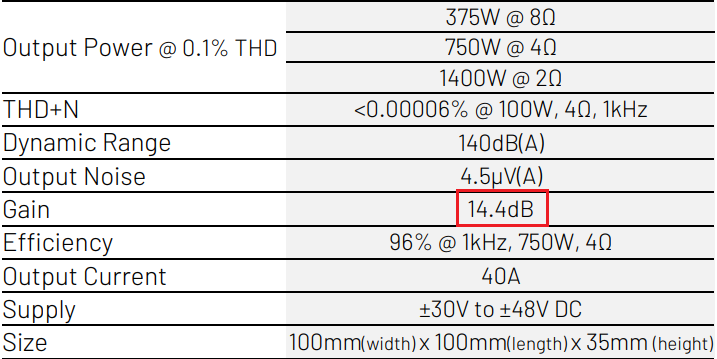
@Alan March I know it is trivial to mention but I noticed your first post notes the 1ET9040BA module gain as 13dB when it is 14.4dB, the 1ET7040SA module gain is 13dB.
"Often they just use the power amp module gain (13dB) where you would require an input signal of 10 volts or more to drive the power amp to full output."
"To put it into context, a typical DAC or streamer with 4 volt XLR output would only drive this amp with a 13dB gain setting to 80 watts output into 4 ohms. Only 20 watts with a 2 volts RCA source."
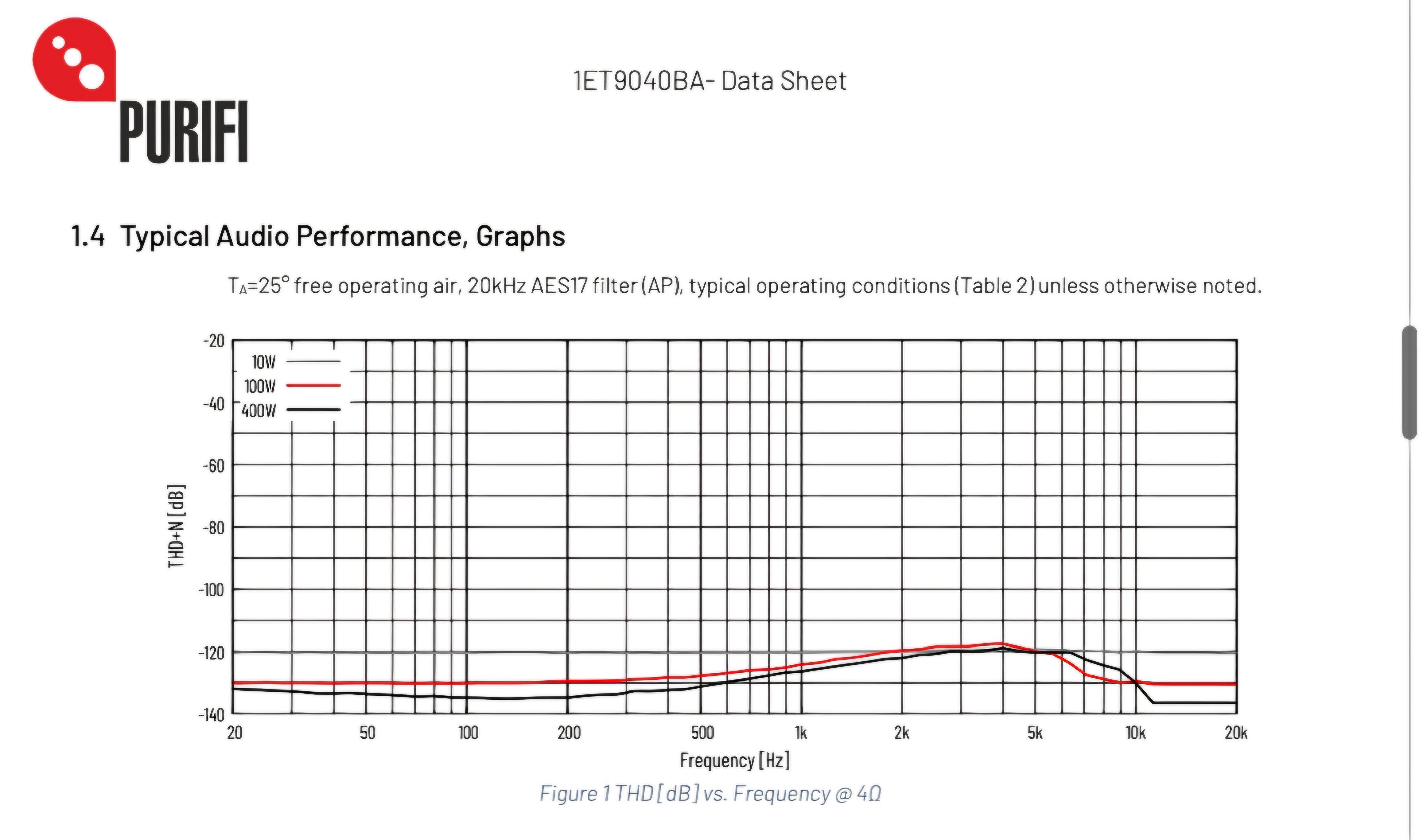
Several posts below you mention "From my post above its shown that we have achieved a 116dB THD + N (SINAD) with our new "Ultra Buffer" at 5 watts 4 ohm load and 23dB overall gain. From the Purifi data above we see the raw module without an input buffer (only 14dB gain) achieves 117dB THD +N at 5 watts 4 ohms."
@Alan March Have you generated Power vs Frequency curves to verify whether the 9040 delivers the same power at 20Hz, 1kHz and 20kHz into 2,4, and 8 ohms? Inadequate storage capacitance has capped low frequency power performance of many class D amps. Easy to deliver rated power at 1kHz but not so much at 20Hz for the rated distortion level. Thanks!
Oniiz86wrote: @Alan March I know it is trivial to mention but I noticed your first post notes the 1ET9040BA module gain as 13dB when it is 14.4dB, the 1ET7040SA module gain is 13dB.
"Often they just use the power amp module gain (13dB) where you would require an input signal of 10 volts or more to drive the power amp to full output."
"To put it into context, a typical DAC or streamer with 4 volt XLR output would only drive this amp with a 13dB gain setting to 80 watts output into 4 ohms. Only 20 watts with a 2 volts RCA source."
Several posts below you mention "From my post above its shown that we have achieved a 116dB THD + N (SINAD) with our new "Ultra Buffer" at 5 watts 4 ohm load and 23dB overall gain. From the Purifi data above we see the raw module without an input buffer (only 14dB gain) achieves 117dB THD +N at 5 watts 4 ohms."
Yes you are right, some errors in numbers. I am writing these things from memory so please excuse me if the odd number is not 100% spot on.
SmartOne_2000wrote: @Alan March Have you generated Power vs Frequency curves to verify whether the 9040 delivers the same power at 20Hz, 1kHz and 20kHz into 2,4, and 8 ohms? Inadequate storage capacitance has capped low frequency power performance of many class D amps. Easy to deliver rated power at 1kHz but not so much at 20Hz for the rated distortion level. Thanks!
Hi
Yes it does. We have extra capacitance beyond what's on the psu, plus the PSU is regulated.
SmartOne_2000wrote:
I know the frequency response is measured at 1 watt into 8 ohms. Have you measured the power bandwidth of the P801?
Yes. I will endeavour to post some more data in the next few days. Can I ask the reason for your question? Are you concerned about high frequency power delivery?
If so may I suggest you take a look at this post regarding music spectral content.
Just to add on to the above regarding low frequency performance, an issue is usually caused by bus pumping. This is where the psu voltage is actually pushed up by power being returned by reactive loads. It can go high enough to trip the over voltage protection on the amp module. Additional capacitance slows the rise of the voltage so it helps prevent it going too high, but it doesnt entirely solve it. You also need the active rectification to help regulate the voltage. Our PSUs have this.
Thank you for the response. My request for the power bandwidth is that no one seems to post them anymore, including Purifi, yet they claim power specs but never post the bandwidth over which these specs are made. My request is not due to some concern about the P801 or any amps you make. Just wanted to know how well the 9040 was designed. I know the bandwidth will be less than the standard 1W response due to a fixed gain bandwidth product for a given amplifier.
SmartOne_2000wrote:
Thank you for the response. My request for the power bandwidth is that no one seems to post them anymore, including Purifi, yet they claim power specs but never post the bandwidth over which these specs are made. My request is not due to some concern about the P801 or any amps you make. Just wanted to know how well the 9040 was designed. I know the bandwidth will be less than the standard 1W response due to a fixed gain bandwidth product for a given amplifier.
I think it is in the specs somwhere, it is 20Hz to 20kHz.
Purifi take a stance I completely agree with. The important range for subjective audio quality is the range we can hear, i.e. below 20kHz.
During a design process yes you do need to know what's going on above 20kHz, but it has little importance to the subjective audio quality.
Example. If you use a test signal above 10kHz all harmonic distortion components will be above 20kHz @ 20,30,40,50kHz and so on. So the audible THD will be zero! So what's the point of measuring to 50kHz or 100kHz? It's meaningless information from a subjective quality point of view.
Same with noise. Whats the point of getting noise figures for above 20kHz when you simply can't hear it?
Regarding power, as the link I posted demonstrates, hardly any power is required at higher frequencies. Music has very littke content at high frequencies. A thousand watt amp might only need to output a couple of watts at 20kHz. Full power at 20 kHz is not an indication of amp quality. It's an indication of something that will never, ever be used.
Just realised there is a relevant graph in the Purifi data sheet. It shows distortion v frequency up to 400 watts and 20kHz. 400 watts would instantly vapourise any domestic speaker tweeter.
Thanks for this...but initially I was more concerned with 20Hz performance not 20kHz :). I think you answered the question by saying, since there are no bus pumping issues, you guarantee full rated power performance at 20Hz with negligible distortion of -120dB or less in all impedances, correct?
I'm new to class D amps and these low frequency issues concern me. They which never existed in analog amps.
It will take a few days but I will try and post some low frequency test data.
It is a power supply issue rather than any amp module issue. Sorry to be picky but can I take the opportunity to correct something. Class d amps are not digital, they are very analogue. They use pulse width modulation. "D" doesn't stand for digital, it is is just the next letter in the alphabet after class A, AB and C 😀. You can see an article on amplifier class here:
Problems of reactive loads just manifest differently with class A and AB amps. In that case the problem makes the output transistors dissipate a lot more power and get much hotter. So low frequency reactive loads can make these amps overheat and shutdown.
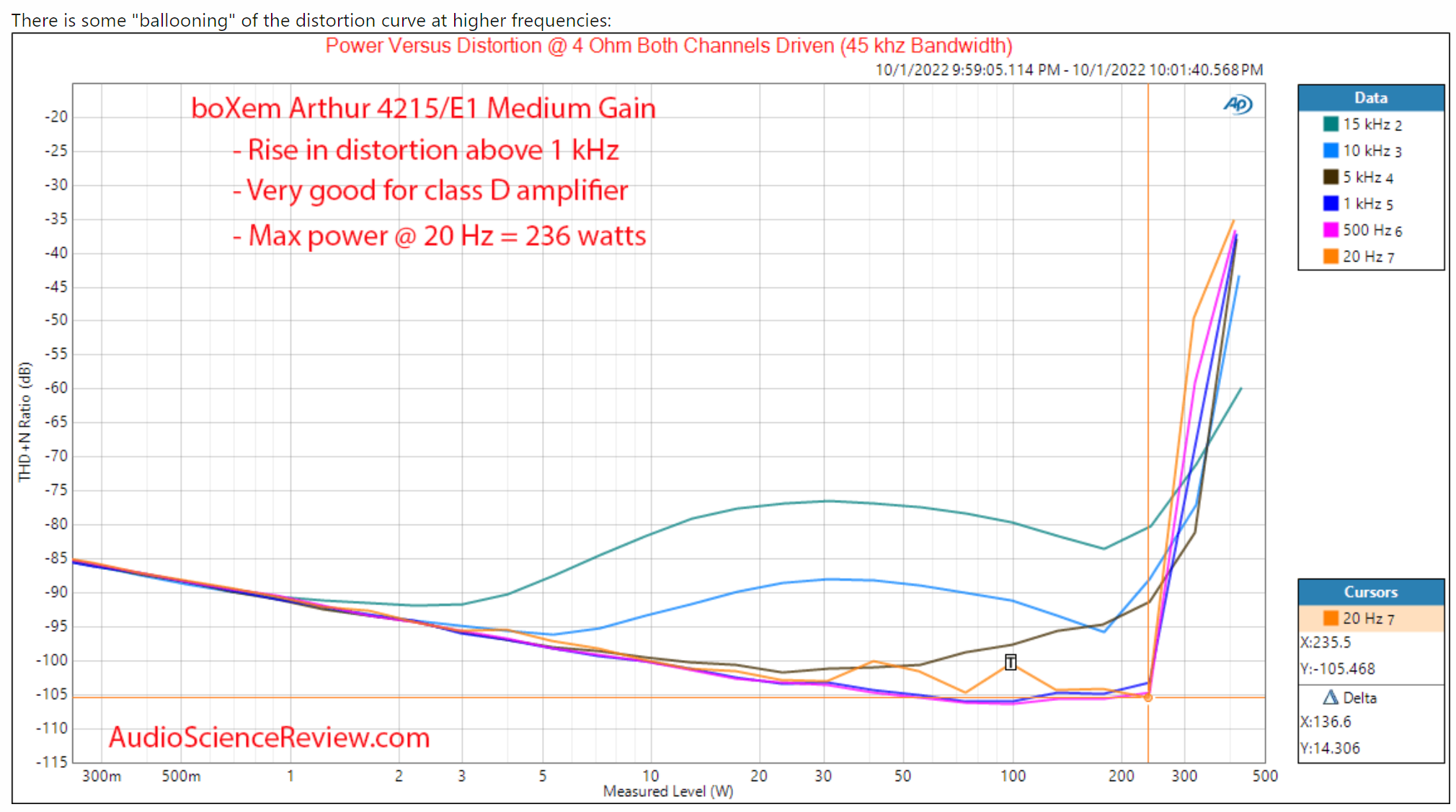
@Alan March , can you please explain this behavior shown below? Its from a 1ET7040 based amp from one of your competitors, Boxem. Measured power at 20Hz is not the same as at 10kHz or 15kHz, using Amir's lowest-distortion-at-the-knee method. And the rise in distortion with frequency is disturbing.
Is this behavior typical of all Class D amps, notably Purifi's latest amps (Hint P801 ... but seriously all your P282 - P801 :)) ? If the behavior is typical, can you offer a reason why? Is it the wide bandwidth they used to generate these curves the issue?
Thanks!
SmartOne_2000wrote: @Alan March , can you please explain this behavior shown below? Its from a 1ET7040 based amp from one of your competitors, Boxem. Measured power at 20Hz is not the same as at 10kHz or 15kHz, using Amir's lowest-distortion-at-the-knee method. And the rise in distortion with frequency is disturbing.
Is this behavior typical of all Class D amps, notably Purifi's latest amps (Hint P801 ... but seriously all your P282 - P801 :)) ? If the behavior is typical, can you offer a reason why? Is it the wide bandwidth they used to generate these curves the issue?
Thanks!
213
Hi. This is a good question.
First thing to say is that Amirs "knee" method is technically wrong. He is selecting random points, at his own whim, to measure the max power point. There is no reason for any of the points he selects. Its just what he feels like. Every test he performs, this power level is at a different distortion point. It's bad science. There is no consistency. It makes it impossible to perform comparisons. You can argue the toss about at what distortion level you should measure the max power, but it must be at the same distortion level each time. Amir will argue to the death about this, but he is wrong. Period. No one else does it this way.
For decades the industry has typically measured max power at 1% THD. However, things have moved on. The state of the art amps have significantly improved, so I no longer feel 1% is appropriate. Personally I feel 0.1% is a better choice. My advice is to ignore Amirs "knee" numbers. Look at his graphs yourself and read off the power at 0.1% THD+N (-60dB), or use his 1% figure derived from the burst test he does.
Anyway, back on to your question. I would have to perform a test to confirm, but I think what you are seeing there is typically of all amplifier classes. At a consistent distortion level of 0.1% (-60dB) the max power levels aren't massively different. You also have to bear in mind the way the AP takes this measurement. It does cause a degree of scatter. If you took it many times and averaged, the max power points would be closer.
A more significant factor is that the lower the fundamental frequency, the more harmonics are included in the measurement. With a 1kHz test frequency and measurement bandwidth of 45kHz as we have here, you will have 44 harmonics - 2, 3, 4, 5kHz..........etc
With a 100Hz fundamental you have 449 harmonics - 200, 300,400,500Hz.........
Yet at 20kHz you only have 1 harmonic - 40kHz.
So the total harmonic distortion in each case is going to be different for reasons nothing to do with the amplifier. I would expect a class AB amp to show very similar things. All things being equal, i.e. a consistent distortion throughout the frequency range, (ha, they never are 😉) lower the test frequency, higher the THD.
I will try and find time to run a test and demonstrate and post some FFT plots to show what's happening.
One more thing, 45kHz IMO is too high a range to be testing THD if you are concerned with the audible effects of distortion. Any of the harmonics that are created above 20kHz are inaudible, so are irrelevant. The measurement bandwidth should be limited to 20kHz.