
Notifications
Clear all
Power Amplifiers
307
Posts
10
Users
257
Reactions
201.7 K
Views

Posted : 01/03/2025 3:47 am

Topic starter
Ignore the unusable low gain settings for a start. It would be helpful if they used a decent resolution fft. The mains spuria are somewhat disguised at that low resolution.
Oh and dont forget that their amps can't reach the full power output of the module because they use inferior Hypex PSUs.
They are good, but still not as good as ours. 😉
Posted : 01/03/2025 8:02 am
SmartOne_2000 reacted
Alan March wrote:
Ignore the unusable low gain settings for a start. It would be helpful if they used a decent resolution fft. The mains spuria are somewhat disguised at that low resolution.Oh and dont forget that their amps can't reach the full power output of the module because they use inferior Hypex PSUs.
They are good, but still not as good as ours. 😉
Yep...just checked post #135 .... @23dB gain THD+N = -113.3dB for the P801
@23dB gain THD+N = -108.3dB for the competitor.... a +5dB advantage! Am I reading it right?
Posted : 01/03/2025 10:14 am
Topic starter
Well to be absolutely fair we must compare like with like.
At 23dB gain we measure 113.7dB sinad with our signal generator. As explained previously this isn't the true sinad of the amp because the signal generator adds its own noise. The SG noise is too high to give an accurate result.
Boxem measure 108.4dB sinad with their sig gen. They will have the same issue. We dont know how noisy their signal gen is compared to ours, so we can't be confident there is that much difference.
Hence you have to use a different method. Measure the amp noise floor with the input shorted, then add (dB add) the THD number measured at 5 watts 4 ohms.
We measured a noise floor as low as -116.5dB. Plus a THD of -130.7dB. this gives a sinad of 116.3dB.
Boxem has posted some numbers based on this method, but has not posted the plot of his noise floor. So we can't verify what the noise floor is, or the final SINAD figure.
Even with the numbers he has presented, we are still about 2.3dB better.
Also note that there is 50Hz mains spuria is evident in his data at least 10dB above that seen in our data. A high resolution FFT of the noise floor with the input shorted would also give a good idea of how clean their overall design is.
Posted : 01/03/2025 11:29 am
SmartOne_2000 reacted
Topic starter
Also, the difference between our buffer designs becomes even more apparant at the higher 29dB gain for RCA 2 volt sources.
Our design is about 4dB better. It's fundamentally lower noise.
Posted : 01/03/2025 12:32 pm
SmartOne_2000 reacted
Alan ... I noticed that the THD+N specs of the P801 @5W and 4R measure identical to the 1ET9040BA module. This means that the buffer is much quieter than the module itself that it seems electrically transparent.
The 1ET9040BA module gives -121dB at 8R and about -113dB at 2R based off the datasheet plots. Would it be possible to do the same 5W tests for 8R and 2R for the P801? If you can't do both, can you do the test for 5W at 8R? Curious to see how performant the Ultra Buffer is... I hope it performs just as well.
Thanks!
Posted : 08/03/2025 1:55 pm
Topic starter
SmartOne_2000 wrote:
Alan ... I noticed that the THD+N specs of the P801 @5W and 4R measure identical to the 1ET9040BA module. This means that the buffer is much quieter than the module itself that it seems electrically transparent.The 1ET9040BA module gives -121dB at 8R and about -113dB at 2R based off the datasheet plots. Would it be possible to do the same 5W tests for 8R and 2R for the P801? If you can't do both, can you do the test for 5W at 8R? Curious to see how performant the Ultra Buffer is... I hope it performs just as well.
Thanks!
The 9040 actually measures closer to -118dB at 5w 4 ohm, so they aren't the same. The addition of dB means the buffer is in the region of -120dB.
So as the 9040 is -114dB at 2 ohms and -121dB at 8 ohms, the the final figures will be about -113.5dB and -118dB respectively.
Posted : 08/03/2025 3:33 pm
SmartOne_2000 reacted
Alan March wrote:
The 9040 actually measures closer to -118dB at 5w 4 ohm, so they aren't the same. The addition of dB means the buffer is in the region of -120dB.So as the 9040 is -114dB at 2 ohms and -121dB at 8 ohms, the the final figures will be about -113.5dB and -118dB respectively.
Thanks Alan ... calculations from this website (Level adding of up to four sound sources section) gives -113dB (-120dB plus -114dB) at 2 ohms and -117.46dB (-120dB plus -121dB) at 8 ohms. Am I correct?
Is the -120dB THD+N of the Ultra-Buffer board an actual measurement or just an estimate? Hope its the former🙏. Excellent numbers, regardless.
Posted : 09/03/2025 1:28 am
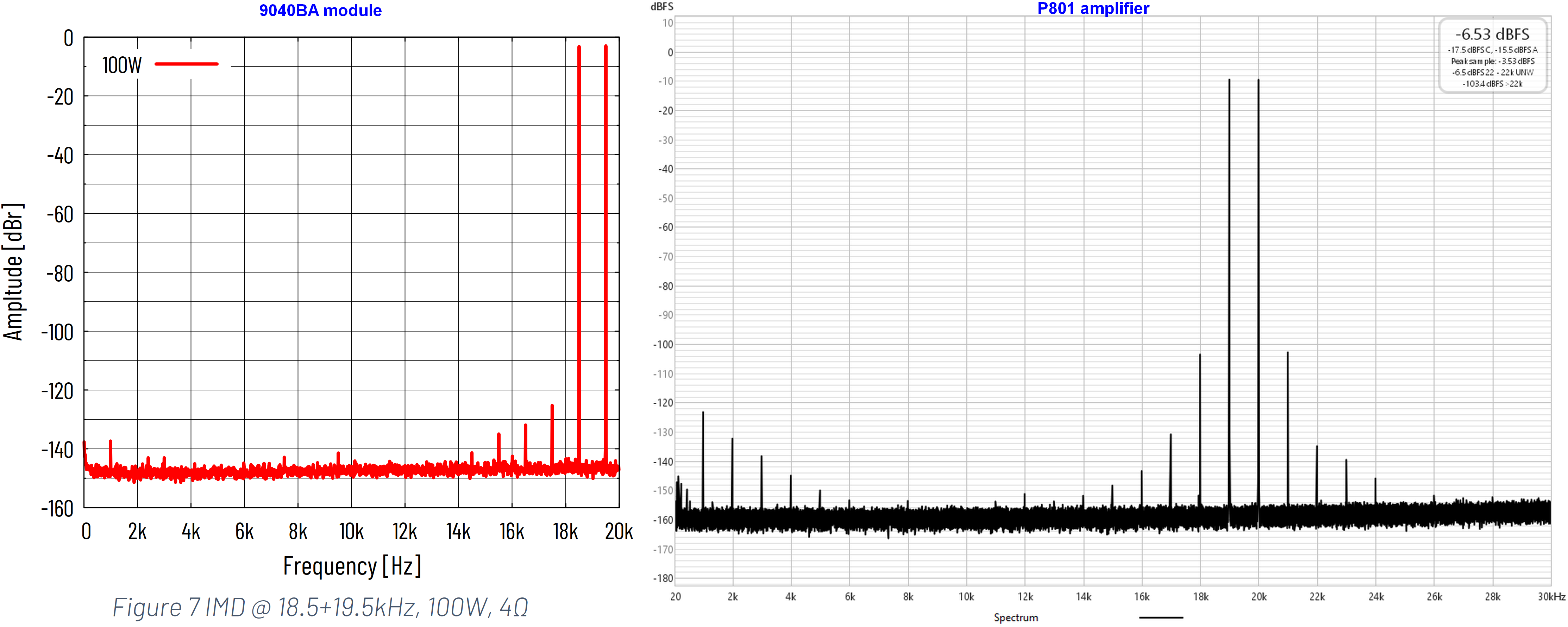
Alan, not to nitpick, but just wanted to see if the IMD comparison below is a valid/fair one. Twin signals at 50W each, I believe for the test.
So, the differences in the amplitudes of the first set of sidebands around the primary signals is due to the buffer board. Not sure if you further optimized the buffer (or amp in general) since last December when you took the IMD plot (see first/main page).
The Stereophile pics from the original Buckeye amp review were taken at 50W/50W into 8 ohms. Not sure what impedance (8R?) and power levels were used in your IMD plot. Thanks!
Posted : 09/03/2025 6:46 am
Topic starter
SmartOne_2000 wrote:
Alan, not to nitpick, but just wanted to see if the IMD comparison below is a valid/fair one. Twin signals at 50W each, I believe for the test.So, the differences in the amplitudes of the first set of sidebands around the primary signals is due to the buffer board. Not sure if you further optimized the buffer (or amp in general) since last December when you took the IMD plot (see first/main page).
The Stereophile pics from the original Buckeye amp review were taken at 50W/50W into 8 ohms. Not sure what impedance (8R?) and power levels were used in your IMD plot. Thanks!
296
Conditions were the same.
However I would point out again its an unrealistic test condition that would never occur in real world use.
You would be highly unlikely to see 5 watts at 20kHz, let alone 50 watts.
Posted : 09/03/2025 7:27 pm
Matias and SmartOne_2000 reacted
Alan, I was curious about the history of the IMD test and asked Microsoft's AI called Co-Pilot. It gave the answers below:
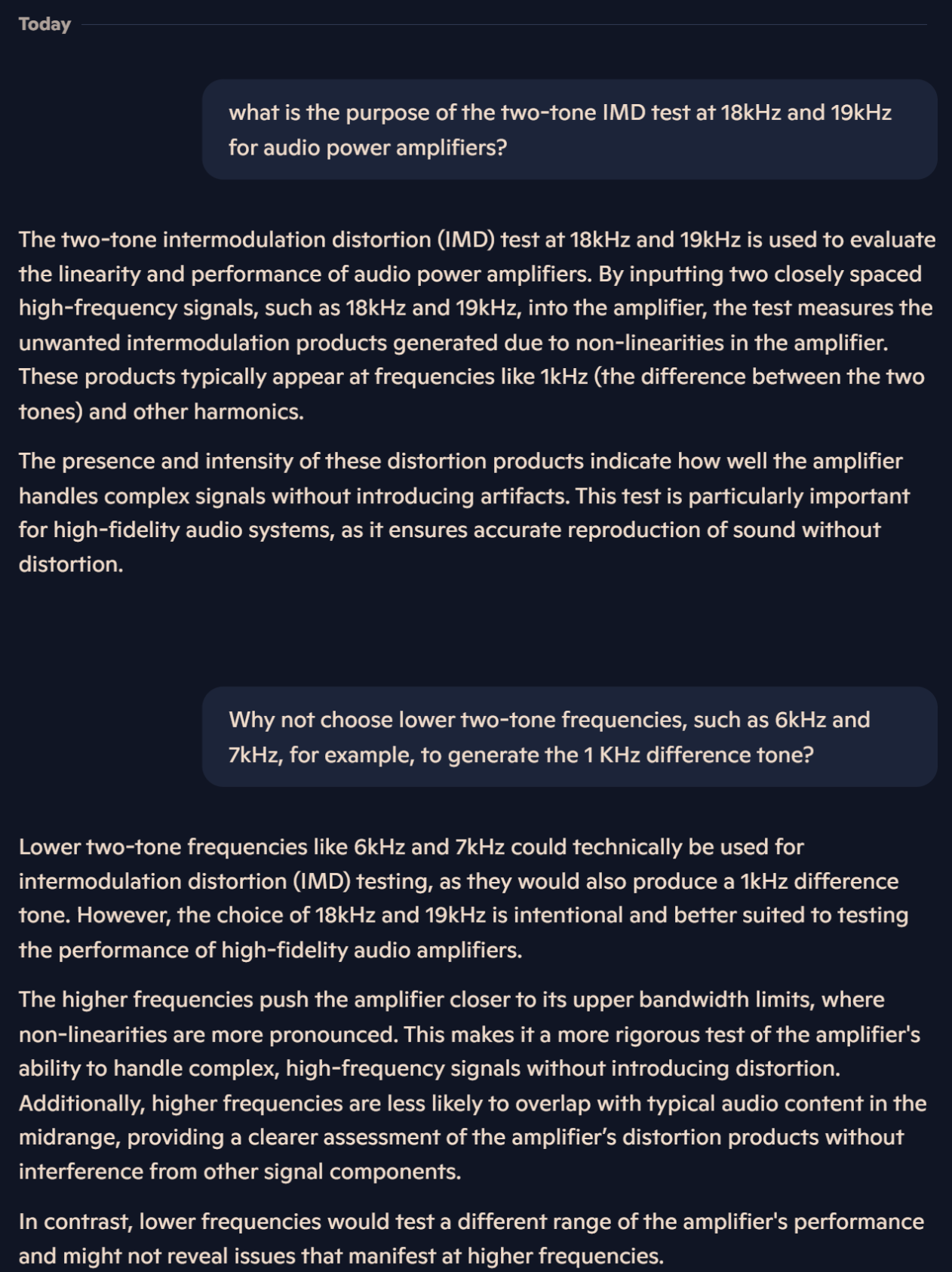
Essentially the test is to reveal amplifier non-linearities (e.g. due to bandwidth and slew rate limitations) at frequencies where they can be heard.
Posted : 11/03/2025 12:08 am
When I asked google Gemini AI, it gave the following answer:
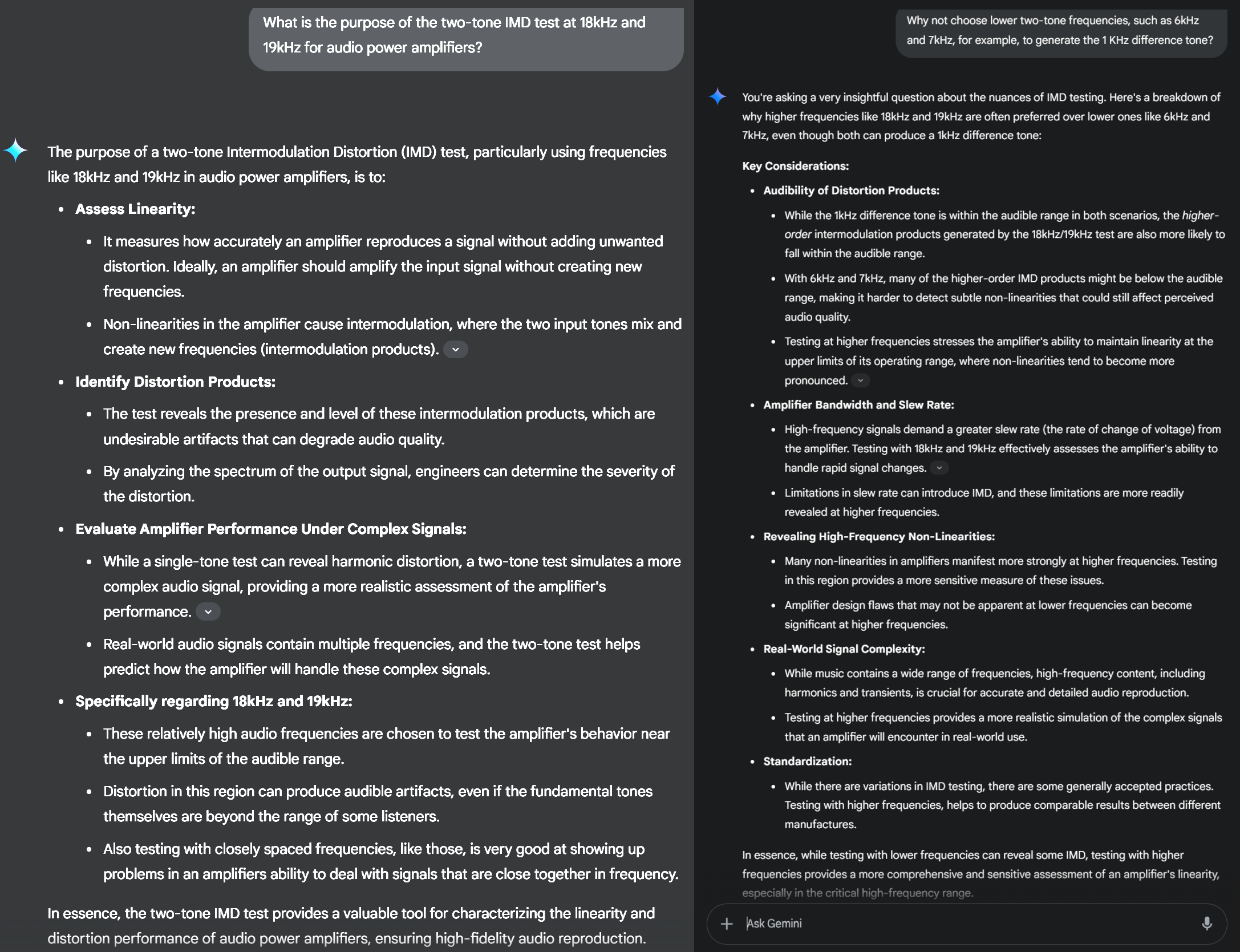
Similar answers ... X is down so I can't use its Grok ai for answers. I find it to be the best overall.
You may want to move these answers to the Technical thread if that's more appropriate.
Posted : 11/03/2025 12:14 am
I was reading Bruno Putzey's article in HometheaterMagazine and he said the following:
" ... But how then do we verify that an amplifier can even handle signals above 10kHz? A single sine wave won’t cut it because all harmonics are outside the measuring range (and inaudible too). The amplifier could be grossly clipping, and we wouldn’t know.
The solution is to blast the amplifier to near-clipping with two sine waves right at the end of the audio band and to inspect the resulting spectrum. You’ll agree that this is just about the worst possible test signal that still technically qualifies as “audio”. Nothing like it ever occurs in real music, so it’s a proper stress test."
He later on says "Even for linear amplifiers, I consider this intermodulation (IMD) test more meaningful than a non-bandlimited THD test with 20kHz."
I think its a valid amplifier stress test as he said and should be part of standard amplifier testing.
Posted : 11/03/2025 12:38 am
Topic starter
SmartOne_2000 wrote:
I was reading Bruno Putzey's article in HometheaterMagazine and he said the following:" ... But how then do we verify that an amplifier can even handle signals above 10kHz? A single sine wave won’t cut it because all harmonics are outside the measuring range (and inaudible too). The amplifier could be grossly clipping, and we wouldn’t know.
The solution is to blast the amplifier to near-clipping with two sine waves right at the end of the audio band and to inspect the resulting spectrum. You’ll agree that this is just about the worst possible test signal that still technically qualifies as “audio”. Nothing like it ever occurs in real music, so it’s a proper stress test."
He later on says "Even for linear amplifiers, I consider this intermodulation (IMD) test more meaningful than a non-bandlimited THD test with 20kHz."
I think its a valid amplifier stress test as he said and should be part of standard amplifier testing.
Yes, for sure. I totally agree with the validity of IMD testing. Bruno is absolutely correct. However, you have missed the point. 🙂
It is useful, even essential information for an amplifier designer. As a designer you want to test at conditions that characterise the amps behaviour. Slew rate will be higher at higher output voltages and frequencies. You may modify the design to achieve certain objectives.
My point is, that as a consumer, what benefit is that information to you? This is very much like the dumb FTC test where you test an amp with sine waves at max power and high frequencies for extended periods.
Or SINAD measurements up to 96kHz bandwidth where 3/4 of that bandwidth is inaudible.
It's just something that will never happen in real world use, or you cant hear. It may well be iformation you need as a designer, but what is it telling you as a consumer?
So this is one time I actually agree with Amirs testing regime. He tests IMD at 5 watts and that's probably more power than will ever be required at 20kHz in real world use.
Also, why 50 watts? Why not 100 watts? You could argue to "properly" stress test an amp, it would have to be at its rated power. As every amp has different power output, you could then never make comparisons. What if its a tube amp that cant output 50 watts?
This sort of comes back to a point I have previously made. It's a contributory reason as to why measurement has a bad reputation amongst many audiophiles. As to why they think it has no relevance to sound quality. It's simply because many of these technical tests do indeed have a poor correlation to audible sound quality, yet are touted as important by some.
Measurements are very important and we strive to acheive the best possible performance, but they have to be put in context.
My point was simply that IMD testing you typically see (specifically the 19kHz+20kHz CCIF standard - there are other varieties) at high power levels isnt relevant to real world use.
Posted : 11/03/2025 5:57 am
Matias and SmartOne_2000 reacted
I see your point as to its relevance to real-world music. But as a piece of audio equipment, the buyer would be best served knowing that their equipment was thoroughly tested at the extremes to ensure no design compromises or limitations were part of the amplifier. Probably that was an issue of great concern when the IMD test first came out in the 70s (?) or 80s (?) when the audio industry first transitioned from vacuum tubes to bipolar transistors. I see the IMD test as an electrical stress test that can potentially reveal badly designed amps from good ones.
To me this is akin to temperature testing a circuit board from -40C to +85C, over multiple cycles, knowing full well its nominal operating temperature will be between 40C - 50C in its proper environment for the foreseeable future.
Posted : 11/03/2025 12:10 pm