
Notifications
Clear all
Power Amplifiers
307
Posts
10
Users
257
Reactions
201.7 K
Views

This is truly amazing, Alan. Thank you for being so open about the true performance of your amps. I'm tired of reading specs from competitor amps which are mere duplications of Purifi module datasheets. As for Zin, I'm not looking for a detailed plot since that will take lots of precious time to set up, measure, etc... just a rough-ish figure of the min/max values or just typical values.
Posted : 11/02/2025 11:43 pm
Alan March reacted
Alan, I noticed you have a 5 year warranty standard and a 10-year as an extra option for a very reasonable price. Your competitors only offer 2 years, with a few stretching offering a 3 years term...and you had to search deep into their site to find this information, listed along with lots of other European legal stuff.
1. What makes your amps so robust as to be confident to offer a 5-year and an unheard of 10-year reliability term? I've heard Hypex power supplies have short life cycles and will probably be the first thing to blow in a Hypex based amplifier. The use of power caps rated only to 85C may be a factor. Maybe that's why Bruno said his next project would be designing new switching power supplies ... He said that 2+ years ago.
2. The Purifi audio landscape will look very different 5 or 10 years from now. Chances are the current Purifi modules will no longer be available. How will you handle warranty replacements for parts no longer made? Will the customer get the latest comparable Purifi modules and possibly new buffer boards if its interface to the latest module has changed?
3. What does the warranty cover (and not cover of course). My apologies but I tried to search for these details on your site but could not find them. Maybe you could point me to the pertinent info.
4. What are the terms and the price for a warranty replacement?
5. Aren't you glad I'm not asking for more technical plots and other time consuming info?:)
PS
Sorry for the many questions as probably a few of them could be condensed into one big question😒.
Posted : 12/02/2025 9:26 am
james dyson reacted

Topic starter
SmartOne_2000 wrote:
Alan, I noticed you have a 5 year warranty standard and a 10-year as an extra option for a very reasonable price. Your competitors only offer 2 years, with a few stretching offering a 3 years term...and you had to search deep into their site to find this information, listed along with lots of other European legal stuff.1. What makes your amps so robust as to be confident to offer a 5-year and an unheard of 10-year reliability term? I've heard Hypex power supplies have short life cycles and will probably be the first thing to blow in a Hypex based amplifier. The use of power caps rated only to 85C may be a factor. Maybe that's why Bruno said his next project would be designing new switching power supplies ... He said that 2+ years ago.
2. The Purifi audio landscape will look very different 5 or 10 years from now. Chances are the current Purifi modules will no longer be available. How will you handle warranty replacements for parts no longer made? Will the customer get the latest comparable Purifi modules and possibly new buffer boards if its interface to the latest module has changed?
3. What does the warranty cover (and not cover of course). My apologies but I tried to search for these details on your site but could not find them. Maybe you could point me to the pertinent info.
4. What are the terms and the price for a warranty replacement?
5. Aren't you glad I'm not asking for more technical plots and other time consuming info?:)
PS
Sorry for the many questions as probably a few of them could be condensed into one big question😒.
1. Starts with fundamentally good design. I.e. adequate cooling , PSU that has properly rated top tier caps and doesnt expire 😉 etc, followed by good quality control. We put every amp through a range of technical tests to ensure it works as specified. One of our competitors has admitted they don't test their amps beyond seeing if it turns on and plays music 😱!
Plus we obviously know the reliability level of the thousands amps we have sold over the past 6 years. They are incredibly reliable. We pay for return shipping from anywhere in the world. We couldn't do that if the failure rate was not vanishingly small.
2. My crystal ball doesn't tell me what Purifi will do over the next 10 years. However, as we have seen with the 1et400 module being upgraded to the 1et6525, the new module is 100% compatible and a drop in replacement. So, hopefully they will continue that policy.
Even if that is not the case and an old module is discontinued without a compatible replacement, we will simply keep a stock of the older modules (and other parts, psu etc). Failing that, then an unrepairable amp would be replaced with a current equivalent model. That's our risk, one we consider very low.
3. The warranty is very standard. Covers defects in materials and workmanship when in normal domestic use. Does not cover damage/misuse/modification/non domestic use. We pay for return shipping from anywhere in the world.
4. Can you clarify what you mean?
5. 😀
Posted : 12/02/2025 7:08 pm
james dyson and SmartOne_2000 reacted
This is good copy. Thanks!
As to question 4, others charge the customer, at cost, for the broken parts inside the amps, hence I assumed you had a similar policy. But from what I understand from what you've said, there are no parts-and-labor charges to the customer if the part(s) fail in normal domestic use.
Since you are an accomplished and experienced EE, based on your online resume, I was wondering if you also designed your own regulated switching mode (or linear?) power supplies, in addition to the ultra buffer and other components?
The main criticism of your amps I've seen on ASR, though lauded for their performance, has been the price (and especially shipping!:)), being quite a bit higher than other offerings with 2 year warranties and free shipping. But from the comms we've had over the past weeks, the "standard" 5 to 10-year warranties that give customers some peace of mind, the performance of the low noise 'ultra-buffer' and your willingness to share internal technical data others will never share shows you have nothing to hide and is definitely worth the 'premium'. As far as I'm concerned, peace of mind one gets knowing their gear is reliable is paramount.
Even a comparable 9040BA based amp from Apollon Audio costs ~ 3000 euros per mono-block (cheaper than the P801) offers 2 year warranties (extensible to 5 years @10% extra cost), the much lauded WEISS OP2 audio buffer and lists Purifi module specs for its amplifier specs! Its this last part that irritates me the most as it smacks of unprofessionalism and is disrespectful to the customer. This tells me they never bothered to test the amp as a whole or are not comfortable listing the true specs of their amplifiers. Sad!
Posted : 12/02/2025 11:15 pm
Do you plan to make amps out of the new Nilai modules or the new Hypex NCx modules? If not, why not? Just curious!
Posted : 13/02/2025 3:48 am
Topic starter
SmartOne_2000 wrote:
This is good copy. Thanks!As to question 4, others charge the customer, at cost, for the broken parts inside the amps, hence I assumed you had a similar policy. But from what I understand from what you've said, there are no parts-and-labor charges to the customer if the part(s) fail in normal domestic use.
Since you are an accomplished and experienced EE, based on your online resume, I was wondering if you also designed your own regulated switching mode (or linear?) power supplies, in addition to the ultra buffer and other components?
The main criticism of your amps I've seen on ASR, though lauded for their performance, has been the price (and especially shipping!:)), being quite a bit higher than other offerings with 2 year warranties and free shipping. But from the comms we've had over the past weeks, the "standard" 5 to 10-year warranties that give customers some peace of mind, the performance of the low noise 'ultra-buffer' and your willingness to share internal technical data others will never share shows you have nothing to hide and is definitely worth the 'premium'. As far as I'm concerned, peace of mind one gets knowing their gear is reliable is paramount.
Even a comparable 9040BA based amp from Apollon Audio costs ~ 3000 euros per mono-block (cheaper than the P801) offers 2 year warranties (extensible to 5 years @10% extra cost), the much lauded WEISS OP2 audio buffer and lists Purifi module specs for its amplifier specs! Its this last part that irritates me the most as it smacks of unprofessionalism and is disrespectful to the customer. This tells me they never bothered to test the amp as a whole or are not comfortable listing the true specs of their amplifiers. Sad!
Re question 4, if other manufacturers are charging for broken parts, then I fail to see how that is a warranty. In warranty, parts should be replaced free of charge. Outside of warranty, yes of course we do charge for broken parts. It's also fairly normal for companies to make the customer pay for return shipping during warranty, but we don't. We pay wherever it is in the world.
Yes I have designed PSUs, but it's always a case effort V reward. It's no trivial task to design an smps and if there is something suitable readily available, there would have to be a compelling reason to spend the time and effort to design your own.
Actually, compared to our serious competitors, there is very little difference in price in most of our amps. Shipping is at cost.
You simply can't compare us to a certain low quality manufacturer who sells at cost, makes no money and won't be around in a few years 😉. They dont have a sustainable business.
The Apollon amp you mention is actually way more expensive than our P801. In USD the Apollon is about $3100 ($3400 to upgrade to 5 year warranty), our P801 is about $2000 USD with standard 5 year warranty.
I sometimes wonder if the critics are confusing AUD with USD on our website. It should geo detect and change to the correct currency for the visitors location. If this doesn't work then there is a country selection flag at the top right.
Posted : 13/02/2025 7:53 am
SmartOne_2000 reacted
Yeah, I believe ASR members compare your prices to Buckeye's who is very popular on the site, with a ferociously loyal customer base and very low prices for the same amplifier configuration. They offer free shipping, but only sell in USA only. Apollon's uber-high prices are mostly due to the fancy casings of their amplifiers and the two expensive Weiss OP2 buffers to a lesser extent. This is similar to buying an expensive and fancy looking $50K watch, when a nice looking but standard $100 watch will do just fine and tell time just the same...sorry not a watch connoisseur:) !
On my end, your main page comes up mostly in Hongkong dollars most of the time (sticker shock is insane) and I have to manually select for US dollars, which removes the sticker shock:). This is using MS Edge and Norton private browsers.
Posted : 13/02/2025 12:32 pm
Topic starter
aaahh, but the Buckeye doesnt work he same or perform as well, even if you dont mind the cheap aesthetics 😉
When you select USD does it correctly remove the Australian GST (goods and services tax)?
So a P482 is AUD $2,980.00 (including 10% GST). The US price should be USD $1,806.20
Posted : 13/02/2025 12:37 pm
james dyson reacted
Yes, it does and now the default currency is USD ... until it isn't:sneaky:. Maybe the fault is on my end with my two browsers.
Posted : 13/02/2025 2:34 pm
Hi Alan:
1. Are you amps protected against power supply transients, such as brownouts, power and lightening surges, over/under voltage conditions, power supply noise, etc.?
2. Due to item #1 above, are the transients able to damage the amp, but hopefully spare the downstream buffers and Purifi modules?
3. What happens if the standard 46VDC output rails suddenly jump to 90V (or greater) for the full duration of the transients? Will they damage the buffer and 9040 module?
Back in the day, we used ESD guns continuously zap our 10/100Gbps high speed fiber-optic transceivers while monitoring their error rates. 2000V air discharge and 1500V or less contact discharge. Had to maintain zero errors during the 15-minutes of testing. I learned the hard way, the value of designing my circuits right the first time around as the boss insisted there was no money for multiple PCB spins. Rev 2 of the PCB was the production version of our modules. A painful lesson indeed but worth it form hindsight.
Thanks!
Posted : 14/02/2025 6:21 am
Topic starter
SmartOne_2000 wrote:
Hi Alan:1. Are you amps protected against power supply transients, such as brownouts, power and lightening surges, over/under voltage conditions, power supply noise, etc.?
2. Due to item #1 above, are the transients able to damage the amp, but hopefully spare the downstream buffers and Purifi modules?
3. What happens if the standard 46VDC output rails suddenly jump to 90V (or greater) for the full duration of the transients? Will they damage the buffer and 9040 module?
Back in the day, we used ESD guns continuously zap our 10/100Gbps high speed fiber-optic transceivers while monitoring their error rates. 2000V air discharge and 1500V or less contact discharge. Had to maintain zero errors during the 15-minutes of testing. I learned the hard way, the value of designing my circuits right the first time around as the boss insisted there was no money for multiple PCB spins. Rev 2 of the PCB was the production version of our modules. A painful lesson indeed but worth it form hindsight.
Thanks!
1. Yes
2. No
3. Modules have overvoltage shut-down and protection, but if that happens it means the psu has catastrophically failed. Never had any of our current psu fail. Saw several Hypex psu fail, but haven't used them for years.
Posted : 14/02/2025 8:38 am
james dyson and SmartOne_2000 reacted
Hey Alan, just curious ... how do your P282/P482 modules compare to the one below? 🙂
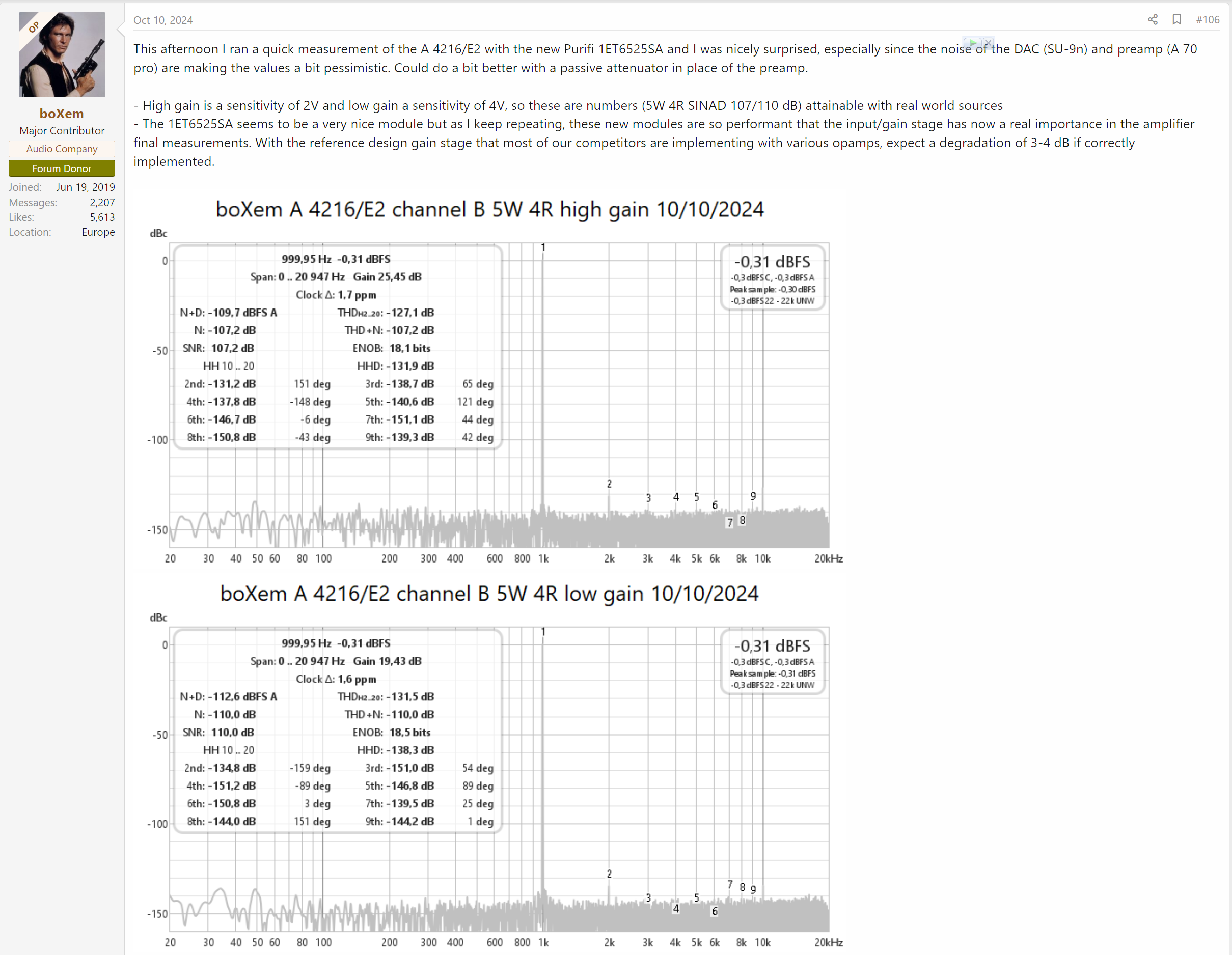
Posted : 15/02/2025 9:49 am
Topic starter
SmartOne_2000 wrote:
hey Alan, just curious ... how do your P282/P482 modules compare to the one below:
271
Ours are lower noise. Our high gain setting has lower thd.
What are the gain levels for those plots?
Shame the FFT resolution is so low, the noise is obscuring the low level distortion and other spuria. It looks like there's a 50Hz main spur at -135dB.
Posted : 15/02/2025 9:52 am
james dyson reacted
Alan March wrote:
Ours are lower noise. Our high gain setting has lower thd.What are the gain levels for those plots?
Shame the FFT resolution is so low, the noise is obscuring the low level distortion and other spuria. It looks like there's a 50Hz main spur at -135dB.
Their website says 20.3/26.3 dB ... I believe the plots indicate 19.43dB/ 25.45dB, close enough? 2V and 4V settings.
Posted : 15/02/2025 10:07 am
Topic starter
SmartOne_2000 wrote:
Their website says 20.3/26.3 dB ... I believe the plots indicate 19.43dB/ 25.45dB, close enough? 2V and 4V settings.
Aaaahhhh, best ignore the gain numbers in the box, they are only accurate if REW has been voltage calibrated. If I'm looking at dB figures I dont usually calibrate the voltage.
So 2.7 dB lower gain than our settings. So, our buffer is definitely lower noise and distortion by a reasonable margin.
Posted : 15/02/2025 10:12 am
james dyson and SmartOne_2000 reacted