
Notifications
Clear all
Power Amplifiers
307
Posts
10
Users
257
Reactions
201.6 K
Views

Topic starter
Hi everyone
We are releasing our new flagship monoblock at the Australian HiFi Show in a few weeks time. Just thought I would share a little test data.
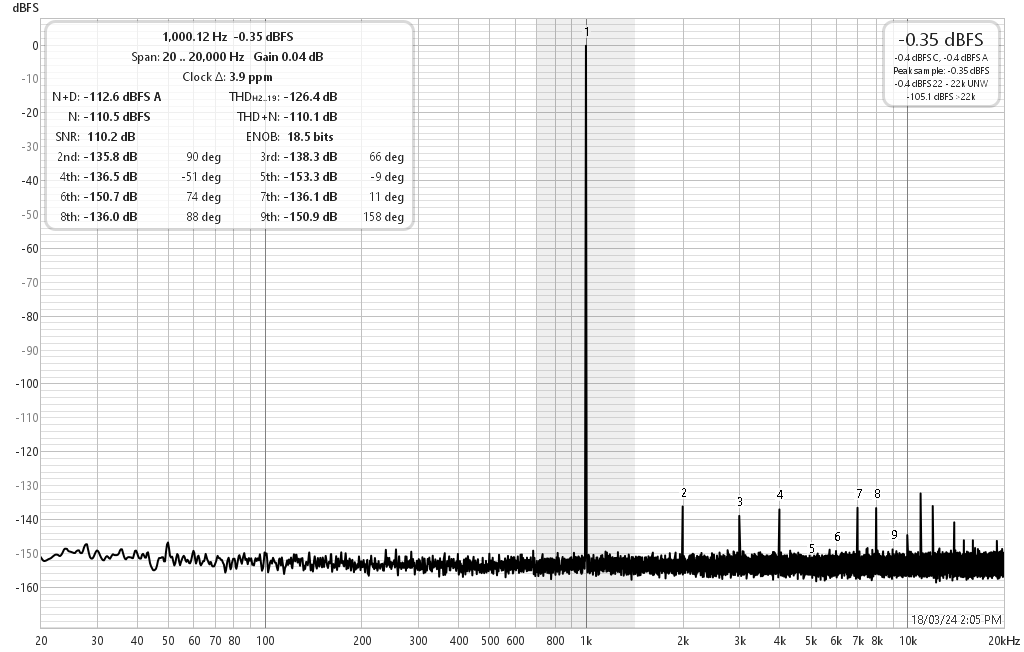
Below is a plot of the P801 running at 5 watts as you would typically see on sites such as ASR. Distortion levels beat anything I have seen.
The SINAD (THD+N) is noise dominated. We cant actually measure an accurate SINAD figure because our measurement signal source, although very good, is too noisy! In reality the noise floor, and SINAD is around -115dB to -116dB.
Please note that our new "ultra buffer" is designed to provide overall gain options of 23dB or 29dB. Here we are set at 23dB. This gain level is required to make the amp hit full rated power output into 4 ohms with a standard balanced XLR 4 volt rms input signal. 29dB is required when using a 2 volt RCA source.
Just be aware/wary when comparing SINAD figures that some manufacturers rely on very low gain levels to obtain their results. This is using the basis that lower gain equals lower noise and therefore higher SINAD. Often they just use the power amp module gain (13dB) where you would require an input signal of 10 volts or more to drive the power amp to full output.
Very few domestic signal sources can do this, particularly with suitably low noise and distortion.
To put it into context, a typical DAC or streamer with 4 volt XLR output would only drive this amp with a 13dB gain setting to 80 watts output into 4 ohms. Only 20 watts with a 2 volts RCA source.
Posted : 18/03/2024 9:57 pm
Topic starter
Another thing to note about the P801 is that we use a custom power supply to ensure the amplifier delivers its full output power and performs to the highest levels with minimum noise and distortion.
The PSU is a new design that has 2 quadrant operation and active synchronous rectification. This means the output voltage stays much more stable and won't suffer from bus pumping.
The PSU can also output 1500 watts which means it will power the Purifi 9040 to its full 2 ohm load capability.
Other manufacturers still use the outdated Hypex supplies which will only drive the Purifi 9040 module to around 1100 watts short term.
Posted : 19/03/2024 8:10 am
Topic starter
I wrote above about the SINAD figure for the P801 being higher than indicated in the measurement. This being due to our signal generator source, although excellent (<1uV 20Hz to 20kHz), being too noisy.
The P801, with 23dB of gain, is essentially amplifying the noise that is present in the source. The measurement is showing this noise, and not what the amplifier is actually capable of.
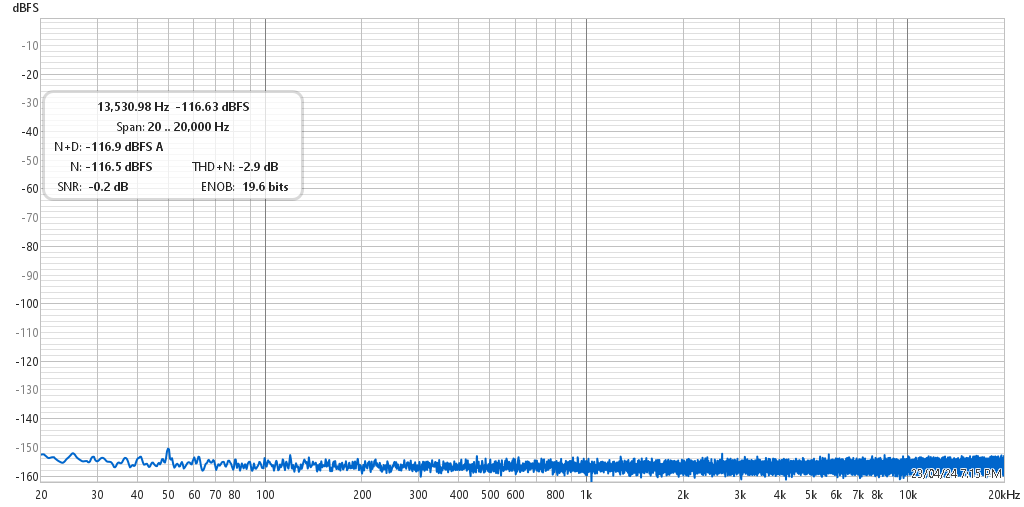
Just to demonstrate this, below is a measurement of the noise floor of the P801 with its input shorted.
We can see that the noise, measured 20Hz to 20kHz is at -116.5dB (7uV rms). 6dB better than with the signal source attached.
From the first measurement we know that the THD is -126.4dB.
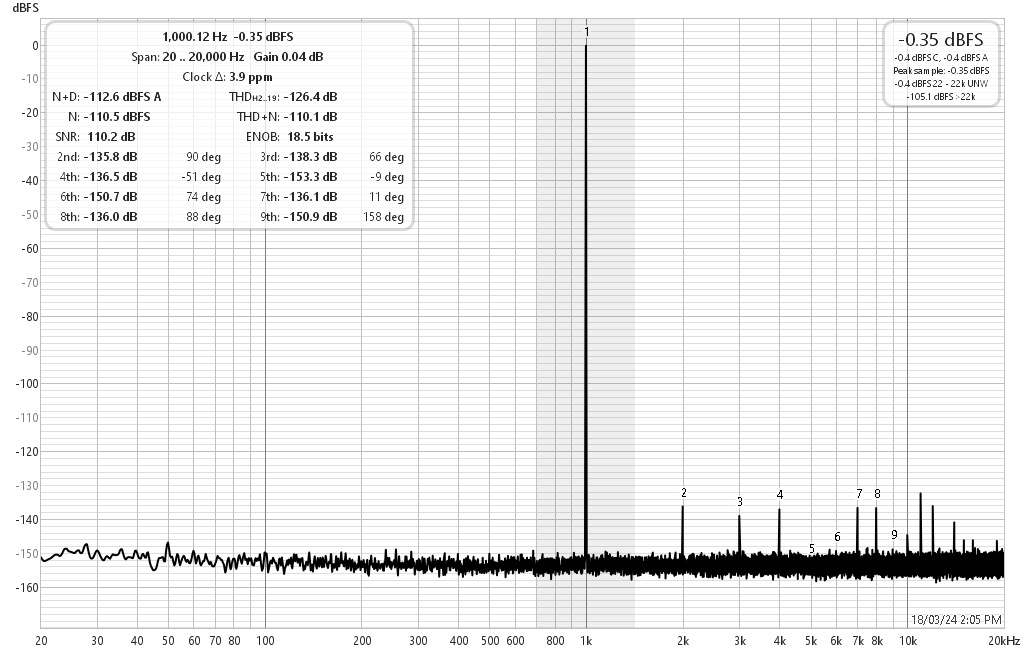
From these 2 figures we can calculate the SINAD, which works out at -116.0dB.
So to accurately measure the SINAD of the P801 a signal generator source would need to have a noise level below about 0.4uV.
Posted : 23/04/2024 8:13 pm

Can you also show power x THD+N into 4 ohms, and price please?
1. WiiM Ultra - Mola Mola Makua - Apollon NCx500+SS2590 - March Audio Sointuva AWG
2. LG 77C1 / WiiM Pro - Marantz SR7005 - Apollon NC502MP+NC252MP - Monitor Audio PL100+PLC150+C265 - SVS SB-3000
3. PC - RME ADI-2 DAC FS - Neumann KH 120 II
4. Phone - NiceHCK Octave - Truthear Pure
Posted : 03/05/2024 8:45 pm

Hi,
In the first post, it is stated, "…4 volt XLR output would only drive this amp with a 13dB gain setting to 80 watts." This seems to refer to how a hypothetical amplifier providing 13dB of gain would perform.
For the P801, what wattage would it output with a 4V XLR input signal and at the 23dB gain setting into 4 ohms?
I can't imagine wanting the full 750W into 4 ohms (at 0.1% THD), I'm just curious about how to understand the use of the amp.
Also, some very cheap Class D amps (not remotely like the Purifi modules) will have load-dependent frequency response. Would it be possible to measure frequency response with a complex load? I believe the other Purifi modules are ruler flat up to 20kHz with a complex load, but I'm wondering if the P801 engineering has gone farther than that?
Posted : 04/05/2024 12:53 am
Topic starter
Hi @Arcturus
A 4 volt rms input signal with an amplifier overall gain of 23dB will deliver 798 watts into a 4 ohm load. Enough gain to drive to the rated 1% THD figure and giving a small amount of lattitude for the 0.1% THD output power. About 3.9 volts input will acheive 750 watts. Not all sources are perfectly 4 volts output at full scale.
Whilst I agree this level of power may be overkill for most applications, there are a few things to consider.
There are some very insensitive "power hungry" speakers out there, and don't forget that into a higher load impedance the power output will be lower (375 watts into 8 ohms). We tend to consider our amplifier powers at 4 ohms because the vast majority of speakers these days are closer to a nominal 4 ohm load than 8 ohms, but of course there are exceptions.
The high power output capability means the amp will almost certainly always be operating within an ultra low distortion range. It will never sound "strained".
Music has a very high RMS to peak power ratio. It depends on the specific music, but the peaks can often be 5 times the RMS level. So in the real world, playing music instead of test sine tones, it's the peak power output that is important. Far too much attention is paid to RMS power ratings. It has little relevance to real world usage.
To realistically recreate the transients in some music you really need a lot of power. Remember that to increase the acoustic volume level by just 3dB, you need to double the power input! As such, power requirements go up dramatically at higher volume levels.
Whilst many speaker long term power ratings will be lower than the RMS rating of this amp, speakers are surprisingly tolerant of very high short term transients.
So in conclusion, the very high power output capabilities of this amplifier aren't as crazy as they first may seem 😀.
Like all the other Purifi amp modules, the P801 drives complex loads with impunity. Unlike most other class d amps from competitors, it really is load invariant.
I will post some data later today.
Hope that helps
Alan
Posted : 04/05/2024 3:25 am
Alan March wrote:
Hi @ArcturusA 4 volt rms input signal with an amplifier overall gain of 23dB will deliver 798 watts into a 4 ohm load. Enough gain to drive to the rated 1% THD figure and giving a small amount of lattitude for the 0.1% THD output power. About 3.9 volts input will acheive 750 watts. Not all sources are perfectly 4 volts output at full scale.
Hope that helps
Alan
Thank you, that does help. I'm in the US and currently use a small pair of Sierra Acoustics' Sierra-LX speakers with an anechoic sensitivity of 83dB @ 2.83v / 1 meter. The impedance dips to 5 ohms in the 200 Hz range, so for bass and louder (but not necessarily extreme) listening levels in a medium-sized room, I do expect that they would enjoy having the sort of clean power that the amp can provide. It's very useful to have the operating limits of the loudspeaker well within the clean, low-distortion operating limits of the amp.
In about 30 years I've only damaged one loudspeaker (a tweeter), and that was with a 25W class A amp that should have been fine to drive a 92 dB efficiency speaker to the listening levels at the point of failure. I think that a peak in the material must have wanted more power from the amp than it could cleanly provide. We were probably listening at 92-94 dB (not something I do very often), so a peak in the material at 96 or 97 dB would have been enough to cause trouble.
Posted : 04/05/2024 3:49 am
Topic starter
Matias wrote:
Can you also show power x THD+N into 4 ohms, and price please?
Price is $2100 USD per amp.
https://marchaudio.com/product/p801-mono-block-power-amplifier/
We will be releasing full amp tested data at a later date, but from the module datasheet.
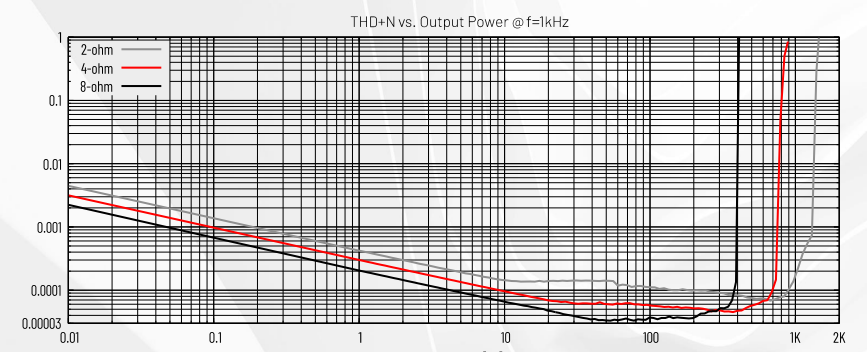
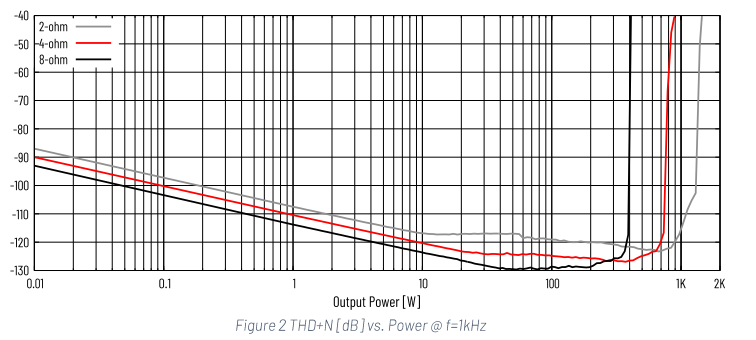
From my post above its shown that we have achieved a 116dB THD + N (SINAD) with our new "Ultra Buffer" at 5 watts 4 ohm load and 23dB overall gain. From the Purifi data above we see the raw module without an input buffer (only 14dB gain) achieves 117dB THD +N at 5 watts 4 ohms.
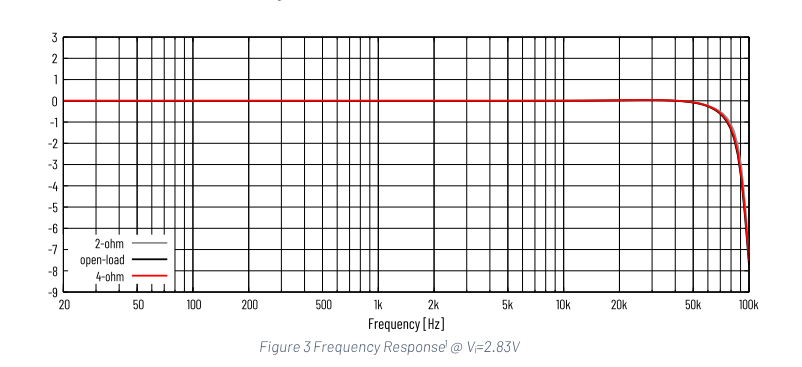
@Arcturus note above how the module frequency response is impervious to different load conditions. The 2,4 ohm and open loads all overlay each other exactly and are completely flat to 40kHz.
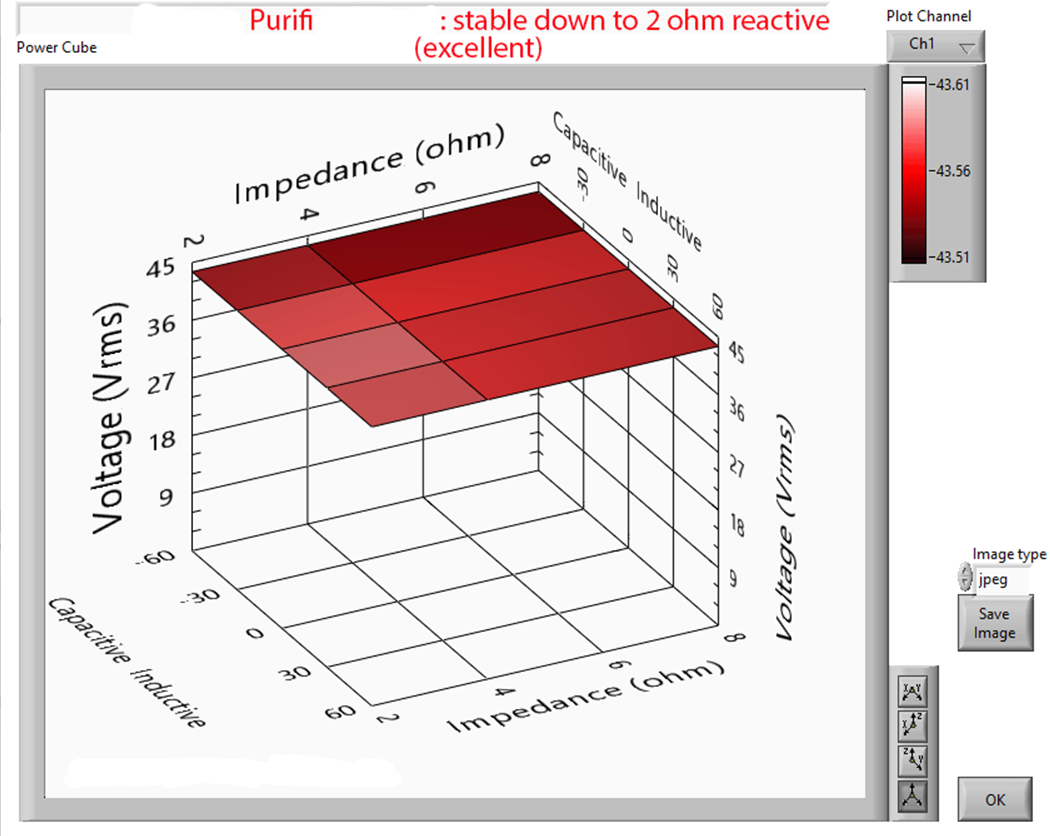
Although the graph below is for a 1et400 module, the same applies to the 1et9040. It shows load conditions with reactive loads ranging from -60 deg capacitive to+ 60 deg inductive and down to 2 ohms. The module is again completely impervious. the modules are also stable down to a short circuit. The current output is limited to 25 amps (1et400) or 40 amps 1ET7040 / 1ET9040).
Posted : 04/05/2024 4:50 pm

Quieter than P421? Insane levels of achievement!
Posted : 12/08/2024 5:44 am
Alan March and Leigh Gurney reacted

Hey Alan
A review of Buckeyes 9040 amp is in Stereophile. It shows several problems such as setting down at half rated power and very high IMD.
https://www.stereophile.com/content/buckeye-purifi-eigentakt-1et9040ba-monoblock-power-amplifier
Can you post the P801 IMD?
Thanks
Posted : 21/12/2024 10:45 am
Topic starter
Hi @james dyson
Trying to upload a plot of our IMD but there is a problem in the forum database. Doing lots of weird stuff. I will take it down and see if I can fix it. Please bear with me.
Posted : 21/12/2024 10:49 am
Topic starter
Phew, thank goodness for backups 😉
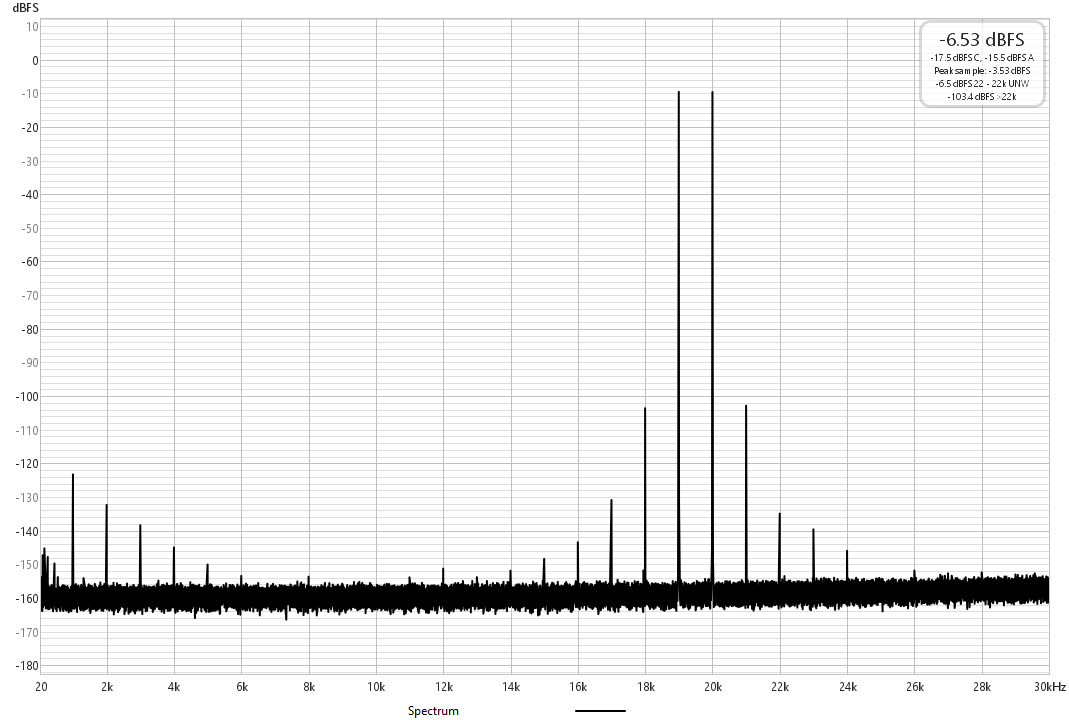
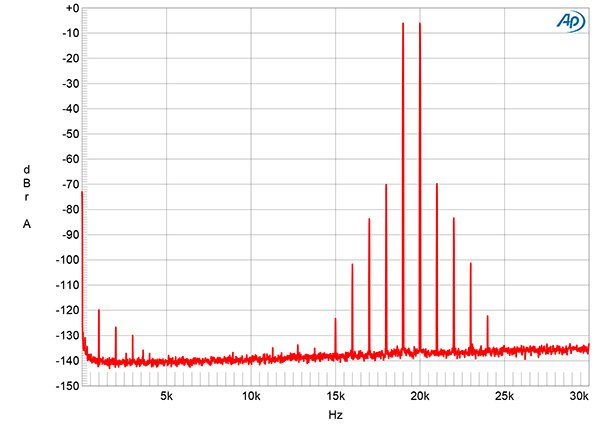
The P801 has no issue with shutting down at low power levels or IMD.
P801 IMD same conditions as the Stereophile Buckeye test.
Probably inappropriate for me to comment on the Buckeye result.
Posted : 21/12/2024 11:01 am
SmartOne_2000 reacted
Thanks Alan
Sorry more questions. Latest info from ASR and Purifi is that it was a module problem. Have Purifi contacted you to recall modules?
Posted : 24/12/2024 10:20 am
Topic starter
Reluctant to get involved in Buckeyes QC issues, but as Purifi have publicly commented and to reassure our own customers, I will relate our experience.
We had a small number, 4 to be precise, of pre production engineering samples of the Purifi 9040 module. These were intended for performance and integration testing into our amp design. During testing we noticed an issue with higher than expected distortion. However it was a simple fix which we carried out ourselves. The board wasnt optimally calibrated and a simple tweak of a pot on the board and problem was solved.
Yes this was a quality escape on Purifis behalf. However hard you try sometimes these things happen and we know they have taken measures to improve the control.
This issue has not affected the production batch of modules we have subsequently received from Purifi. None of the pre production modules were used for customer units. We keep these things quite seperate.
This is a good demonstration as to why we individually test every amplifier after build. It ensures problems such as these don't get to customers. So any customer that has purchased our P801 amplifiers can rest assured that it doesn't have the Buckeye high IMD problem and works to specification.
Posted : 26/12/2024 7:30 am
Any preproduction samples should never used for commercial regular products without proper notice to customers. It looks way beyond the just QC problem. It's thw policy and how they look and treat their products and customers...
Not even Purifi products can't cure that.
Posted : 28/12/2024 7:32 pm
Alan March reacted
Page 1 / 21
Next